For fans planning to attend the 2026 FIFA World Cup, various accommodatio00n and hospitality options are available. Official hospitality packages, which include premium seating, entertainment, and high-quality food and beverages, are currently available for U.S. matches. Packages for Mexico and Canada are set to be released later. Here is everything about the 2026 FIFA World Cup Accommodation, Pricing, Visa Requirements and Facilitation
Ticket prices for the 2026 FIFA World Cup vary widely. General admission tickets are not yet on sale, but estimates suggest group stage tickets will average around $305, with prices ranging from $15 to $990 depending on seat category and match stage.
Hospitality packages, available since May 2025, start at $1,350 for group stage/round of 32 matches in some cities (e.g., Kansas City) and can go up to $73,200 for premium packages, including the final at MetLife Stadium.
General sales are expected to start in late 2025 via FIFA.com. Be cautious of third-party resellers, as FIFA warns against unofficial ticket sources.
These packages feature various lounge options, including the Pitchside Lounge, VIP areas, the Champions Club, and the FIFA Pavilion.
Custom travel packages, designed for flexibility, start from $2,165 for 3 nights, $4,095 for 6 nights, and $5,975 for 9 nights per person, based on double occupancy. For those wishing to follow a specific team, “Follow My Team” packages for 6 nights begin at $5,950 for Team USA, $6,850 for Team Mexico, $4,800 for Team Canada, and $4,265 for other teams.
Semifinal packages for 3 nights range from $4,595 to $6,315 in Dallas and $4,595 to $5,845 in Atlanta. Attending the Final in New York will incur higher costs, with 4-night packages starting from $11,225 and reaching up to $14,545 per person. On average, accommodation is expected to consume approximately 40% of a World Cup budget.
The 2026 FIFA World Cup will be jointly hosted by the United States, Canada, and Mexico from June 11 to July 19, 2026, making it the first-ever triple-hosted tournament.
Expanding to 48 teams competing in 12 groups of four, the tournament will feature 104 matches and introduce a new Round of 32 knockout phase.
The final will be held at MetLife Stadium in New Jersey on July 19, 2026, with the opening match scheduled in Mexico City.
Currently, the 2026 FIFA World Cup tournament is in the qualification stage, and 48 teams will join the final stage of the tournament.
2026 FIFA World Cup Accommodation and Pricing
Table of Contents
Visa Requirements and Facilitation
Visa requirements can create a significant logistical challenge for international travellers. Most tourists coming to the U.S. for the World Cup will need either a B-2 tourist visa or qualify for the Visa Waiver Program.
Mexico and Canada each have their specific entry requirements, so obtaining a visa for one country does not guarantee entry into the other.
A significant issue is the unusually long visa processing times for various countries. In some cases, the wait times for U.S. visitor visas can exceed 600 to 700 days.
For Indian nationals applying for B-1/B-2 visas, the wait can be as long as a year. Specifically, the average wait time in Chennai is 11.5 months, while in Mumbai, it is 7.5 months.
Currently, unlike the previous tournaments held in Russia (2018 FIFA World Cup) and Qatar (2022 FIFA World Cup), which implemented a Fan ID system for visa-free entry, the U.S. has no plans to expedite visa applications for World Cup ticket holders. This lack of a streamlined process presents a significant challenge.
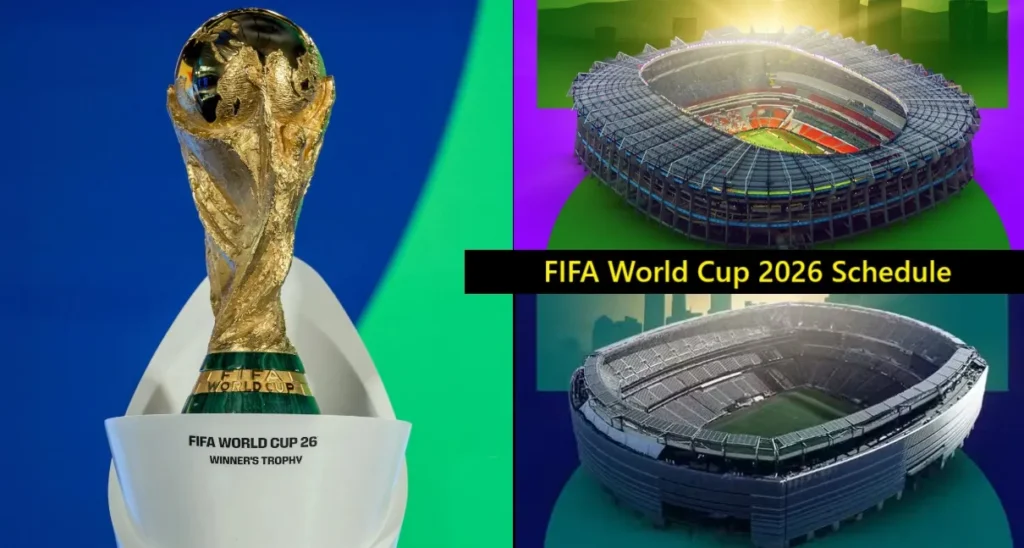
There are 16 stadiums involved in the 2026 FIFA World Cup.
How to Get a Visa for the 2026 FIFA World Cup in the USA?
The visa application process may slightly vary depending on the country.
- The visa application process for the U.S. typically involves:
- Completing the DS-160 online form.
- Paying the visa fee (currently USD 185).
- Scheduling and attending an interview at a U.S. Embassy or Consulate.
- Gathering and presenting required documents like a valid passport, proof of funds, travel itinerary, and evidence of ties to the home country.
US Visa Wait Times for B-1/B-2 Visas for Indian Nationals
| City | Average Wait Time (B-1/B-2) | Next Available Appointment (B-1/B-2) |
|---|---|---|
| Chennai | 11.5 months | 13.5 months |
| Hyderabad | 7.5 months | 7.5 months |
| Kolkata | 8 months | 8 months |
| Mumbai | 7.5 months | 9.5 months |
| New Delhi | 9 months | 9 months |
How to Apply for the 2026 FIFA World Cup Visa as an Australian?

USA Visa Wait Times for B-1/B-2 Visas for Australian Nationals
| City | Average Wait Time (B-1/B-2) | Next Available Appointment (B-1/B-2) |
|---|---|---|
| Sydney | 28 days | 28 days |
| Melbourne | 70 days | 75 days |
| Perth | 65 days | 70 days |
| Brisbane | 60 days | 65 days |
| Canberra | 55 days | 60 days |
How to Apply for a Visa for the 2026 FIFA World Cup as a UAE Resident
USA Visa Wait Times for B-1/B-2 Visas for UAE Nationals
| City | Average Wait Time (B-1/B-2) | Next Available Appointment (B-1/B-2) |
|---|---|---|
| Abu Dhabi | 20 days | 25 days |
| Dubai | 28 days | 30 days |
How to Apply for a Visa to Attend the 2026 FIFA World Cup as a Resident of Japan?
USA Visa Wait Times for B-1/B-2 Visas for Japanese Nationals
| City | Average Wait Time (B-1/B-2) | Next Available Appointment (B-1/B-2) |
|---|---|---|
| Tokyo | 22 days | 30 days |
| Osaka | 80 days | 85 days |
| Sapporo | 50 days | 55 days |
| Fukuoka | 60 days | 65 days |
| Nagoya | 45 days | 50 days |
How to Apply for a Visa to Attend the 2026 FIFA World Cup as a Resident of Europe?
USA Visa Wait Times for B-1/B-2 Visas for European Nationals
| City | Country | Average Wait Time (B-1/B-2) | Next Available Appointment (B-1/B-2) |
|---|---|---|---|
| London | United Kingdom | 15 days | 20 days |
| Paris | France | 25 days | 30 days |
| Frankfurt | Germany | 18 days | 22 days |
| Madrid | Spain | 35 days | 40 days |
| Rome | Italy | 40 days | 45 days |
Discussions and proposed solutions are currently underway to address the delays in visa processing. Lawmakers have suggested implementing a special visa system that would allow ticket holders to move freely between the host nations, similar to the Fan ID system.
The U.S. government has acknowledged the issue and proposed to enhance consular services as well as utilise AI to manage the increased demand for visas.
The U.S. State Department advises prospective visitors to apply for their visas now, assuring them that there is still ample time for processing.
The U.S. Embassy emphasises the importance of following the correct visa application procedures, warning against fraudulent attempts and outlining severe penalties for violations. Additionally, the Embassy conducts thorough background checks as part of the application process.
The long visa wait times and the lack of a unified Fan ID system across the three host countries pose a serious threat to the promised “seamless experience” for millions of international fans. This issue directly affects the projected tourism revenue, which is a significant part of the total estimated expenditure of $13.9 billion.
The urgency highlighted by the U.S. Travel Association and members of Congress emphasises that this is a critical, unresolved operational and economic risk that could lead to global embarrassment for the host countries.
The absence of a streamlined, multi-country visa facilitation system, combined with the current lengthy wait times, represents the most significant logistical and reputational challenge for the 2026 World Cup. This situation jeopardises fan attendance and the expected tourism revenues.
The tripartite hosting model presents significant challenges in managing travel logistics for cross-border events. Unlike single-host tournaments, which can utilise a unified visa or Fan ID system, the three co-hosts—the USA, Canada, and Mexico—each have their own immigration policies. This fragmentation complicates travel for fans wanting to attend matches across different venues.
The proposal for a special visa process acknowledges this challenge, but its implementation is still uncertain. Additionally, the complexities extend beyond visas to include labour and security issues as well.
As a result, there is a pressing need for a highly coordinated and potentially innovative visa solution to facilitate smooth movement for fans, a challenge that has not yet been adequately addressed.