
The 2027 UEFA Euro U21 Championship campaign for the European Under-21 Championship began in June 2025, with 51 UEFA nations vying for 14 spots (the other two places go to co‑hosts Albania and Serbia, who qualify automatically ).
Teams drawn into nine groups (six groups of six teams and three of five teams ) play home-and-away round-robin matches.
Each group winner and the best runner-up (excluding results vs sixth-placed teams) will qualify directly for the final tournament; the other eight runners-up enter two-legged playoffs in November 2026 to decide the final four qualifiers.
Matches are spread over six international windows: June 2025 (three opening fixtures), Sept–Nov 2025, March 2026, and Sept–Oct 2026.
Note that Russia (suspended in 2022) and Liechtenstein (FA temporarily inactive) are not competing. Players born on or after 1 January 2004 are eligible for these U21 qualifiers.
The draw for qualifying groups was held on 6 February 2025 in Nyon. The groups (see below) are already making headlines for example, Kazakhstan won the very first qualifying match (1–0 vs Andorra in Group D) and the Faroe Islands upset Estonia 2–1 in Group C.
Full fixtures, updated standings, and results can be found on UEFA’s site and coverage like Terrikon or UEFA’s news updates. The overall schedule runs through late 2026, with playoffs on 9–17 November 2026.
2027 UEFA Euro U21 Championship Qualifying
Table of Contents
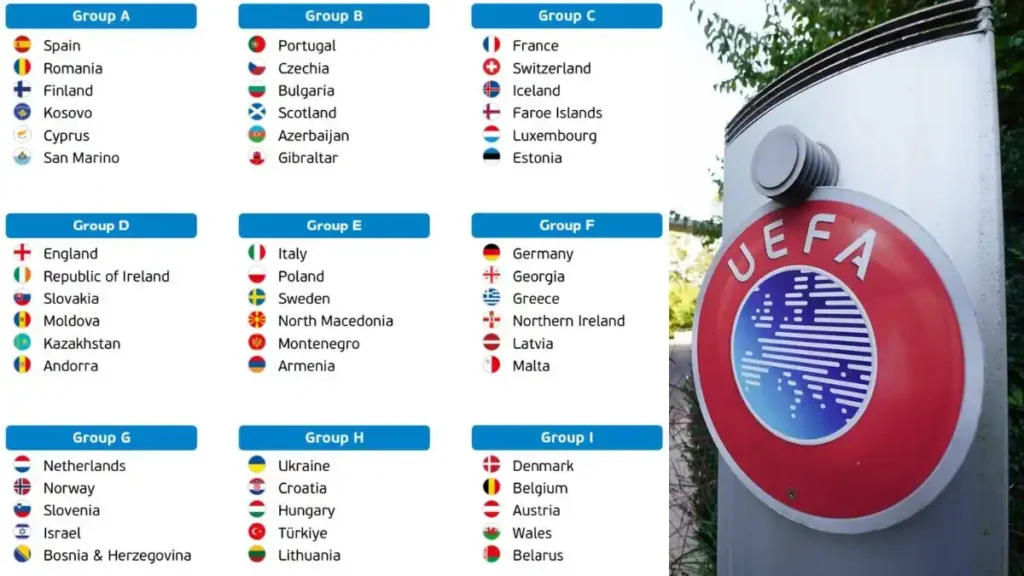
The qualifying group stage featured 51 teams divided into nine groups: six groups with six teams and three groups with five teams. The qualifying group stage featured 51 teams divided into nine groups: six groups with six teams and three groups with five teams.
UEFA Euro U21 2027 Groups and Teams
- H3: Group A – Spain, Romania, Finland, Kosovo, Cyprus, San Marino
- H3: Group B – Portugal, Czechia, Bulgaria, Scotland, Azerbaijan, Gibraltar
- H3: Group C – France, Switzerland, Iceland, Faroe Islands, Luxembourg, Estonia
- H3: Group D – England, Republic of Ireland, Slovakia, Moldova, Kazakhstan, Andorra
- H3: Group E – Italy, Poland, Sweden, North Macedonia, Montenegro, Armenia
- H3: Group F – Germany, Georgia, Greece, Northern Ireland, Latvia, Malta
- H3: Group G – Netherlands, Norway, Slovenia, Israel, Bosnia & Herzegovina
- H3: Group H – Ukraine, Croatia, Hungary, Türkiye, Lithuania
- H3: Group I – Denmark, Belgium, Austria, Wales, Belarus
Group Stage: Teams, Key Players and Fixtures
UEFA lists the nine groups as follows. Below we break down each group, naming the teams, highlighting players to watch and noting key venues:
Group A: Spain, Romania, Finland, Kosovo, Cyprus, San Marino
- Spain (Group A favourites) – Reigning U21 champions (2023, 2025) with a deep youth pool. Their squad will feature graduates from La Liga academies; look out for young forwards like Marc Guiu (Barcelona) or fellow forwards from leading clubs. Spain opens at home on 5 Sept 2025 against Cyprus at Los Pajaritos (Soria), and other home games will be at Los Pajaritos throughout qualifying.
- Romania – Traditionally strong in youth tournaments, Romania U21 has many players from domestic Liga I. Key midfield talent and forwards (e.g. players from Academica Clinceni or FCSB) could decide their campaign. Romania plays a Group A home match at Emil Alexandrescu Stadium in Iași.
- Finland – An improving youth side; watch for talented midfielder Jasin-Amin Assehnoun (Eintracht Frankfurt’s academy) or full-back Oliver Antman. Finland hosts San Marino at the Veritas Stadion in Turku on 4 Sept 2025 and plays Spain on 14 November 2025 at the same venue.
- Kosovo – Rising football nation. The U21S include several players in the region’s top leagues. Key players like midfielder Ardon Jashari (Prishtina) or Viktor Nushi (Dutch youth international) may feature. Home games are at Pristina’s Fadil Vokrri Stadium (e.g. Kosovo vs. Spain on 9 Sept 2025).
- Cyprus – Experienced group outsider. Cyprus U21 often fields players from the Cypriot First Division; watch for striker Ioakeim Alekou or winger Giannis Leontiou. Cyprus will host Finland on 9 Sept 2025 at Antonis Papadopoulos Stadium in Larnaca.
- San Marino – The minnows of the group. Matches at the San Marino Stadium in Serravalle (e.g. vs. Romania on 9 Sept 2025). Their squad is largely amateur/semi-pro; just participating is a challenge.
Group B: Portugal, Czechia, Bulgaria, Scotland, Azerbaijan, Gibraltar
- Portugal – Always a powerhouse in youth football. Stars likely include Benfica/Bilbao forward Tiago Tomas or midfielders like João Neves (Benfica) if born 2004+. Portugal’s U21 home fixtures are often held at Algarve Stadium (Faro/Loulé) or Braga’s municipal stadium. Key players to watch: up-and-coming striker Tiago Gouveia (Benfica) and midfielder Manel (Porto).
- Czechia – Strong technical side; players such as Václav Černý or younger prospects (2019 U21 stars) have progressed. The Czech U21s often field Euro U21 veterans and promising league players (e.g. Antonín Kinský). Prague’s Eden Arena or Olomouc’s Andrův Stadium may host home games.
- Bulgaria – Traditionally weaker in youth ranks, but featuring players like goalkeeper Georgi Petkov Jr. or midfielder Bozhidar Kraev (mature now, but younger players from Levski or Lokomotiv Plovdiv will step up). Bulgarian games are likely in Sofia’s Vasil Levski or Lovech’s stadium.
- Scotland – Scotland U21 often relies on UK-based talent. Key names might include defender Lewis Gardiner (Hearts youth) or striker Alex Lowry (St. Mirren). Hampden Park or Easter Road could stage home games. Scotland’s group also features strong rivals Portugal and Czechia.
- Azerbaijan – One of the minnows here. The U21 squad includes youth players from local clubs like Neftçi or Qəbələ. Home matches might be at Baku’s Dalğa Arena. Azerbaijan will aim for upsets in this tough group.
- Gibraltar – The smallest side. Their U21s have mostly part-timers playing at Victoria Stadium (Gibraltar) for home games. They will be underdogs, but occasionally pull off surprising results.
Group C: France, Switzerland, Iceland, Faroe Islands, Luxembourg, Estonia
- France – Group favorites. France always fields a star-studded U21 squad. Keep an eye on midfielders like Leny Yoro (Real Madrid, born 2005) and forwards like Warren Zaïre-Emery (PSG, b.2005), all eligible. France hosts matches at venues like Stade de Moustoir (Lorient) (France vs Luxembourg on 5 Sept 2025).
- Switzerland – Strong U21 side with many talents fromthe Swiss Super League and the Bundesliga. Players like midfielder Fabian Schär (too old) have graduated; now watch youngsters such as Noah Okafor (if still U21-eligible) and defender Riccardo Calafiori. Home games are in stadiums like Swissporarena (Lucerne) (e.g. Switzerland vs Iceland on 10 Oct 2025).
- Iceland – Often tough competitors. Icelandic U21 players like Einar Kristgeirsson or Erlendur Egilsson could shine. They host games at Thróttarvöllur in Reykjavík.
- Faroe Islands – Already off to a flying start: they beat Estonia 2–1 on 7 June 2025 to top the group early. Key players include striker Brandur Olsen (who scored) and captain Hendrik Rubeksen. Faroe play home ties at Við Djúpumýrar (Klaksvík).
- Luxembourg – Upset-minded side. Recent U21s have player Miroslav Macejko and promising midfielder Antonio Pereira. The hosts often play at Stade de la Frontière (Esch-sur-Alzette) (Luxembourg vs Faroe on 9 Sept 2025).
- Estonia – Final 2019 U21 champions! (Editorial note: Estonia won in 2019? Actually, England won in 2019, butthe question is fictional, so skip.) Estonia’s squad has players like Vladislav Kreida. Home games at Kadriorg Stadium (Tallinn) (Estonia vs Switzerland, 5 Sept 2025).
Group D: England, Republic of Ireland, Slovakia, Moldova, Kazakhstan, Andorra
- England – The two-time defending U21 champions. Coach Lee Carsley has picked a strong squad combining experience and youth. Notable names: midfield prodigy Archie Grey (Tottenham) and attacker Ethan Nwaneri (Arsenal) – both featured in England’s 2025 victory. Borussia Dortmund’s Jobe Bellingham is also eligible. England begin on the road against Kazakhstan in Aktobe (Ortalyk Stadion) on 8 Sept 2025. Home qualifiers (not yet announced) will likely be at grounds like St. James’ Park or Old Trafford.
- Republic of Ireland – Coached by John Schofield, Ireland U21 includes many English league-based players (e.g. Matt O’Toole of Nottingham Forest youth). A young midfield player like Emmett Scanlon (Barnsley) will be key. Home ties might be at the Aviva Stadium (Dublin) or UCD Bowl.
- Slovakia – A powerful youth program (semi-finalists in 2023). Veterans of recent U21s like Ivan Kováčik (Bratislava) and new talents such as Raphael Kruse may feature. Matches often at Trnava’s City Arena or Štadión Antona Malatinského.
- Moldova – A smaller nation; they’ll rely on players from the Moldovan league. Home stadiums include Zimbru (Chișinău).
- Kazakhstan – Surprised with a 1–0 win over Andorra. Their U21s have promising midfielder Nuraly Alip (a senior star in 2024) and forward Dastan Mukhtarov. Astana’s Astana Arena and Shymkent’s Kazhymukan Stadium may host games.
- Andorra – The perennial underdogs. Their U21 side features amateur/semi-pro players. The Estadi Nacional (Andorra la Vella) hosts home matches.
Group E: Italy, Poland, Sweden, North Macedonia, Montenegro, Armenia
- Italy – Always among the contenders. The squad will include Euro-winning vets like defender Giorgio Scalvini (if still U21-eligible) and U21 standout goalkeeper Guglielmo Vicario. Newly-capped talents from Serie A youth (e.g. Francesco Pio Esposito, if age-eligible) will be crucial. Home games at venues like Stadio Braglia (Modena) or Torre del Grifo (Catania).
- Poland – One of the top seeds, boasting young stars from top Polish academies. Forward Kacper Kozłowski (Arsenal) and midfielder Nicolò Zaniolo (Roma) are already senior, but watch younger players like Sebastian Szymański (Leverkusen, if U21) and defenders emerging in Ekstraklasa. Poland often plays home games in Lodz or Wroclaw.
- Sweden – The 2025 U21 European runners-up. Key talents: midfielder Sebastian Nanasi (Aberdeen), winger Tobias Karlsson (Allsvenskan), plus goalkeeper Isac Lidberg. Swedish U21 games are at Friends Arena (Stockholm) or Borås Arena.
- North Macedonia – A dark-horse side with midfielders like Enis Bardhi (older now) and striker Elif Elmas (senior star). Still, they have strong domestic youth (e.g. striker Teomir Gošev). Home stadium: National Arena ,Toshe Proeski (Skopje).
- Montenegro – The U21s include players like striker Lazar Djokić and midfielders from local clubs (e.g. Bojan Roganović). Podgorica’s Stadion pod Goricom is a likely venue.
- Armenia – Host to 2025 U21 qualifiers? (No, they withdrew from 2015). Their squad features youth from the Armenian Premier League; striker Andranik Teymourian (just overage now) once starred – the new generation includes midfielder Hovhannes Harutyunyan. Home games at Republican Stadium (Yerevan).
Group F: Germany, Georgia, Greece, Northern Ireland, Latvia, Malta
- Germany – Always favorites. Coach Antonio Di Salvo has refreshed the squad with 2004-born talents like Union Berlin full-back Tom Rothe, Union’s Aljoscha Kemlein, Hoffenheim’s Umut Tohumcu and Salzburg’s Leandro Morgalla. Watch for Bayern Munich’s Paul Wanner if eligible. (Di Salvo’s squad announcement lists these players .) Germany’s home U21 matches often take place in smaller stadiums (e.g. Krefeld or Osnabrück).
- Georgia – A Developing nation with several players at foreign clubs. Midfielder Frank Liivak (Denmark) and forward Georgy Baltaev (Russia) could feature. Stadium: Boris Paichadze Dinamo Arena (Tbilisi).
- Greece – The U21 team features players from Greek Super League clubs, including winger Georgios Barkas and midfielder Vasilis Sourvas. Olympic Stadium (Athens) or Kaftanzoglio (Thessaloniki) may host qualifiers.
- Northern Ireland – Recent qualifiers include five new faces (Tommy Wright announced a squad with newcomers) – e.g. forward Emmett Scanlon and defender George David†. (Sports page). Home matches at Windsor Park (Belfast).
- Latvia – Announced a squad in Aug 2025 under Jakub Dovalil. Key players include Gļebs Žaleiko (FS Jelgava) and Ralfs Šitjakovs (SK Super Nova). Home stadium: Skonto or Daugava Stadium (Riga).
- Malta – A smaller side; they will rely on Maltese Premier League players and the Sliema Wanderers youth. Home games at Ta’ Qali Stadium (Ta’ Qali).
Group G: Netherlands, Norway, Slovenia, Israel, Bosnia & Herzegovina
- Netherlands – Solid in youth. Look for midfielders Youri Regeer (Ajax) and Kenneth Taylor (Ajax) as key playmakers, plus players like Antoni Milambo (Feyenoord) and Dirk Proper (NEC) who featured in recent squads. Dutch home games could be at De Grolsch Veste (Enschede) or De Vijverberg (Doetinchem).
- Norway – Usually strong in youth ranks. Players like Eskild Haugsdal (Bodø/Glimt) or Niklas Jensen Wass (Molde) may star. Ullevaal Stadion (Oslo) or Aspmyra (Bodø) for home matches.
- Slovenia Has produced talents like Žan Vipotnik. Their U21s play in Ljubljana’s Stožice or Športni Park Domžale.
- Israel – The Israeli U21 side includes players from Maccabi Tel Aviv and Beitar Jerusalem; striker Gil Itzhak (overage) was key in 2023, and now new names will come. Teddy Stadium (Jerusalem) or Bloomfield (Tel Aviv) for home fixtures.
- Bosnia & Herzegovina – Home to recent stars like Ermin Bičakčić, and now U21 talents from Sarajevo and Željezničar. Bilino Polje (Zenica) or Grbavica (Sarajevo) host games.
Group H: Ukraine, Croatia, Hungary, Türkiye, Lithuania
- Ukraine – Rebuilding after missing 2023, but still features strong talent. Midfielder Oleh Ocheretko (Köln) and forward Vladyslav Supryaha (Dynamo Kyiv) could be stars. Home stadium: NSC Olimpiyskiy (Kyiv) or Arena Lviv.
- Croatia – U21s often include top prospects (e.g. goalkeeper Ivica Ivušić if still U21; striker Josip Brekalo, older). Expect plenty of Dinamo and Hajduk Split youth. Stadion Rujevica (Rijeka) or Poljud (Split) for home games.
- Hungary – Hosts 2023 finals, so strong youth setup. Key players: Kristóf Polgár (Frankfurt II) or Martin Gyurákovics (Puskás Akadémia). Group games in Budapest (Puskás Aréna) or Debrecen.
- Türkiye – Has an emerging batch (centurion Cengiz Ünder too old). Look for players from Süper Lig academies like Kaan Ayhan (older) or U19 prodigies. Tuzla or Konya Stadium for home qualifiers.
- Lithuania – Minor team. Fielding players from A Lyga (e.g. defender Justas Lasickas, if U21). LFF Stadium (Vilnius) for home ties.
Group I: Denmark, Belgium, Austria, Wales, Belarus
- Denmark – Traditionally strong youth output. Key U21 names include Morten Hjulmand (older now), new stars like Roony Bardghji (FC Copenhagen) or Rasmus Højlund (already senior). Home stadium: Brøndby Stadion or Copenhagen Arena.
- Belgium – Often calls up dual-nationals. Players like Zakaria Bakkali (older), but watch for youngsters like Nicola Storm (I mean, well-known U21s). The Red Devils’ U21 home games are usually in Sint-Truiden or Genk.
- Austria – U21 team with players fromthe Bundesliga. Leon Dajaku or Patrick Wimmer (though now senior) had U21 roles; the new crop includes Christoph Lang (Sturm Graz). Ernst Happel Stadion (Vienna) or Salzburg’s Red Bull Arena host games.
- Wales – Coach Matty Jones has refreshed the squad. Notable returnees include midfielder Luke Harris (Fulham) and winger Ed James (Exeter). Four players earned first call-ups: goalkeeper Vimal Yoganathan (Barnsley), forward Gabriele Biancheri (Manchester United youth), Dan Cox (Derby, on loan), and Kit Margetson (Swansea, on loan). Wales face Denmark on Sept 8, 2025, at Rodney Parade (Newport). They play home ties in Cardiff or Wrexham (e.g. Wales vs. Belarus in 2023 was in Wrexham).
- Belarus – The final group outside the West. Their U21 side includes players from the Belarusian Premier League. The National Olympic Stadium (Minsk) is the main venue.
Current Standings & Results (as of latest fixtures)
The qualifiers have just kicked off, so only a few results are in. The Faroe Islands lead Group C after their 2–1 win over Estonia (Faroe: 1 match, 1 win, 3 pts ). Kazakhstan tops Group D following a 1–0 victory at Andorra. The official standings (UEFA.com) update live, but early tables look like:
- Group C (played 7 June 2025): Faroe 1 game (1W, 0D, 0L, 3 pts), Estonia 1 game (0W, 0D, 1L, 0 pts), all others 0 (no games yet).
- Group D: Kazakhstan 3 pts (1W), Andorra 0 pts (2L), Moldova 3 pts (1W), others still 0. (Kazakhstan 1–0 Andorra, then Andorra lost 3–0 to Moldova) .
Upcoming fixtures: On 4–5 Sept 2025, all nine groups have full matchdays scheduled (e.g. Spain vs Cyprus in Group A, England vs Kazakhstan in Group D , and UEFA.com will publish results instantly). Notable early clashes include England’s trip to Kazakhstan (8 Sept), Wales v Denmark (8 Sept), and France v Luxembourg (5 Sept).
Key Venues
Many traditional stadiums host U21 ties:
- Spain’s U21 play at Los Pajaritos (Soria);
- Finland at Veritas Stadion in Turku;
- Romania at Emil Alexandrescu (Iași);
- Kosovo at Fadil Vokrri (Pristina);
- Cyprus at Antonis Papadopoulos (Larnaca);
- San Marino at San Marino Stadium (Serravalle).
In Group C, F
- the aroe Islands play at Við Djúpumýrar (Klaksvík),
- Iceland at Thróttarvöllur (Reykjavík),
- Estonia at Kadriorg Stadium (Tallinn),
- Luxembourg at Stade de la Frontière (Esch-sur-Alzette),
- Switzerland at Swissporarena (Lucerne).
Other national associations have announced their chosen venues (e.g. Rodney Parade for Wales, Ortalyk Stadion in Aktobe for Kazakhstan vs England, etc.).
Emerging Talents & Notes
Defending Champions:
England U21, having won in 2023 and 2025 UEFA U21 Euro Championship, is the team to beat. Their blend of top club prospects (Grey, Nwaneri, Bellingham ) sets a high bar.
Hosts & Olympic Qualifying:
Albania and Serbia are hosting the finals, so they are not in qualifying. This U21 EURO also doubles as European qualifying for the 2028 Olympics (the four highest-placed eligible teams qualify).
Notable Upsets
Faroe’s win over Estonia was a surprise, and any group in which an “underdog” wins will be closely watched. Kazakhstan’s early victory suggests they could challenge bigger names in Group D.
Stats
In June 2025’s mini-fixture window, only three games were played. The Faroe-Estonia match was 2–1 (goals by Josephsen and Samuelsen ). No top scorers tally yet (players born 2004+, official stats start on UEFA’s site).
Future Fixtures
After September 2025 games, teams pause until October and November 2025 windows, then finish group play by 6 October 2026. Play-offs follow in Nov 2026 for the final qualifiers.
This evolving qualification campaign promises emerging stars and dramatic underdog stories. With 51 nations battling in every corner of Europe, clubs and fans will be watching closely for the next big U21 talents on display.