
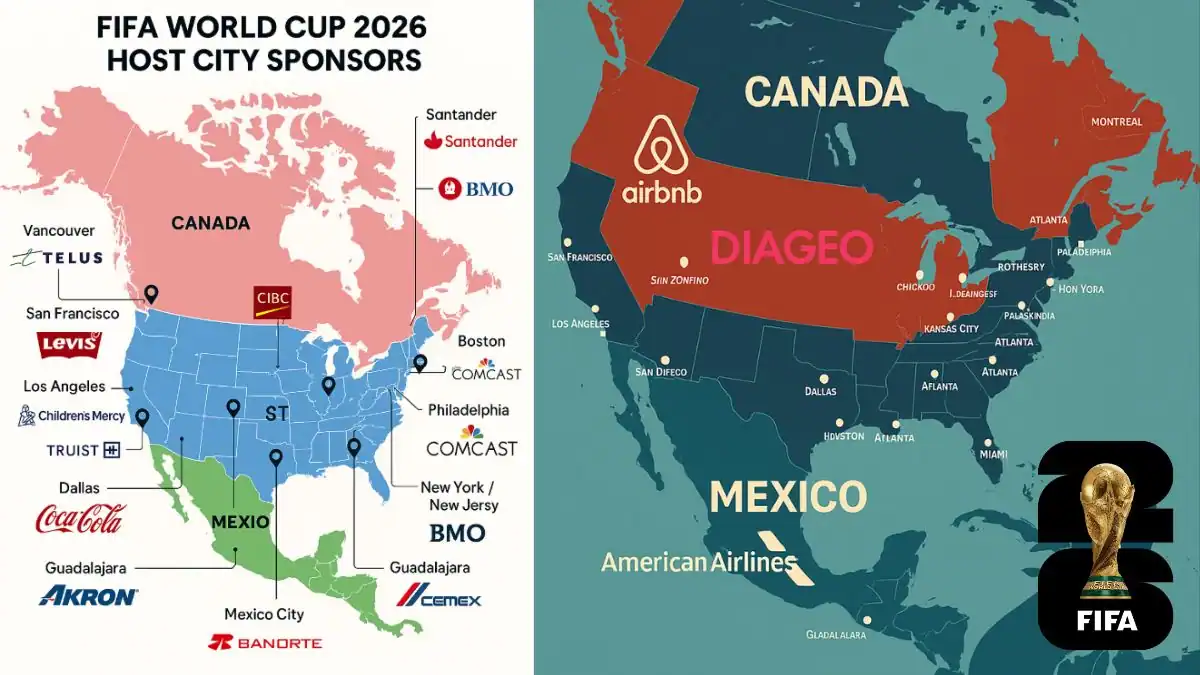
You need to learn everything about the FIFA World Cup 2026 City sponsors list form the 16 cities of the USA, Canada, and Mexico.
The FIFA World Cup 2026 will make history as the first World Cup hosted by three countries – the USA, Canada, and Mexico – featuring 48 teams playing 104 matches scheduled across 16 host cities.
Beyond the traditional global FIFA sponsors, this tournament introduces a groundbreaking Host City Supporter program that allows each of the 16 host cities to secure their local commercial partnerships, creating unprecedented opportunities for city-level sponsorship deals.
For the first time in FIFA World Cup history, FIFA has introduced the Host City Supporter program for 2026.
This innovative framework allows each of the 16 host cities to designate up to 10 companies as supporters, providing a unique opportunity for local and regional businesses to associate with the world’s largest sporting event without paying the premium prices of global FIFA partnerships.
List of the FIFA World Cup 2026 City sponsors
Table of Contents
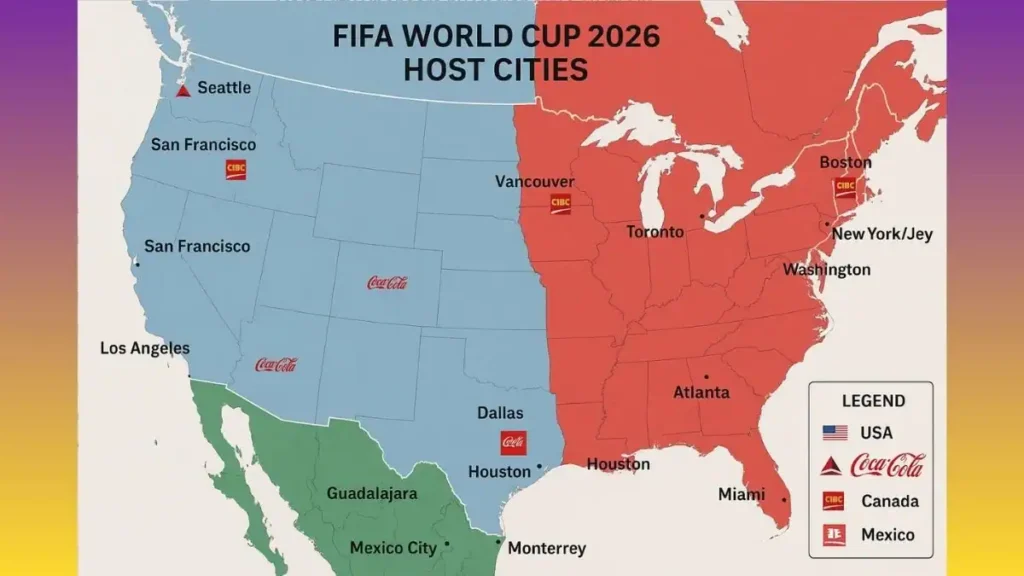
The Host City Supporter program is constantly evolving, with FIFA’s Miami office offering ongoing support to host cities. Each city has the freedom to create partnerships that suit its specific community needs and business environments.
As the tournament approaches, additional Host City Supporters are expected to be announced across all 16 cities, creating a comprehensive network of local partnerships that complement FIFA’s global sponsorship program while providing meaningful community engagement and economic impact for each host region.
- Atlanta – Cox Enterprises, Georgia-Pacific, Home Depot, NAPA Auto Parts, Southern Company
- Boston – N/A
- Dallas – Arca Continental, Choctaw Casinos & Resorts,
- Guadalajara – N/A
- Houston – Aramco, Arca Continental, Houston Methodist Hospital, NRG Energy, Quanta Services, Visit Sugar Land
- Kansas City – Black & Veatch, J. E. Dunn Construction Group, Populous, Purina, University of Kansas Health System
- Los Angeles – Discover Los Angeles, Los Angeles Metro, Archer Aviation
- Monterrey – N/A
- Mexico City – N/A
- Miami – Florida Sports Foundation, Greater Miami Convention & Visitors Bureau, Miami, Miami Beach, Miami-Dade County
- New York/New Jersey – Onyx Equities, Paul, Weiss, Rifkind, Wharton & Garrison
- Philadelphia – N/A
- San Francisco Bay Area – Boston Consulting Group, Electronic Arts, Genentech, Kaiser Permanente
- Seattle – Puyallup Tribe of Indians
- Toronto – Humber Polytechnic, Ontario Power Generation
- Vancouver – N/A
The FIFA World Cup 2026 Host City Supporter program represents an unprecedented opportunity for businesses to associate with the world’s largest sporting event at a local level, creating lasting legacies for their communities while building global brand recognition through one of the most-watched events in human history.
Host City Sponsors by Regional
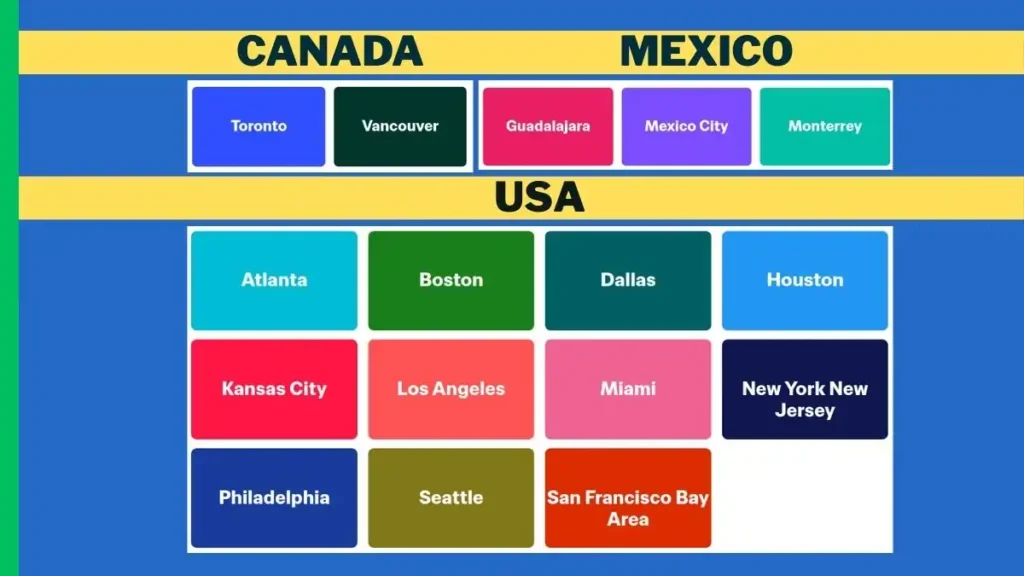
The FIFA World Cup 2026 introduces a revolutionary Host City Supporter program, allowing each of the 16 host cities across the USA, Canada, and Mexico to secure up to 10 local commercial partnerships.
This groundbreaking approach enables regional businesses to associate with the world’s largest sporting event at a city level, creating unprecedented opportunities for local brands to engage with global audiences while supporting their home communities. Here is the FIFA World Cup 2026 City sponsors List for the United States –
Atlanta Host City Supporters
Atlanta has announced its first four Host City Supporters
The Home Depot – The Atlanta-based home improvement retailer leverages both its global FIFA sponsorship and local Atlanta Host City Supporter status. The company, which has been a sponsor of the Mexican national team since 2003 and MLS since 2008, views this as an opportunity to engage with its multicultural customer base.
Cox Enterprises – The telecommunications and media conglomerate serves as a key partner in bringing the tournament to Atlanta’s community.
Georgia-Pacific – The paper products manufacturer, approaching its 100th anniversary in 2027, sees this as an opportunity to advance brand awareness globally while supporting its hometown of Atlanta.
Southern Company – The energy utility company, through its operating companies Georgia Power and Atlanta Gas Light, supports the tournament in their home market. CEO Chris Womack emphasised their century-long commitment to powering the Atlanta community.
Houston World Cup Partnerships
Houston has secured significant support from NRG Energy as an official supporter. The energy company partnered with the FIFA World Cup 26 Houston Host Committee, demonstrating the strong corporate backing from local energy sector leaders.
New York/New Jersey Commercial Support
MetLife Stadium, hosting the World Cup Final on July 19, 2026, represents the premier venue for the tournament. New Jersey committed $67.5 million for stadium preparations and infrastructure improvements, expecting $2 billion in economic impact and 14,000 jobs for the region.
Other US Host Cities
Miami has developed comprehensive sponsorship opportunities with its Host Committee, working on co-created partnerships that go beyond traditional sponsorship models. The committee emphasises community engagement and infrastructure development as key components of their sponsor packages.
Boston, Philadelphia, Los Angeles, Dallas, Kansas City, and San Francisco are all actively developing their Host City Supporter programs, with announcements expected throughout 2025.
Canadian Host Cities
Here is the FIFA World Cup 2026 City sponsors List for Canada –
Toronto Host City Supporters
Ontario Power Generation (OPG) became Toronto’s first Official Host City Supporter. The partnership includes:
- Supply of Made-in-Ontario Clean Energy Credits from low-carbon generation facilities
- Support for clean energy use at Toronto Stadium (BMO Field)
- Fan engagement activities and FIFA Fan Festival presence
- Reinforcement of Toronto’s commitment to climate action
Vancouver Commercial Partnerships
Vancouver has developed its Host City Supporter program with up to 10 opportunities available. The city offers unique experiences, including:
- FIFA World Cup 26 tickets
- VIP hospitality experiences
- Exclusive access to ancillary events during the tournament
- Invitations to key FIFA events at BC Place, Vancouver
Mexican Host Cities
Here is the FIFA World Cup 2026 City sponsors List for Mexico –
Mexico City, Guadalajara, and Monterrey
The three Mexican host cities – Mexico City (hosting the opening match at Estadio Azteca), Guadalajara, and Monterrey are developing their local sponsorship programs.
Mexico City will host the tournament’s opening match on June 11, 2026, at the legendary Estadio Azteca, which will become the first stadium to host three World Cups.
Monterrey has been particularly active in building excitement, organising a Legends Game and developing local partnerships to support the four matches scheduled at Estadio Monterrey.
Regional and Continental Supporters
North American Supporters
Several companies have secured Regional Supporter status covering multiple countries or regions:
- Airbnb – Official Alternative Accommodation and Experiences Booking Platform, contributing an estimated $3.6 billion to Host City economies with over 380,000 expected guests.
- Diageo – Official spirits supporter in the Americas.
- American Airlines – Official North American airline supplier.
- Rock-it Cargo – Official logistics provider for the United States.
South American supporters
- Diageo – Official spirits supporter in the Americas.
European supporters
- Globant – Technical IT support for the World’s biggest World cup ever
Economic Impact and Business Opportunities
The Host City Supporter program represents a mid-eight-figure investment range for each partnership. The total tournament is projected to generate $13.9 billion across North America, with a breakdown including:
- Tourism expenditure: $7.5 billion (54%)
- FIFA expenditure: $3.8 billion (27%)
- Host city operational expenditure: $1.8 billion (13%)
- Capital investments: $0.9 billion (6%)
The United States, hosting 11 of the 16 cities, is expected to account for $11.1 billion of this total impact[original article data].
Transportation and Infrastructure Partnerships
Several cities have developed specific partnerships for tournament infrastructure:
- Kansas City became the first host city to announce bus procurement, securing 200 buses for expanded service during the tournament.
- Vancouver and Toronto are leading volunteer applications, ranking first and second among all 16 host cities with over 180,000 applications from Canada alone.
Key Features of Host City Sponsorships
Economic Impact and Business Opportunities
Rights and Benefits:
- Use of city-specific intellectual property and marketing materials within designated geographic regions
- Activation opportunities within local FIFA Fan Festivals
- Access to match tickets and hospitality packages for games in that specific city
- Right to use “Official Host City Supporter” designation
- Exclusive supporter mark specific to each host city
Important Limitations:
- Cannot use FIFA’s global intellectual property, including World Cup logos and official marks
- Rights are geographically restricted to the specific host city region
- No association with FIFA’s broader commercial program