FIFA’s 2026 World Cup will be the first edition with 48 teams. The final draw (Dec 5, 2025) in Washington, D.C., will place those teams into 12 groups of four, with the tournament then progressing to a round of 32. Here’s a look at how the World Cup 2026 draw works mechanics, seeding, and the rules that shape each group.
Before the 2026 World Cup draw, 42 teams have already qualified, and only 6 playoff spots are left. This draw will set the stage for the biggest World Cup ever, where all the FIFA associate teams are divided into four pots based on FIFA World Rankings.
- Total teams: 48.
- Groups: 12 groups, labelled A–L, each with 4 teams.
- Progression: Top two teams from every group (24 teams) plus the eight best third-placed teams advance — making a 32-team knockout bracket (round of 32).
How the World Cup 2026 draw works
Table of Contents

The FIFA World Cup 2026, set to be hosted across the United States, Mexico, and Canada, and its draw is all set to take place at the Kennedy Center in Washington, D.C. In the edition, 48 teams are competing across 104 matches scheduled in 16 host cities.
The World Cup 2026 draw will see 48 teams divided into four pots of 12. Each of the 12 groups (A–L) will include one team from each pot — ensuring a mix of high-ranked, mid-tier and lower-ranked (or playoff-qualified) teams.
| Pot | Teams / Entries |
|---|---|
| Pot 1 | Spain (1), Argentina (2), France (3), England (4), Brazil (5), Portugal (6), Netherlands (7), Belgium (8), Germany (9), United States (host), Mexico (host), Canada (host)Â |
| Pot 2 | Croatia, Morocco, Colombia, Uruguay, Switzerland, Japan, Senegal, Iran, South Korea, Ecuador, Austria, Australia |
| Pot 3 | Norway, Panama, Egypt, Algeria, Scotland, Paraguay, Tunisia, Côte d’Ivoire, Uzbekistan, Qatar, Saudi Arabia, South Africa |
| Pot 4 | Jordan, Cape Verde, Ghana, Curaçao, Haiti, New Zealand, UEFA Play-off A winner, UEFA Play-off B winner, UEFA Play-off C winner, UEFA Play-off D winner, FIFA / inter-confederation Play-off Tournament spot 1, FIFA / inter-confederation Play-off Tournament spot 2  |
Pots & seeding — how teams are allocated before the ball is even drawn
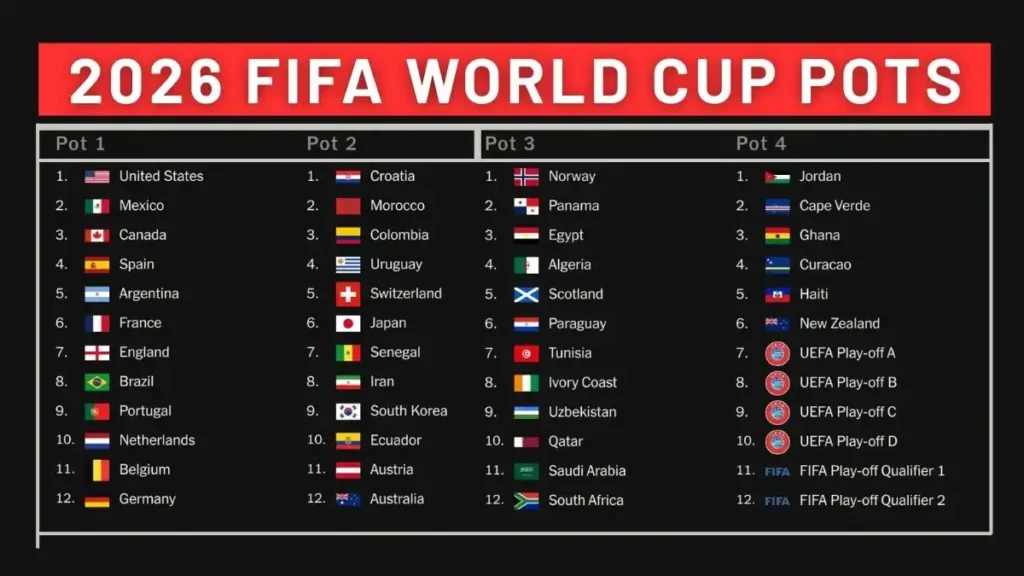
FIFA separates the 48 teams into four pots of 12 teams each. Pots are filled using the FIFA/Coca-Cola Men’s World Ranking published on 19 November 2025 (except the hosts):
- Pot 1 contains the three hosts (Canada, Mexico, USA) plus the top nine-ranked teams.
- Pots 2–4 contain the remaining teams, ordered by ranking; Pot 4 also includes the play-off placeholders (the inter-confederation and European play-off slots).
Why this matters: pots determine the strength level assigned to each group and help lower the chances of many top teams ending up in the same group.
Hosts: fixed positions and pre-assigned spots
FIFA has pre-assigned the three host nations to specific group positions to fit the match schedule and local logistics:
- Mexico = A1, Canada = B1, USA = D1 — these host slots will be represented by different coloured balls during the draw and are fixed to positions in Groups A, B and D respectively. The other nine Pot 1 teams will be drawn into the remaining Group 1 positions.
2026 World Cup Draw Results
- Group A – Mexico (H), Team A2, Team A3, Team A4
- Group B – Canada (H), Team B2, Team B3, Team B4
- Group C – Team C1, Team C2, Team C3, Team C4
- Group D – USA(H), Team D2, Team D3, Team D4
- Group E – Team E1, Team E2, Team E3, Team E4
- Group F – Team F1, Team F2, Team F3, Team F4
- Group G – Team G1, Team G2, Team G3, Team G4
- Group H – Team H1, Team H2, Team H3, Team H4
- Group I – Team I1, Team I2, Team I3, Team I4
- Group J – Team J1, Team J2, Team J3, Team J4
- Group K –Team K1, Team K2, Team K3, Team K4
- Group L – Team L1, Team L2, Team L3, Team L4
Confederation rules & fairness constraints
To maximise geographic balance and competitive integrity, the draw follows confederation constraints:
- No group may contain more than one team from the same confederation, except UEFA (Europe), which will have 16 teams in the tournament; therefore, each group must have at least one and no more than two UEFA teams.
- Play-off placeholders in Pot 4 are handled carefully so the confederation restrictions still apply once actual teams qualify.
Group positions (how a drawn team gets A2, A3, A4, etc.)
Unlike the old method where each pot’s ball was drawn and manually placed into a numbered slot, FIFA now uses a set allocation pattern to assign positions within a group for Pots 2–4.
Basically, the pot a team comes from and the group it’s placed in together decide its position (like A2, B3, etc.), as outlined in FIFA’s draw procedures. This makes the process faster and keeps the fixture list balanced.
Pathways and bracket design (avoiding early super-clashes)
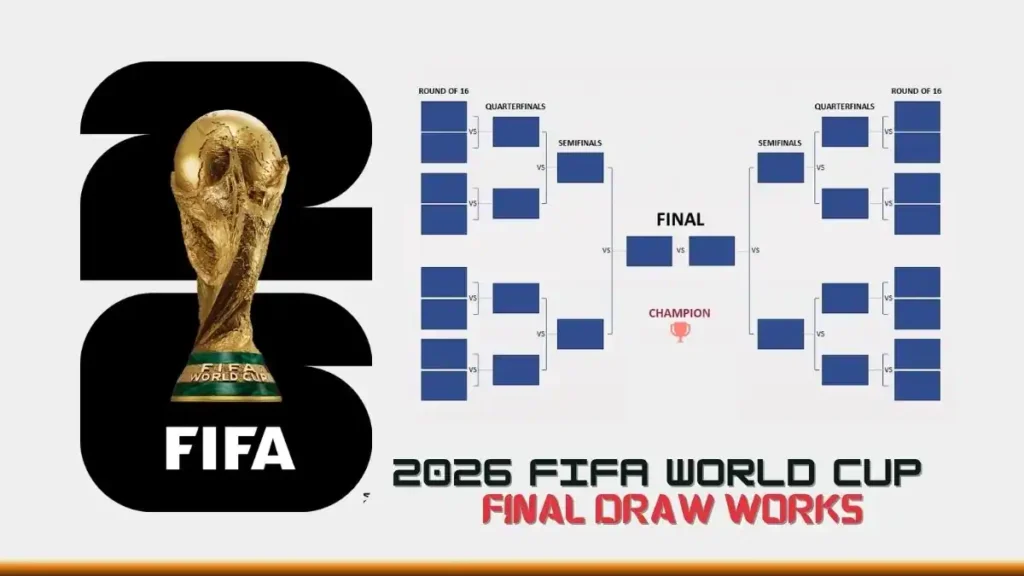
FIFA also built two separate “pathways” into the match schedule so that the four highest-ranked teams (as determined by the Nov 19 ranking) are placed into pathways that keep the top two from meeting before the final — i.e., the draw is designed so, if the top seeds win their groups, the very best teams do not face each other until the later knockout rounds. This is a competition design choice intended to protect competitive balance through the bracket.
Play-off placeholders & unresolved spots
At draw time a small number of places remain unfilled (play-off winners). FIFA places those play-off placeholders into Pot 4, and the draw treats them the same as other Pot 4 balls — with the additional confederation constraint logic applied once the actual teams qualify. This means the draw can proceed even before every qualifying match is decided.
The six play-off paths are:
- UEFA Play-off A: Italy, Wales, Bosnia-Herzegovina, Northern Ireland
- UEFA Play-off B: Ukraine, Poland, Albania, Sweden
- UEFA Play-off C: Turkey, Slovakia, Kosovo, Romania
- UEFA Play-off D: Denmark, Czech Republic, Republic of Ireland, North Macedonia
- Fifa Play-off 1: DR Congo, Jamaica, New Caledonia
- Fifa Play-off 2: Iraq, Bolivia, Suriname
Timeline & what to watch on draw day
- Draw date & venue: 5 December 2025, Kennedy Center (Washington, D.C.).
- 72 group-stage matches (up from 48 in 2022)
- Updated match schedule (stadiums & kick-off times): will be published the day after the draw (6 December). Expect the draw show to be theatrical — with celebrity assistants and global TV coverage.
- Round of 32 with 16 teams eliminated
- Single elimination continues: Round of 16 → Quarterfinals → Semifinals → Final
Quick FAQ (for embedding in a blog sidebar)

Will Portugal and Spain be in the same group?
Only if the draw and confederation constraints allow it, two UEFA teams can be in one group, but FIFA’s bracket rules and pots make same-group pairings among top teams less likely.
How many third-placed teams progress?
The eight best third-placed teams across the 12 groups advance to fill the Round of 32.
- The 12×4 format keeps a familiar group size while increasing global representation.
- Pot seeding and confederation rules aim to protect competitive balance and geographical diversity.
- Hosts are fixed into pre-assigned slots (Mexico A1, Canada B1, USA D1), so their group schedules are certain before the draw.
- Play-off placeholders in Pot 4 let FIFA complete the draw even if a few qualifying matches remain.