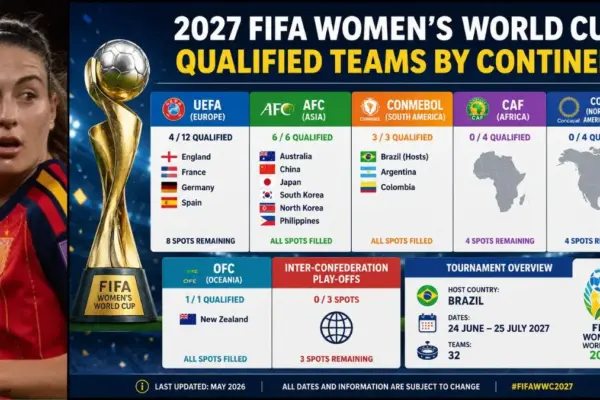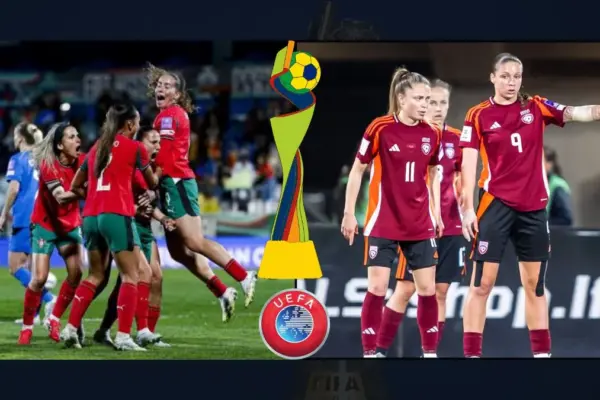
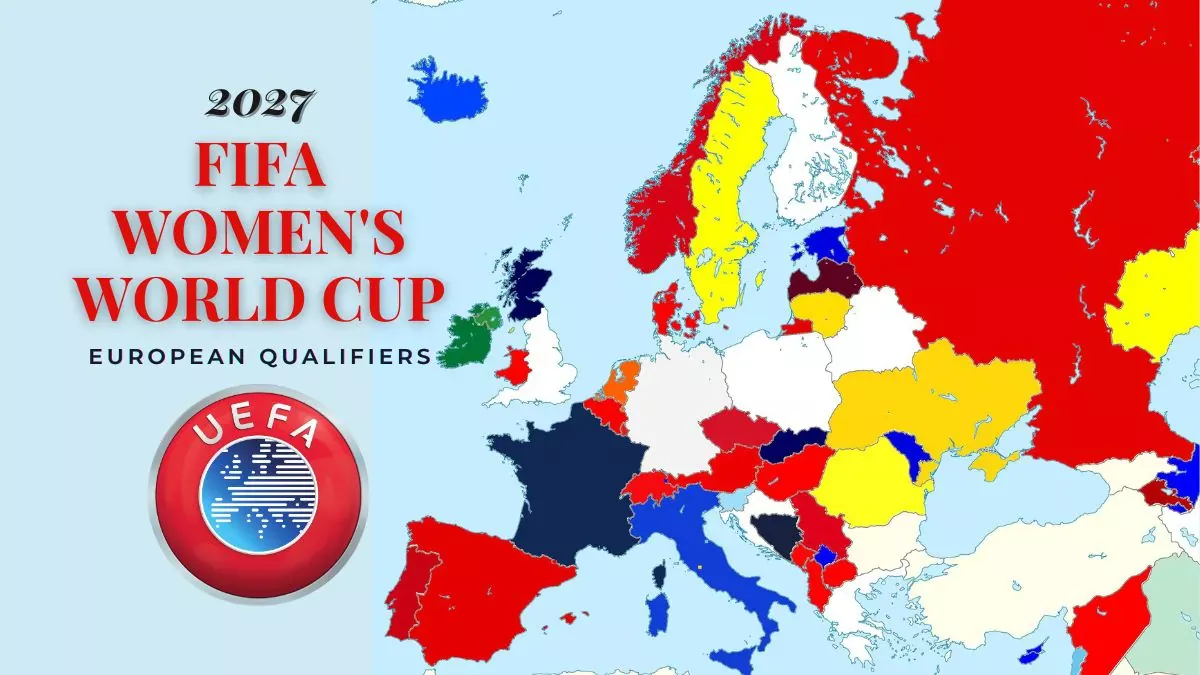
The Women’s World Cup UEFA Qualification tournament for the 2027 FIFA Women’s World Cup represents the pathway for Europe’s top women’s national teams to reach the prestigious tournament in Brazil. With 53 European nations competing for 11 direct qualification spots plus one additional berth through inter-confederation play-offs, this qualification campaign promises intense competition, dramatic rivalries, and historic matchups.
Running from March to December 2026, the Women’s European Qualifiers utilize an innovative league-based system that combines Women’s World Cup qualification with promotion and relegation for the 2027-29 UEFA Women’s Nations League cycle.
This dual-purpose structure creates high stakes for every match, ensuring competitive intensity across all three leagues.
The qualification features a blockbuster rematch between reigning World Cup champions Spain and European champions England, alongside traditional powerhouses like France, Germany, the Netherlands, and Sweden competing for direct qualification spots.
2027 FIFA Women’s World Cup UEFA Qualification Overview – Structure, Groups, Teams, Schedule & Format

Qualification Slots
European Allocation for 2027 Women’s World Cup:
- 11 Direct Qualification Spots: Guaranteed places at the finals in Brazil
- 1 Inter-Confederation Play-off Spot: Additional opportunity through global play-offs
How Spots Are Determined:
- 4 Direct Qualifiers: League A group winners (automatic qualification)
- 7 Play-off Qualifiers: Best seven teams from two-round play-off system
- 1 Inter-Continental Play-off: Eighth play-off winner advances to global play-offs
Three-League Format
The 53 participating UEFA nations are divided into three leagues based on their 2025 UEFA Women’s Nations League overall phase rankings:
League A: 16 teams (ranked 1-16)
League B: 16 teams (ranked 17-32)
League C: 21 teams (ranked 33-53)
This league structure mirrors the UEFA Women’s Nations League format, creating a familiar competitive environment while determining World Cup qualification and future Nations League composition simultaneously.
Tournament Timeline
Qualifying Draw: November 4, 2025 (Nyon, Switzerland)
League Phase: March 3 – June 9, 2026 (6 matchdays)
Play-off Draw: June 24, 2026
Play-off Round 1: October 7-13, 2026 (two-legged ties)
Play-off Round 2: November 26 – December 5, 2026 (two-legged ties)
Inter-Confederation Play-offs: February 2027
Finals: June 24 – July 25, 2027 (Brazil)
League A: Elite European Teams
League A features the 16 highest-ranked European teams competing in four groups of four. The group winners qualify directly for the 2027 Women’s World Cup in Brazil, while all remaining teams advance to the play-off phase.
Group A1: Scandinavian Powerhouse
| Pos | Team | Pld | W | D | L | GF | GA | GD | Pts |
|---|---|---|---|---|---|---|---|---|---|
| 1 | Denmark | 6 | 4 | 2 | 0 | 12 | 5 | +7 | 14 |
| 2 | Italy | 6 | 2 | 3 | 1 | 12 | 4 | +8 | 9 |
| 3 | Sweden | 6 | 2 | 2 | 2 | 6 | 6 | 0 | 8 |
| 4 | Serbia | 6 | 0 | 1 | 5 | 2 | 17 | −15 | 1 |
Teams:
- 🇸🇪 Sweden (UEFA Rank: 4th)
- FIFA Women’s World Ranking: 3rd
- Recent Form: 2023 World Cup bronze, 2025 Women’s Nations League semi-finalists
- Key Players: Fridolina Rolfö, Magdalena Eriksson, Kosovare Asllani
- Tournament Record: Qualified for every Women’s World Cup (8/8)
- Strengths: Tactical discipline, defensive solidity, set-piece excellence
- 🇮🇹 Italy (UEFA Rank: 7th)
- FIFA Women’s World Ranking: 15th
- Recent Form: 2025 UEFA Women’s EURO semi-finalists
- Key Players: Valentina Giacinti, Barbara Bonansea, Manuela Giugliano
- Tournament Breakthrough: Euro 2025 semi-final run showed major progress
- Playing Style: Organized defense, counter-attacking threat
- 🇩🇰 Denmark (UEFA Rank: 9th)
- FIFA Women’s World Ranking: 13th
- Recent Form: Consistent performers in major tournaments
- Key Players: Pernille Harder, Stina Ballisager Pedersen
- Tournament History: Euro 2017 finalists
- Tactical Approach: Technical excellence, possession-based football
- 🇷🇸 Serbia (UEFA Rank: 14th)
- FIFA Women’s World Ranking: 47th
- Recent Form: League A debutants after promotion from League B
- Historic Achievement: Never qualified for a major tournament
- Development: Only conceded one goal in the Nations League promotion campaign
- Underdog Status: Seeking first-ever World Cup qualification
Group Analysis: This group recreates the exact 2025 Women’s Nations League lineup, where Sweden, Italy, and Denmark were separated by just three points. Sweden’s perfect record against these opponents (three wins, one draw) makes them favorites, but Italy’s Euro 2025 semi-final run and Denmark’s consistency create a highly competitive group.
Serbia makes its League A debut, facing an uphill battle, but its defensive organization could yield surprises.
Group A2: Franco-Dutch Showdown
| Pos | Team | Pld | W | D | L | GF | GA | GD | Pts |
|---|---|---|---|---|---|---|---|---|---|
| 1 | France | 6 | 4 | 1 | 1 | 11 | 5 | +6 | 13 |
| 2 | Netherlands | 6 | 3 | 2 | 1 | 12 | 9 | +3 | 11 |
| 3 | Republic of Ireland | 6 | 3 | 0 | 3 | 9 | 9 | 0 | 9 |
| 4 | Poland | 6 | 0 | 1 | 5 | 6 | 15 | −9 | 1 |
Teams:
- 🇫🇷 France (UEFA Rank: 1st)
- FIFA Women’s World Ranking: 2nd
- Recent Form: Consistent top-tier performances, World Cup contenders
- Key Players: Wendie Renard, Marie-Antoinette Katoto, Grace Geyoro, Kadidiatou Diani
- Tournament History: Multiple World Cup semi-finalists
- Strengths: Physicality, athleticism, attacking firepower
- Coach: Hervé Renard (experienced World Cup tactician)
- 🇳🇱 Netherlands (UEFA Rank: 5th)
- FIFA Women’s World Ranking: 8th
- Recent Form: 2023 World Cup quarter-finalists, Euro 2017 champions
- Key Players: Vivianne Miedema, Danielle van de Donk, Daphne van Domselaar
- Tournament Pedigree: Euro 2017 winners, 2019 World Cup finalists
- Playing Style: Total football philosophy, technical excellence
- Attacking Power: Among Europe’s most prolific scorers
- 🇵🇱 Poland (UEFA Rank: 12th)
- FIFA Women’s World Ranking: 31st
- Recent Form: Newly promoted back to League A
- Historic Context: First World Cup appearance in 2023
- Development: Rapidly improving women’s program
- Challenge: Testing against elite European opposition
- 🇮🇪 Republic of Ireland (UEFA Rank: 16th)
- FIFA Women’s World Ranking: 24th
- Recent Form: 2023 World Cup debutants (first major tournament)
- Historic Achievement: Qualified for the first World Cup in 2023
- Rising Program: Building on recent success
- Ambition: Seeking consecutive World Cup appearances
Group Analysis: France enters as overwhelming favorites with their top UEFA ranking and world-class squad depth. The Netherlands provides the primary challenge with their Euro 2017 triumph and 2019 World Cup final experience.
Poland and Ireland, both newly promoted to League A, face difficult tasks but bring the confidence of recent upward trajectories. The France-Netherlands clashes will likely determine the group winner.
Group A3: Blockbuster Rivalry
| Pos | Team | Pld | W | D | L | GF | GA | GD | Pts |
|---|---|---|---|---|---|---|---|---|---|
| 1 | Spain | 6 | 5 | 0 | 1 | 21 | 3 | +18 | 15 |
| 2 | England | 6 | 5 | 0 | 1 | 13 | 5 | +8 | 15 |
| 3 | Iceland | 6 | 2 | 0 | 4 | 3 | 12 | −9 | 6 |
| 4 | Ukraine | 6 | 0 | 0 | 6 | 2 | 19 | −17 | 0 |
Teams:
- 🇪🇸 Spain (UEFA Rank: 3rd)
- FIFA Women’s World Ranking: 1st
- Recent Form: 2023 World Cup champions, 2025 Women’s Nations League champions
- Key Players: Alexia Putellas, Aitana Bonmatí (2x Ballon d’Or winner), Salma Paralluelo
- Tournament Status: Defending World Cup champions
- Coach: Sonia Bermúdez (continued La Roja’s dominance)
- Record: Retained Nations League title without conceding a goal in 2025 finals
- Playing Style: Tiki-taka possession football, technical supremacy
- 🏴 England (UEFA Rank: 6th)
- FIFA Women’s World Ranking: 4th
- Recent Form: 2025 UEFA Women’s EURO champions (defended their title)
- Key Players: Keira Walsh, Lauren James, Georgia Stanway, Leah Williamson
- Tournament Record: Back-to-back European champions (2022, 2025), 2023 World Cup finalists
- Coach: Sarina Wiegman (most successful women’s coach)
- Historic Achievement: Defeated Spain on penalties in 2025 Euro final
- 🇮🇸 Iceland (UEFA Rank: 11th)
- FIFA Women’s World Ranking: 12th
- Recent Form: Consistent Euro qualifiers, never reached a World Cup
- Key Players: Sara Björk Gunnarsdóttir, Karólína Lea Vilhjálmsdóttir
- Tournament Heartbreak: Qualified for five consecutive Euros but never a World Cup
- Determination: Desperate to break World Cup qualification curse
- Playing Style: Organized, resilient, set-piece specialists
- 🇺🇦 Ukraine (UEFA Rank: 15th)
- FIFA Women’s World Ranking: 26th
- Recent Form: Development phase under new coach Iya Andrushchak
- Coach Background: Former player with 50+ caps
- Challenge: Facing “giants of world football” (coach’s description)
- First World Cup Goal: Seeking historic qualification
- Underdog Spirit: Embracing opportunity against elite opponents
Group Analysis: This is the headline group of the entire qualification campaign. Spain and England, who contested both the 2023 World Cup final (Spain won 1-0) and the 2025 Euro final (England won on penalties), renew their epic rivalry.
Their Wembley clash on April 14, 2026 (Matchday 3) will be must-watch television. Spain enters as slight favorites given their world #1 ranking and recent form, but England’s back-to-back Euro titles and home advantage make them formidable contenders. Iceland seeks to finally break through to a World Cup, while Ukraine embraces their underdog status.
Group A4: Central European Battle
| Pos | Team | Pld | W | D | L | GF | GA | GD | Pts |
|---|---|---|---|---|---|---|---|---|---|
| 1 | Germany | 6 | 5 | 1 | 0 | 18 | 1 | +17 | 16 |
| 2 | Norway | 6 | 4 | 0 | 2 | 11 | 9 | +2 | 12 |
| 3 | Austria | 6 | 1 | 1 | 4 | 3 | 9 | −6 | 4 |
| 4 | Slovenia | 6 | 1 | 0 | 5 | 3 | 16 | −13 | 3 |
Teams:
- 🇩🇪 Germany (UEFA Rank: 2nd)
- FIFA Women’s World Ranking: 5th
- Recent Form: Two-time world champions, eight-time Euro champions
- Key Players: Alexandra Popp (veteran leader), Lena Oberdorf, Giulia Gwinn
- Tournament History: 2003, 2007 World Cup winners; last won Euro 2013
- Current Status: Rebuilding phase after 2023 World Cup group stage exit
- Ambition: Return to elite status, seeking redemption
- 🇳🇴 Norway (UEFA Rank: 8th)
- FIFA Women’s World Ranking: 17th
- Recent Form: 1995 World Cup winners, Euro 1987, 1993 champions
- Key Players: Caroline Graham Hansen (Barcelona star), Ada Hegerberg (Ballon d’Or winner)
- Golden Generation: Experienced squad seeking final major tournament run
- Playing Style: Physical, direct, counter-attacking excellence
- Hegerberg Factor: World-class striker provides elite goal threat
- 🇦🇹 Austria (UEFA Rank: 10th)
- FIFA Women’s World Ranking: 16th
- Recent Form: Euro 2017 semi-finalists, consistent tournament participants
- Key Players: Experienced squad with Bundesliga representation
- Tournament Status: Regular World Cup participants
- Playing Style: Organized, disciplined, defensively solid
- 🇸🇮 Slovenia (UEFA Rank: 13th)
- FIFA Women’s World Ranking: 48th
- Recent Form: Rapid rise from League C to League A in two cycles
- Inspirational Story: Example of UEFA competition system success
- Historic Achievement: Made Nations League play-offs from League C in 2024
- Development: Building competitive program through structured progression
- Underdog Role: Seeking to establish themselves in elite company
Group Analysis: Germany and Norway, two former World Cup champions with eight Euro titles between them, headline this group. Germany seeks to return to their dominant form after a disappointing 2023 World Cup, while Norway’s golden generation aims for one final tournament qualification. Austria provides consistent mid-tier competition, and Slovenia’s remarkable rise through the leagues makes them the inspirational story of League A. The Germany-Norway clashes will be high-quality encounters.
League A Match Schedule
Matchday 1 (Tuesday, March 3, 2026)
Matchday 2 (Saturday, March 7, 2026)
Matchday 3 (Tuesday, April 14, 2026)
Matchday 4 (Saturday, April 18, 2026)
Matchday 5 (Friday, June 5, 2026)
Matchday 6 (Tuesday, June 9, 2026)
All times are listed in CET (Central European Time) for early matches and CEST (Central European Summer Time) for matches from Matchday 3 onwards.
League B: Contenders and Rising Teams
League B features 16 teams ranked 17-32 in the UEFA hierarchy, divided into four groups of four. The top three teams from each group (group winners, runners-up, and third-place teams) advance to the play-off phase.
Group B1: Welsh Leadership
| Pos | Team | Pld | W | D | L | GF | GA | GD | Pts |
|---|---|---|---|---|---|---|---|---|---|
| 1 | Wales | 6 | 4 | 2 | 0 | 17 | 5 | +12 | 14 |
| 2 | Czech Republic | 6 | 3 | 2 | 1 | 18 | 8 | +10 | 11 |
| 3 | Albania | 6 | 2 | 1 | 3 | 9 | 14 | −5 | 7 |
| 4 | Montenegro | 6 | 0 | 1 | 5 | 6 | 23 | −17 | 1 |
Teams:
- 🏴Wales (UEFA Rank: 17th) – British challengers
- 🇨🇿 Czechia (UEFA Rank: 22nd) – Central European strength
- 🇦🇱 Albania (UEFA Rank: 25th) – Balkan representatives
- 🇲🇪 Montenegro (UEFA Rank: 29th) – Development phase
Group Analysis: Wales leads this group with their higher ranking and recent competitive form. Czechia provides the primary challenge with Central European tactical discipline. Albania and Montenegro seek to establish themselves in League B while eyeing potential play-off qualification.
Group B2: Swiss Efficiency
| Pos | Team | Pld | W | D | L | GF | GA | GD | Pts |
|---|---|---|---|---|---|---|---|---|---|
| 1 | Switzerland | 6 | 5 | 1 | 0 | 18 | 5 | +13 | 16 |
| 2 | Turkey | 6 | 4 | 1 | 1 | 11 | 5 | +6 | 13 |
| 3 | Northern Ireland | 6 | 2 | 0 | 4 | 10 | 9 | +1 | 6 |
| 4 | Malta | 6 | 0 | 0 | 6 | 4 | 24 | −20 | 0 |
Teams:
- 🇨🇭 Switzerland (UEFA Rank: 18th) – Euro 2025 hosts
- 🇳🇮 Northern Ireland (UEFA Rank: 24th) – British determination
- 🇹🇷 Türkiye (UEFA Rank: 27th) – Rising program
- 🇲🇹 Malta (UEFA Rank: 32nd) – Mediterranean underdogs
Group Analysis: Switzerland, as Euro 2025 hosts, brings tournament experience and home advantage for select matches. Northern Ireland’s physical style challenges opponents, while Türkiye’s improving program and Malta’s development create competitive dynamics.
Group B3: Iberian Challenge
| Pos | Team | Pld | W | D | L | GF | GA | GD | Pts |
|---|---|---|---|---|---|---|---|---|---|
| 1 | Portugal | 6 | 5 | 0 | 1 | 17 | 4 | +13 | 15 |
| 2 | Finland | 6 | 5 | 0 | 1 | 15 | 6 | +9 | 15 |
| 3 | Slovakia | 6 | 2 | 0 | 4 | 8 | 17 | −9 | 6 |
| 4 | Latvia | 6 | 0 | 0 | 6 | 4 | 17 | −13 | 0 |
Teams:
- 🇵🇹 Portugal (UEFA Rank: 19th) – Iberian quality
- 🇫🇮 Finland (UEFA Rank: 23rd) – Nordic consistency
- 🇸🇰 Slovakia (UEFA Rank: 26th) – Recently promoted
- 🇱🇻 Latvia (UEFA Rank: 30th) – Baltic development
Group Analysis: Portugal enters as favorites with their technical ability and FIFA ranking advantage. Finland, recently relegated from League A, seeks immediate return with their Euro 2025 experience. Slovakia and Latvia battle for play-off positions and League B survival.
Group B4: Belgian and Scottish Authority
| Pos | Team | Pld | W | D | L | GF | GA | GD | Pts |
|---|---|---|---|---|---|---|---|---|---|
| 1 | Scotland | 6 | 4 | 2 | 0 | 24 | 2 | +22 | 14 |
| 2 | Belgium | 6 | 4 | 2 | 0 | 22 | 1 | +21 | 14 |
| 3 | Israel | 6 | 2 | 0 | 4 | 10 | 20 | −10 | 6 |
| 4 | Luxembourg | 6 | 0 | 0 | 6 | 1 | 34 | −33 | 0 |
Teams:
- 🇧🇪 Belgium (UEFA Rank: 20th) – Red Flames rising
- 🏴Scotland (UEFA Rank: 21st) – British rivals
- 🇮🇱 Israel (UEFA Rank: 28th) – Middle Eastern representatives
- 🇱🇺 Luxembourg (UEFA Rank: 31st) – Development nation
Group Analysis: Belgium and Scotland provide the group’s competitive core, with both nations possessing Euro qualification experience. Israel brings tactical organisation, while Luxembourg continues to build its women’s program.
Ranking of third-place teams
| Pos | Grp | Team | Pld | W | D | L | GF | GA | GD | Pts |
|---|---|---|---|---|---|---|---|---|---|---|
| 1 | B1 | Albania | 6 | 2 | 1 | 3 | 9 | 14 | −5 | 7 |
| 2 | B2 | Northern Ireland | 6 | 2 | 0 | 4 | 10 | 9 | +1 | 6 |
| 3 | B3 | Slovakia | 6 | 2 | 0 | 4 | 8 | 17 | −9 | 6 |
| 4 | B4 | Israel | 6 | 2 | 0 | 4 | 10 | 20 | −10 | 6 |
League C: Development and Opportunity
League C contains 21 teams (ranked 33-53) competing in six groups. The six group winners plus the two best-ranked runners-up advance to the play-off phase, creating eight total play-off spots from League C.
Groups Overview
Group C1: Bosnia and Herzegovina, Estonia, Lithuania, Liechtenstein
| Pos | Team | Pld | W | D | L | GF | GA | GD | Pts |
|---|---|---|---|---|---|---|---|---|---|
| 1 | Lithuania | 6 | 3 | 2 | 1 | 11 | 3 | +8 | 11 |
| 2 | Bosnia and Herzegovina | 6 | 3 | 2 | 1 | 23 | 5 | +18 | 11 |
| 3 | Estonia | 6 | 3 | 2 | 1 | 11 | 6 | +5 | 11 |
| 4 | Liechtenstein | 6 | 0 | 0 | 6 | 3 | 34 | −31 | 0 |
Group C2: Croatia, Kosovo, Bulgaria, Gibraltar
| Pos | Team | Pld | W | D | L | GF | GA | GD | Pts |
|---|---|---|---|---|---|---|---|---|---|
| 1 | Kosovo | 6 | 5 | 0 | 1 | 20 | 3 | +17 | 15 |
| 2 | Croatia | 6 | 5 | 0 | 1 | 16 | 1 | +15 | 15 |
| 3 | Bulgaria | 6 | 2 | 0 | 4 | 10 | 11 | −1 | 6 |
| 4 | Gibraltar | 6 | 0 | 0 | 6 | 1 | 32 | −31 | 0 |
Group C3: Hungary, Azerbaijan, North Macedonia, Andorra
| Pos | Team | Pld | W | D | L | GF | GA | GD | Pts |
|---|---|---|---|---|---|---|---|---|---|
| 1 | Hungary | 6 | 5 | 1 | 0 | 21 | 2 | +19 | 16 |
| 2 | Azerbaijan | 6 | 4 | 0 | 2 | 11 | 5 | +6 | 12 |
| 3 | North Macedonia | 6 | 2 | 0 | 4 | 5 | 17 | −12 | 6 |
| 4 | Andorra | 6 | 0 | 1 | 5 | 2 | 15 | −13 | 1 |
Group C4: Greece, Faroe Islands, Georgia (3 teams)
| Pos | Team | Pld | W | D | L | GF | GA | GD | Pts |
|---|---|---|---|---|---|---|---|---|---|
| 1 | Greece | 4 | 4 | 0 | 0 | 11 | 4 | +7 | 12 |
| 2 | Faroe Islands | 4 | 2 | 0 | 2 | 6 | 7 | −1 | 6 |
| 3 | Georgia | 4 | 0 | 0 | 4 | 4 | 10 | −6 | 0 |
Group C5: Romania, Cyprus, Moldova (3 teams)
| Pos | Team | Pld | W | D | L | GF | GA | GD | Pts |
|---|---|---|---|---|---|---|---|---|---|
| 1 | Romania | 4 | 3 | 1 | 0 | 8 | 0 | +8 | 10 |
| 2 | Moldova | 4 | 1 | 2 | 1 | 2 | 1 | +1 | 5 |
| 3 | Cyprus | 4 | 0 | 1 | 3 | 0 | 9 | −9 | 1 |
Group C6: Belarus, Kazakhstan, Armenia (3 teams)
| Pos | Team | Pld | W | D | L | GF | GA | GD | Pts |
|---|---|---|---|---|---|---|---|---|---|
| 1 | Belarus | 4 | 3 | 0 | 1 | 10 | 1 | +9 | 9 |
| 2 | Kazakhstan | 4 | 2 | 1 | 1 | 5 | 2 | +3 | 7 |
| 3 | Armenia | 4 | 0 | 1 | 3 | 1 | 13 | −12 | 1 |
Ranking of runners-up
| Pos | Grp | Team | Pld | W | D | L | GF | GA | GD | Pts |
|---|---|---|---|---|---|---|---|---|---|---|
| 1 | C2 | Croatia | 4 | 3 | 0 | 1 | 6 | 1 | +5 | 9 |
| 2 | C6 | Kazakhstan | 4 | 2 | 1 | 1 | 5 | 2 | +3 | 7 |
| 3 | C3 | Azerbaijan | 4 | 2 | 0 | 2 | 6 | 4 | +2 | 6 |
| 4 | C4 | Faroe Islands | 4 | 2 | 0 | 2 | 6 | 7 | −1 | 6 |
| 5 | C5 | Moldova | 4 | 1 | 2 | 1 | 2 | 1 | +1 | 5 |
| 6 | C1 | Bosnia and Herzegovina | 4 | 1 | 2 | 1 | 4 | 4 | 0 | 5 |
Key Features:
- Groups C1-C3 contain four teams each
- Groups C4-C6 contain three teams each
- All matches count toward qualification standings
- Results against fourth-place teams excluded when ranking runners-up
Competitive Balance: League C provides crucial development opportunities for emerging women’s football nations while offering realistic paths to the play-offs for competitive teams. Bosnia and Herzegovina, Hungary, Romania, Croatia, and Greece enter as favorites in their respective groups.
Qualified teams for the 2027 FIFA Women’s World Cup
| Team | Qualified on |
|---|---|
| Directly Qualified | |
| Denmark | 9 June 2026 |
| France | 9 June 2026 |
| Spain | 9 June 2026 |
| Germany | 5 June 2026 |
| After Playoff | |
| TBD | December 2026 |
| TBD | December 2026 |
| TBD | December 2026 |
| TBD | December 2026 |
| TBD | December 2026 |
| TBD | December 2026 |
| TBD | December 2026 |
Play-Off System Explained

The play-off phase determines seven direct World Cup qualifiers plus one inter-confederation play-off participant through a two-round, two-legged knockout format.
Play-Off Participants (32 Teams Total)
From League A (12 teams):
- 4 second-place teams
- 4 third-place teams
- 4 fourth-place teams
From League B (12 teams):
- 4 group winners
- 4 second-place teams
- 4 third-place teams
From League C (8 teams):
- 6 group winners
- 2 best-ranked runners-up
Round 1: Two Paths (October 7-13, 2026)
Path 1 (16 teams – 8 ties):
- Seeded (Home Second Leg): 4 League A second-place teams + 4 League A third-place teams
- Unseeded (Home First Leg): 6 League C group winners + 2 best-ranked League C runners-up
- Format: Two-legged knockout ties
- Advancement: 8 winners advance to Round 2
Path 2 (16 teams – 8 ties):
- Seeded (Home Second Leg): 4 League A fourth-place teams + 4 League B group winners
- Unseeded (Home First Leg): 4 League B second-place teams + 4 League B third-place teams
- Format: Two-legged knockout ties
- Advancement: 8 winners advance to Round 2
Round 2: Unified Draw (November 26 – December 5, 2026)
Participants: 16 teams (8 Path 1 winners + 8 Path 2 winners)
Seeding:
- Seeded (Home Second Leg): 8 Path 1 winners
- Unseeded (Home First Leg): 8 Path 2 winners
Draw Process: Teams from both paths drawn into 8 two-legged ties
Final Qualification:
- 7 Best-Ranked Winners: Direct qualification to 2027 Women’s World Cup
- 8th-Ranked Winner: Advances to inter-confederation play-offs
Ranking Criteria: Based on overall league phase rankings from the 2026 Women’s European Qualifiers
Promotion and Relegation System
The qualification campaign simultaneously determines the league structure for the 2027-29 UEFA Women’s Nations League cycle.
Promotion
From League C to League B:
- All 6 group winners promoted
From League B to League A:
- All 4 group winners promoted
Total Promoted: 10 teams
Relegation
From League A to League B:
- All 4 fourth-place teams are relegated
From League B to League C:
- All 4 fourth-place teams are relegated
- 2 lowest-ranked third-place teams relegated (ranked 27-28 in overall rankings)
Total Relegated: 10 teams
League Stability
League A: Winners, runners-up, and third-place teams remain
League B: Winners, runners-up, two best third-place teams remain
League C: Runners-up, third-place, fourth-place teams (where applicable) remain
This creates competitive pressure across all positions, ensuring every match carries significance for both World Cup qualification and Nations League composition.
Key Matchups and Storylines

Spain vs England: The Mega Rivalry
Background: The two teams have dominated recent women’s football:
- 2023 World Cup Final: Spain 1-0 England (Sydney)
- 2025 Euro Final: England defeated Spain on penalties (London)
Group A3 Fixtures:
- Matchday 1 (March 3): Spain vs Iceland (19:00 CET), Ukraine vs England (18:00 CET)
- Matchday 3 (April 14): Spain vs England at Wembley Stadium (likely sell-out crowd)
- Return Fixture (June): England vs Spain in Spain
Stakes: Beyond group supremacy, these matches carry psychological weight for the 2027 World Cup. Spain seeks revenge for the Euro 2025 final penalty defeat, while England aims to prove their Euro triumph was no fluke.
Tactical Battle: Spain’s possession-based tiki-taka against England’s physicality and tactical flexibility under Sarina Wiegman creates fascinating strategic contrasts.
France vs Netherlands: Franco-Dutch Classic
Historic Rivalry: Two traditional European powers with contrasting styles
- France: Physical, athletic, direct
- Netherlands: Technical, possession-oriented, total football
Group A2 Implications: These fixtures will likely determine the group winner and potentially impact play-off seeding.
Star Power: Wendie Renard vs Vivianne Miedema, Marie-Antoinette Katoto vs Daphne van de Donk
Germany’s Redemption Quest
After their shocking 2023 World Cup group stage elimination, Germany faces immense pressure to qualify convincingly for Brazil 2027. Their Group A4 matches against Norway will test the quality of their rebuilt squad.
Iceland’s World Cup Dream
Five consecutive Euro qualifications but zero World Cup appearances. Iceland’s Group A3 campaign represents potentially their best chance yet, though facing Spain and England makes qualification extremely challenging.
Serbia’s Historic Opportunity
In their League A debut, Serbia is aiming for a historic first qualification to a major tournament. Facing tough opponents like Sweden, Italy, and Denmark will be no easy task, but their solid defensive structure from the Nations League promotion run shows they have what it takes to compete.
Slovenia’s Remarkable Rise
From League C to League A in just two cycles, Slovenia’s presence among Europe’s elite demonstrates the effectiveness of the UEFA competition structure. Their Group A4 campaign, regardless of results, marks a historic achievement.
Qualification Scenarios and Projections
Direct Qualifiers (League A Group Winners)
Likely Winners:
- Group A1: Sweden (favorites based on recent head-to-head record)
- Group A2: France (top-ranked team, deepest squad)
- Group A3: Spain or England (50/50 – Spain slight edge as world #1)
- Group A4: Germany (pedigree and quality, seeking redemption)
Alternative Scenarios:
- Italy could upset Sweden if Euro 2025 form continues
- Netherlands might challenge France given their attacking prowess
- England’s home advantage and Euro 2025 triumph make them genuine Spain challengers
- Norway’s golden generation could produce final major tournament qualification
Play-Off Contenders
Strong League A Teams Missing Direct Qualification:
- England or Spain (one will finish 2nd/3rd in Group A3)
- Netherlands (likely 2nd in Group A2 behind France)
- Italy or Denmark (competitive Group A1)
- Norway (strong contender in Group A4)
League B Challengers:
- Switzerland (Euro 2025 hosts with tournament experience)
- Belgium (rising program with consistent improvement)
- Portugal (technical quality and FIFA ranking)
- Wales (British determination and competitive spirit)
League C Breakthrough Candidates:
- Bosnia and Herzegovina (highest-ranked League C team)
- Hungary, Croatia, Romania (Group winners potential)
- Kosovo (making waves in Balkan football)
Dark Horses
Iceland: If they can steal points from Spain/England and dominate Ukraine, an unlikely direct qualification remains possible.
Scotland: Strong League B team capable of reaching play-off Round 2 and potentially qualifying.
Slovenia: While League A survival is their primary goal, their recent trajectory suggests they shouldn’t be underestimated.
Historical Context and Significance
UEFA’s European Dominance
European teams have historically dominated women’s football:
- World Cup Titles: 4 of 9 tournaments (Germany 2x, Norway, Spain)
- World Cup Finalists: 14 of 18 final participants
- 2023 World Cup: Spain (winners), England (runners-up), Sweden (3rd)
Evolution of Competition Format
The league-based qualification system represents a major evolution from traditional group-based qualifiers:
Benefits:
- Competitive matches throughout campaign
- Meaningful games for all teams
- Dual purpose (World Cup + Nations League)
- Clear promotion/relegation stakes
- Reduced dead rubbers
Impact on Development:
- Smaller nations gain competitive experience
- League structure prevents mismatches
- Clear pathways for emerging programs
- Regular competitive football for all levels
Record-Breaking Campaigns
Most Qualifications: Germany (9/9 World Cups attended)
Recent Success: Spain (World Cup 2023 winners entering as favorites)
Breakthrough Stories: Slovenia (League C to League A in two cycles)
Emerging Powers: Italy (Euro 2025 semi-finalists showing major growth)
Matchday-by-Matchday Schedule
Matchday 1 (Tuesday, March 3, 2026)
League A Fixtures:
- Denmark vs Serbia (18:00 CET)
- Italy vs Sweden (18:15 CET)
- Poland vs Netherlands (18:00 CET)
- Republic of Ireland vs France (19:30 CET)
- Ukraine vs England (18:00 CET)
- Spain vs Iceland (19:00 CET)
- Germany vs Slovenia (17:45 CET)
- Austria vs Norway (18:00 CET)
League B & C: All groups in action (times TBD)
Matchday 2 (Saturday, March 7, 2026)
Return fixtures with reversed home/away assignments
Matchday 3 (Tuesday, April 14, 2026)
- Armenia vs Belarus – 5:30 PM – Vazgen Sargsyan Stadium
- Bulgaria vs Kosovo – 7:30 PM – Ovcha Kupel Stadium
- Moldova vs Cyprus – 7:30 PM – Nisporeni Stadium
- North Macedonia vs Hungary – 7:30 PM – Petar Milosevski Stadium
- Estonia vs Liechtenstein – 8:30 PM – A. Le Coq Arena
- Lithuania vs Bosnia – 8:30 PM – LSC Complex
- Czechia vs Montenegro – 9:00 PM – Letní Stadion
- Finland vs Slovakia – 9:00 PM – Bolt Arena
- Faroe Islands vs Greece – 9:30 PM – Tórsvollur
- Norway vs Slovenia – 9:30 PM – Åråsen Stadion
- Poland vs Ireland – 9:30 PM – Gdansk Arena
- Germany vs Austria – 9:45 PM – Max-Morlock-Stadion
- Serbia vs Italy – 9:45 PM – Dubocica Stadium
- Andorra vs Azerbaijan – 10:30 PM – Estadi Nacional
- Gibraltar vs Croatia – 10:30 PM – Europa Point Stadium
- Latvia vs Portugal – 10:30 PM – Daugava Stadium
- Sweden vs Denmark – 10:30 PM – Gamla Ullevi
- Switzerland vs Türkiye – 10:30 PM – Letzigrund
- Israel vs Luxembourg – 10:45 PM – Budaörs Stadium
- England vs Spain – 11:30 PM – Wembley Stadium
- Northern Ireland vs Malta – 11:30 PM – Mourneview Park
- Wales vs Albania – 11:45 PM – Racecourse Ground
- Iceland vs Ukraine – 12:00 AM – Laugardalsvöllur
- Scotland vs Belgium – 12:00 AM – Easter Road
- Netherlands vs France – 12:15 AM – Rat Verlegh Stadion
Matchday 4 (Saturday, April 18, 2026)
- FIFA Women’s World Cup Qualifying – UEFA
- Belarus vs Kazakhstan – 5:30 PM – Tengiz Burjanadze Stadium
- Azerbaijan vs Andorra – 6:30 PM – Bank Respublika Stadium
- Denmark vs Italy – 6:30 PM – Parken Stadium
- Hungary vs North Macedonia – 6:30 PM – Pancho Arena
- Romania vs Cyprus – 6:30 PM – Stadionul Arcul de Triumf
- Estonia vs Lithuania – 7:30 PM – A. Le Coq Arena
- Liechtenstein vs Bosnia and Herzegovina – 7:30 PM – Rheinpark Stadion
- Montenegro vs Czechia – 7:30 PM – Gradski Niksica
- Republic of Ireland vs Poland – 7:30 PM – Aviva Stadium
- Slovakia vs Portugal – 7:30 PM – Futbal Tatran Arena
- Spain vs Ukraine – 7:30 PM – Nuevo El Arcángel
- Sweden vs Serbia – 7:30 PM – Friends Arena
- Croatia vs Gibraltar – 8:00 PM – Gradski Stadion Sinj
- Slovenia vs Norway – 8:30 PM – Ptuj City Stadium
- Albania vs Wales – 9:30 PM – Elbasan Arena
- Austria vs Germany – 9:30 PM – Innviertel Arena
- Faroe Islands vs Georgia – 9:30 PM – Tórsvollur
- Kosovo vs Bulgaria – 9:30 PM – Fadil Vokrri Stadium
- Luxembourg vs Israel – 9:30 PM – Árok utcai pálya
- Türkiye vs Switzerland – 9:30 PM – Sinop City Stadium
- Iceland vs England – 10:00 PM – Laugardalsvöllur
- Latvia vs Finland – 10:30 PM – Daugavas Stadions
- Malta vs Northern Ireland – 10:30 PM – MFA Centenary Stadium
- Belgium vs Scotland – 12:00 AM – King Power at Den Dreef Stadion
- France vs Netherlands – 12:40 AM – Stade de l’Abbé-Deschamps
Matchday 5 (Friday, June 5, 2026)
- FIFA Women’s World Cup Qualifying – UEFA
- Liechtenstein vs Estonia – 10:30 PM – Rheinpark Stadion
- Andorra vs North Macedonia – TBD – Estadi Nacional d’Andorra
- Armenia vs Kazakhstan – TBD – FFA Academy Stadium
- Austria vs Slovenia – TBD – Wiener Sportclub-Platz
- Azerbaijan vs Hungary – TBD – Mehdi Huseynzade Stadium
- Bosnia and Herzegovina vs Lithuania – TBD – Nogometni Kamp Reprezentacije BiH
- Bulgaria vs Gibraltar – TBD – Ovcha Kupel Stadium
- Czechia vs Albania – TBD – eFotbal Arena
- Denmark vs Sweden – TBD – TBC
- Georgia vs Faroe Islands – TBD – David Petriashvili Stadium
- Germany vs Norway – TBD – RheinEnergieStadion
- Italy vs Serbia – TBD – TBC
- Kosovo vs Croatia – TBD – TBC
- Moldova vs Romania – TBD – Nisporeni Central Stadium
- Montenegro vs Wales – TBD – Podgorica City Stadium
- Poland vs France – TBD – TBC
- Portugal vs Latvia – TBD – Estádio António Coimbra da Mota
- Scotland vs Israel – TBD – TBC
- Slovakia vs Finland – TBD – Stadión Pod Zoborom
- Spain vs England – TBD – Son Moix Stadium
- Switzerland vs Malta – TBD – AIL Arena
- Türkiye vs Northern Ireland – TBD – Pendik Stadium
- Ukraine vs Iceland – TBD – Stadion Miejski, Mielec
- Belgium vs Luxembourg – 11:45 PM – King Power at Den Dreef Stadion
- Republic of Ireland vs Netherlands – 12:00 AM – Páirc Uí Chaoimh
Matchday 6 (Tuesday, June 9, 2026)
- FIFA Women’s World Cup Qualifying – UEFA
- Albania vs Montenegro – 10:30 PM – Arena Egnatia
- Belarus vs Armenia – 10:30 PM – TBC
- Croatia vs Bulgaria – 10:30 PM – Stadion Aldo Drosina
- Cyprus vs Moldova – 10:30 PM – Antonis Papadopoulos Stadium
- Estonia vs Bosnia and Herzegovina – 10:30 PM – TBC
- Finland vs Portugal – 10:30 PM – Tammelan Stadion
- Georgia vs Greece – 10:30 PM – TBC
- Gibraltar vs Kosovo – 10:30 PM – Europa Point Stadium
- Hungary vs Andorra – 10:30 PM – TBC
- Israel vs Scotland – 10:30 PM – TBC
- Latvia vs Slovakia – 10:30 PM – Daugavas Stadions
- Lithuania vs Liechtenstein – 10:30 PM – LSC Sporto Kompleksas
- Luxembourg vs Belgium – 10:30 PM – TBC
- Malta vs Türkiye – 10:30 PM – MFA Centenary Stadium
- North Macedonia vs Azerbaijan – 10:30 PM – TBC
- Northern Ireland vs Switzerland – 10:30 PM – TBC
- Wales vs Czechia – 10:30 PM – Cardiff City Stadium
- Iceland vs Spain – TBD – Laugardalsvöllur
- Netherlands vs Poland – TBD – Erve Asito
- Norway vs Austria – TBD – Ullevaal Stadion
- Serbia vs Denmark – TBD – Sports Center of FA Serbia
- Slovenia vs Germany – TBD – TBC
- Sweden vs Italy – TBD – Gamla Ullevi
- England vs Ukraine – 12:30 AM – Hill Dickinson Stadium
- France vs Republic of Ireland – 12:30 AM – Stade des Alpes
Final matchday determining:
- All 4 direct qualifiers (League A group winners)
- All 32 play-off participants
- Promotion and relegation for the 2027 Nations League
Women’s World Cup UEFA Qualification Top goalscorers
| Rank | Player | Country | Goals |
|---|---|---|---|
| 1 | Caroline Weir | Scotland | 10 |
| 2 | Tessa Wullaert | Belgium | 8 |
| 3 | Vital Kats | Israel | 6 |
| Rimantė Jonušaitė | Lithuania | ||
| Kika Nazareth | Portugal | ||
| Hannah Cain | Wales | ||
| 7 | Milena Nikolić | Bosnia and Herzegovina | 5 |
| Erëleta Memeti | Kosovo | ||
| Edna Imade | Spain | ||
| 10 | Megi Doçi | Albania | 4 |
| Sevinj Jafarzade | Azerbaijan | ||
| Hannah Eurlings | Belgium | ||
| Janja Čanjevac | Croatia | ||
| Klára Cahynová | Czech Republic | ||
| Michaela Khýrová | Czech Republic | ||
| Pernille Harder | Denmark | ||
| Georgia Stanway | England | ||
| Melvine Malard | France | ||
| Diána Csányi | Hungary | ||
| Blerta Smaili | Kosovo | ||
| Carolina Santiago | Portugal | ||
| Jenna Clark | Scotland | ||
| Kathleen McGovern | Scotland | ||
| Vicky López | Spain | ||
| Clàudia Pina | Spain | ||
| 26 | Emina Ekić | Bosnia and Herzegovina | 3 |
| Marija Milinković | Bosnia and Herzegovina | ||
| Amalie Vangsgaard | Denmark | ||
| Alessia Russo | England | ||
| Vlada Kubassova | Estonia | ||
| Lotta Lindström | Finland | ||
| Ria Öling | Finland | ||
| Marie-Antoinette Katoto | France | ||
| Vivien Endemann | Germany | ||
| Vanessza Nagy | Hungary | ||
| Gentiana Fetaj | Kosovo | ||
| Modesta Uka | Kosovo | ||
| Ada Hegerberg | Norway | ||
| Ewa Pajor | Poland | ||
| Ana Capeta | Portugal | ||
| Katie McCabe | Republic of Ireland | ||
| Ioana Bălăceanu | Romania | ||
| Aurélie Csillag | Switzerland | ||
| Riola Xhemaili | Switzerland | ||
| Mared Griffiths | Wales |
How to Follow the Qualification Campaign
Television and Streaming
UEFA Platforms:
- UEFA.tv (Official streaming platform – select matches)
- UEFA.com (Live match center, statistics, updates)
National Broadcasters:
- BBC (United Kingdom – England matches and selected games)
- ARD/ZDF (Germany – all Germany matches)
- TF1/France TV (France – all France matches)
- RTVE (Spain – all Spain matches)
- Various national broadcasters across Europe
Streaming Services:
- DAZN (Select territories)
- National FA platforms
- Regional sports networks
Digital Coverage
Official Sources:
- UEFA.com (Match reports, standings, statistics)
- FIFA.com (World Cup qualification coverage)
- National FA websites (Team-specific content)
Social Media:
- @UEFA (Twitter/X)
- @FIFAWWC (Twitter/X – World Cup focus)
- Individual team accounts
Frequently Asked Questions (FAQ)

How many UEFA teams qualify for the 2027 Women’s World Cup?
UEFA has been allocated 11 direct qualification spots for the 2027 FIFA Women’s World Cup in Brazil, plus one additional potential berth through inter-confederation play-offs, for a possible total of 12 European teams at the finals.
When does UEFA qualification for the 2027 Women’s World Cup take place?
The UEFA Women’s European Qualifiers run from March 3 to December 5, 2026. The league phase takes place from March 3 to June 9, 2026 (6 matchdays), followed by play-off Round 1 (October 7-13, 2026) and play-off Round 2 (November 26 – December 5, 2026).
What is the format of the qualification tournament?
Fifty-three European nations compete in a league-based system across three leagues (A, B, C). The four League A group winners qualify directly. The remaining 32 teams (12 from League A, 12 from League B, 8 from League C) compete in two rounds of two-legged play-offs. The seven best-ranked play-off Round 2 winners qualify directly, while the eighth-ranked winner enters inter-confederation play-offs.
Which teams are favorites to qualify?
Spain (world #1, defending champions), France (UEFA #1), Germany (two-time champions), England (Euro 2025 winners), Sweden (consistent World Cup medalists), and the Netherlands (Euro 2017 winners) are considered the strongest favorites for direct qualification or play-off success.
When is the Spain vs England match?
Spain and England will meet twice in Group A3. The first encounter at Wembley Stadium is scheduled for Matchday 3 on Tuesday, April 14, 2026. The return fixture in Spain will take place during Matchday 4-6 (exact date TBD).
Can Germany fail to qualify?
While highly unlikely given their quality, Germany could theoretically miss qualification if they finish fourth in Group A4 and then lose both play-off rounds. Their 2023 World Cup group stage exit demonstrated they’re not invincible, but qualification remains overwhelmingly probable.
How does promotion and relegation work?
The qualification campaign simultaneously determines leagues for the 2027-29 UEFA Women’s Nations League. League B and C group winners are promoted, while League A and B fourth-place teams plus the two lowest-ranked League B third-place teams are relegated.
Which teams have never qualified for a Women’s World Cup?
Among League A teams, Serbia has never reached a major tournament. Iceland, despite qualifying for five consecutive Euros, has never reached a World Cup. Many League B and C teams are also seeking their first World Cup appearance.
What happens if teams are tied on points?
Tiebreakers applied in order: points in head-to-head matches, goal difference in head-to-head matches, goals scored in head-to-head matches, overall goal difference, overall goals scored, disciplinary points, and UEFA coefficient ranking.
Can Russia participate in the qualification?
No. Russia remains suspended indefinitely from UEFA and FIFA competitions following their country’s invasion of Ukraine. The suspension was in effect when UEFA finalized the qualifying process, and Russia was excluded from European qualification.
How many matches does each team play?
League A and B teams play 6 matches (home and away against each group opponent). League C teams play either 6 matches (four-team groups) or 4 matches (three-team groups). Teams reaching the play-offs play an additional 2-4 matches depending on progression.
Who hosts the play-off matches?
In play-off Round 1, higher-ranked teams (League A teams in Path 1, League A fourth-place teams and League B winners in Path 2) are seeded and host the second leg. In Round 2, Path 1 winners are seeded and host the second leg.
What are inter-confederation play-offs?
The inter-confederation play-offs are a global tournament in February 2027 featuring teams from different confederations competing for the final World Cup spots. UEFA will send one team (the eighth-ranked play-off Round 2 winner) to compete against teams from other confederations.
When will the final 11 qualifiers be confirmed?
The four direct qualifiers (League A group winners) will be confirmed on June 9, 2026 after Matchday 6. The seven play-off qualifiers will be confirmed after play-off Round 2 concludes on December 5, 2026. The potential 12th qualifier (inter-confederation play-off winner) will be determined in February 2027.
Can I attend matches?
Yes. Tickets are available through national football associations and official ticketing platforms. Information on ticket sales, pricing, and availability varies by host nation and can be found on respective FA websites.
Are these matches considered official internationals?
Yes. All matches in the Women’s European Qualifiers are official international fixtures and count toward FIFA World Rankings, player caps, and statistical records.
What is the prize for qualifying?
Beyond participation in the 2027 Women’s World Cup in Brazil, teams receive FIFA prize money, global exposure, development benefits, and enhanced commercial opportunities. The 2023 World Cup featured a $152 million prize pool distributed to participating teams and players.
How does this affect the 2027 Nations League?
The same league structure from this qualification campaign becomes the league composition for the 2027-29 UEFA Women’s Nations League cycle. Promoted and relegated teams will compete in their new leagues for the next edition.
Why did UEFA change to this league format?
The league-based system creates more competitive matches throughout the campaign, reduces mismatches, provides clear development pathways, serves dual purposes (World Cup + Nations League), and ensures meaningful games for all teams regardless of qualification prospects.
Which teams are dark horses to qualify?
Iceland (Group A3 – seeking first World Cup), Portugal (League B – improving program), Switzerland (Euro 2025 hosts), Belgium (rising Red Flames), and Bosnia and Herzegovina (League C favorites) are considered dark horse candidates for unexpected qualification.
Where can I find live standings and results?
Live standings, results, fixtures, and statistics are available on UEFA.com, FIFA.com, and fifaworldcupnews.com. Official match centers provide real-time updates during matches.
Conclusion
The UEFA qualification tournament for the 2027 FIFA Women’s World Cup promises eight months of compelling football action featuring Europe’s finest women’s national teams. From the blockbuster Spain-England rivalry in Group A3 to Germany’s redemption quest in Group A4, from France’s pursuit of qualification to Iceland’s historic World Cup dream, this qualification campaign offers narratives that transcend sport.
The innovative league-based format ensures competitive integrity while serving the dual purpose of determining both World Cup qualifiers and the next Nations League structure. Every match carries weight—whether for direct qualification, play-off positioning, promotion celebration, or relegation avoidance.
As the campaign kicks off on March 3, 2026, with opening matchday fixtures across all three leagues, 53 European nations begin their journey toward Brazil 2027. Only 11 (potentially 12) will achieve their ultimate goal, but every team will benefit from the competitive experience, development opportunities, and global visibility this qualification tournament provides.
Key Dates to Remember:
- March 3, 2026: Matchday 1 – Qualification begins
- April 14, 2026: Spain vs England at Wembley (Matchday 3)
- June 9, 2026: Final matchday – 4 direct qualifiers confirmed
- December 5, 2026: Play-off Round 2 concludes – 7 more qualifiers confirmed
- February 2027: Inter-confederation play-offs
- June 24, 2027: 2027 FIFA Women’s World Cup kicks off in Brazil
For complete match schedules, live results, group standings, team news, and comprehensive coverage of the UEFA Women’s European Qualifiers for the 2027 FIFA Women’s World Cup, stay connected to FIFA World Cup News. Follow us for real-time updates, tactical analysis, player profiles, and everything you need to follow Europe’s journey to Brazil 2027.