
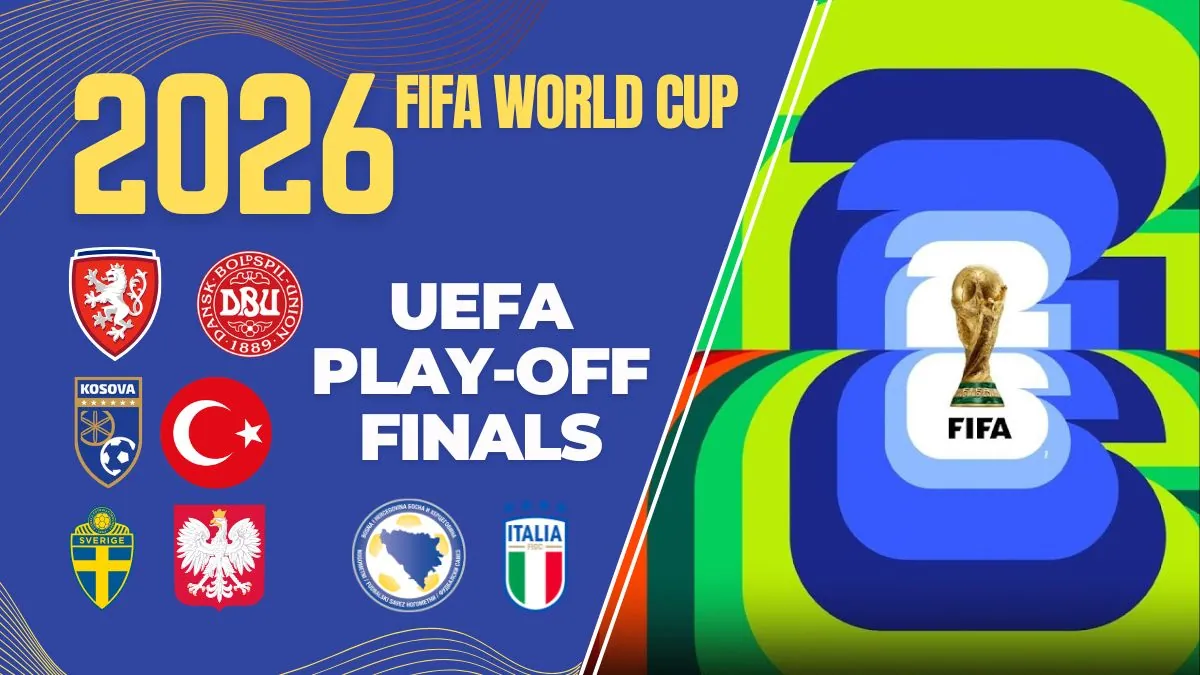
The road to the 2026 FIFA World Cup is down to its UEFA play-off finals sprint. After the UEFA Second Round semifinals qualification on Thursday, March 26, 2026, eight teams are still alive and only four World Cup tickets remain.
The winners of Bosnia and Herzegovina vs Italy, Sweden vs Poland, Kosovo vs Türkiye, and Czechia vs Denmark will book their place at the 2026 finals in the United States, Mexico, and Canada.
UEFA’s European play-offs are being played as single-leg ties, with 16 teams originally split into four paths and four final spots on the line.
This UEFA Play-Off Final is more than just a soccer match, as for the first time, FIFA has allotted 16 slots for UEFA qualification. In the first round of European qualification, 12 teams have already secured their spots, while the remaining 4 will qualify after the UEFA second Round qualifications.
Every European qualifier helps shape the final World Cup field, which means potential future group-stage opponents, more global star power, and more storylines heading into a tournament that will be played across North America from June 11 to July 19, 2026.
FIFA and UEFA both confirmed that UEFA has 16 World Cup places in total, while the play-offs decide the final four European berths.
How the 2026 FIFA World Cup UEFA play-offs work?

UEFA’s 2026 World Cup play-off format is simple but brutally intense. The 16 teams in the play-offs are made up of the 12 group runners-up from the European qualifiers and the four best-ranked Nations League group winners who did not finish first or second in their qualifying groups.
They were drawn into four paths, each with one semi-final and one final, all played in the same March 2026 international window. That means every team had to survive two one-off matches to secure a spot in the World Cup teams.
That format always creates drama. There is no safety net, no two-leg cushion, and no time to recover from one bad night. In a knockout setup like this, home advantage, bench depth, mental strength, and set-piece quality can matter just as much as reputation.
That is why some of Europe’s biggest names are still sweating, while a few underdogs are dreaming of the biggest upset of their recent history.
The semifinal results changed everything
The semifinals gave us a clear picture of who is in form and who is surviving by grit. Italy beat Northern Ireland 2-0, Sweden stunned Ukraine 3-1, Türkiye edged Romania 1-0, and Denmark produced the most convincing scoreline of the night with a 4-0 win over North Macedonia.
Bosnia and Herzegovina beat Wales on penalties after a 1-1 draw, Kosovo also advanced on penalties against Slovakia, and Czechia survived a shootout after a 2-2 battle with the Republic of Ireland.
Those results matter because they tell us not only who is still in the race, but also how each team is winning. Italy looked controlled and professional. Sweden showed firepower. Türkiye showed discipline. Denmark looked ruthless.
Bosnia and Herzegovina, Kosovo, and Czechia, meanwhile, showed the kind of resilience that can turn a playoff final into a coin-flip.
UEFA Play-Off Finals Preview and Prediction
The UEFA play-off finals are exactly the kind of March football that keeps fans glued to the screen. Four matches, four winners, and only four tickets left for the World Cup.
Based on the semifinal results and the shape of the finals, Italy, Sweden, Türkiye, and Denmark look like the best bets to go through. But if these semifinals taught us anything, it is that nothing in this stage comes easy.
One mistake can end a dream. One big night can create a World Cup story.
Path A: Bosnia and Herzegovina vs Italy

This is the classic “big name vs home momentum” final. Bosnia and Herzegovina get the match in Zenica, which gives them a real lift. Still, Italy arrive with the stronger pedigree and the sharper semifinal performance after a 2-0 win over Northern Ireland.
Bosnia needed penalties to get past Wales, which shows character, but also suggests they were pushed harder than Italy were.
My prediction here is Italy. The Azzurri know how to handle pressure in these exact types of games, and their semi-final performance suggested control rather than panic.
Bosnia will make it ugly and emotional, especially at home, but Italy are the safer pick to qualify. That is an opinion based on the results and the overall profile of the two teams, not a guarantee.
| Round | Date | Match | Score |
|---|---|---|---|
| Semi-final | 26 March 2026 | Wales vs Bosnia and Herzegovina | 1(2)–1(4) |
| Semi-final | 26 March 2026 | Italy vs Northern Ireland | 2–0 |
| Final | 31 March 2026 | Bosnia and Herzegovina vs Italy | – |
Path B: Sweden vs Poland

This may be the most entertaining of the four finals. Sweden beat Ukraine 3-1 and got a huge attacking boost from Viktor Gyökeres, who delivered a hat-trick in the semifinal round-up.
Poland, on the other hand, came through a 2-1 battle with Albania. The final is in Solna, which gives Sweden a major home advantage.
On balance, Sweden look slightly more convincing. They have form, confidence, and the advantage of playing in front of their own crowd.
Poland are always dangerous, especially with big-match experience, but Sweden’s semifinal performance felt more complete. If I had to choose one team, I would lean Sweden to win Path B and reach the World Cup.
| Round | Date | Match | Score |
|---|---|---|---|
| Semi-final | 26 March 2026 | Ukraine vs Sweden | 1–3 |
| Semi-final | 26 March 2026 | Poland vs Albania | 2–1 |
| Final | 31 March 2026 | Sweden vs Poland | – |
Path C: Kosovo vs Türkiye

This is the most unpredictable final on the board. Kosovo beat Slovakia on penalties, which tells you they are mentally tough and capable of surviving high-pressure moments.
Türkiye, however, were efficient in a narrow 1-0 semifinal win over Romania and have the stronger overall tournament résumé going into the final in Pristina.
Kosovo will believe they can shock Türkiye at home, and that belief is important in a one-off final. Still, Türkiye’s blend of defensive discipline and higher-level experience makes them the slight favorite in my view.
If they stay compact and avoid a slow start, Türkiye should have enough to get over the line.
| Round | Date | Match | Score |
|---|---|---|---|
| Semi-final | 26 March 2026 | Slovakia vs Kosovo | 3–4 |
| Semi-final | 26 March 2026 | Turkey vs Romania | 1–0 |
| Final | 31 March 2026 | Kosovo vs Turkey | – |
Path D: Czechia vs Denmark

This might be the most balanced matchup of all. Czechia needed penalties to get through Ireland after a 2-2 draw, while Denmark were the most dominant semifinal winner of the night with a 4-0 statement against North Macedonia.
The final in Prague gives Czechia home support, but Denmark’s semifinal performance was the strongest signal that any team sent on Thursday.
If I am picking one team to win Path D, I would go with Denmark. The clean sheet, the four-goal margin, and the overall authority of that semifinal win make them look the most “ready” of the four finalists.
Czechia can absolutely make this messy and drag Denmark into a tense night, but Denmark are the more convincing side right now. That is my prediction, not a certainty.
| Round | Date | Match | Score |
|---|---|---|---|
| Semi-final | 26 March 2026 | Czech Republic vs Republic of Ireland | 2–2 (4–3 p) |
| Semi-final | 26 March 2026 | Denmark vs North Macedonia | 4–0 |
| Final | 31 March 2026 | Czech Republic vs Denmark | – |
Who will win the UEFA play-off finals?
If I had to make the four calls today, I would pick Italy, Sweden, Türkiye, and Denmark to qualify for the 2026 FIFA World Cup. That would leave Bosnia and Herzegovina, Poland, Kosovo, and Czechia heartbreakingly close, but just short of North America.
The main reasons are simple: Italy’s experience, Sweden’s home edge, Türkiye’s control, and Denmark’s most impressive semifinal display.
Of course, playoff football is famous for ruining neat predictions. Bosnia and Herzegovina have the home crowd, Poland have enough pedigree to make Sweden nervous, Kosovo will not fear Türkiye in Pristina, and Czechia have already shown they can survive a shootout.
One set-piece, one red card, or one penalty miss can completely flip a path. That is exactly why these UEFA Play-Off Finals are so compelling.
| Path | Teams | Expert Prediction | Key Factor |
|---|---|---|---|
| A | Italy vs Bosnia | Italy | Desperation to avoid missing a third consecutive World Cup. |
| B | Sweden vs Poland | Sweden | Strong home advantage in Solna and current form. |
| C | Kosovo vs Turkey | Turkey | Superior individual quality, though Kosovo’s home fervor makes them dangerous. |
| D | Czech Republic vs Denmark | Denmark | Experience on the big stage despite the “fading force” narrative. |
Why U.S. Fans Should Care About These Playoffs
For fans in the United States, these UEFA Play-Off Finals are more than just late-night soccer games — they actually shape what the 2026 World Cup will feel like on home soil.
Think about it: the teams that qualify here could end up playing in cities like New York, Los Angeles, Dallas, or Miami. That means U.S. fans might get the chance to watch nations like Italy or Sweden live in packed stadiums, bringing that full European atmosphere right into American venues.
There’s also the excitement factor. Big European teams bring star players, huge fan bases, and intense rivalries. The more competitive these final qualifiers are, the better the overall World Cup experience will be for fans in North America.
And let’s be real — it’s also about storylines. Every World Cup has surprise teams, last-minute qualifiers, and underdog runs. These playoff finals are where those stories begin. Whether it’s a dramatic penalty shootout or a last-minute winner, these matches often create moments that fans remember long after the tournament ends.
So even if you’re following from the U.S., these games are worth watching — because they’re not just deciding who qualifies, they’re shaping the tournament you’ll soon experience in your own backyard.
Top Goals Goalscorers
| Rank | Player (Country) | Goals |
|---|---|---|
| 1 | Viktor Gyökeres (Sweden) | 3 |
| 2 | Gustav Isaksen (Denmark) | 2 |
| 3 | Arbër Hoxha (Albania) | 1 |
| Edin Džeko (Bosnia and Herzegovina) | ||
| Ladislav Krejčí (Czech Republic) | ||
| Patrik Schick (Czech Republic) | ||
| Mikkel Damsgaard (Denmark) | ||
| Christian Nørgaard (Denmark) | ||
| Moise Kean (Italy) | ||
| Sandro Tonali (Italy) | ||
| Fisnik Asllani (Kosovo) | ||
| Kreshnik Hajrizi (Kosovo) | ||
| Veldin Hodža (Kosovo) | ||
| Florent Muslija (Kosovo) | ||
| Robert Lewandowski (Poland) | ||
| Piotr Zieliński (Poland) | ||
| Troy Parrott (Republic of Ireland) | ||
| Lukáš Haraslín (Slovakia) | ||
| David Strelec (Slovakia) | ||
| Martin Valjent (Slovakia) | ||
| Ferdi Kadıoğlu (Turkey) | ||
| Matviy Ponomarenko (Ukraine) | ||
| Daniel James (Wales) | ||
| Matěj Kovář (Czech Republic) (Own Goal) |