

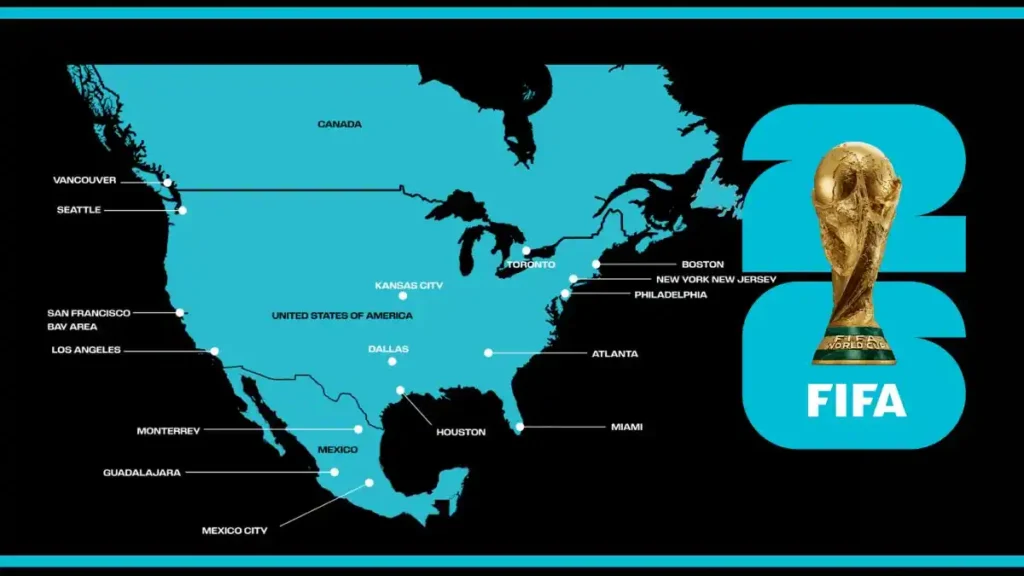
The 2026 FIFA World Cup is not just the biggest Soccer tournament in history — it is the most geographically ambitious. For the first time, three nations are jointly hosting the Men’s World Cup: the United States, Canada, and Mexico. Spread across a continent spanning over 4,500 kilometres from Vancouver to Miami, 16 world-class 2026 FIFA World Cup Venues will stage 104 matches between June 11 and July 19, 2026.
From the legendary Estadio Azteca, renowned as the only venue to host three World Cups, to the ultra-modern NFL stadiums like AT&T Stadium and MetLife Stadium, this list of venues is unlike anything the tournament has ever experienced.
If you plan to travel, watch from home, or simply want the complete picture before the opening whistle, this guide provides details on every 2026 FIFA World Cup venue.
2026 FIFA World Cup Venues at a Glance
| Stat | Detail |
|---|---|
| Total venues | 16 |
| Host countries | USA (11), Mexico (3), Canada (2) |
| Total matches | 104 |
| Opening match | June 11 — Estadio Azteca, Mexico City |
| Final | July 19 — MetLife Stadium, East Rutherford, NJ |
| Largest stadium | AT&T Stadium, Dallas (94,000) |
| Smallest stadium | BMO Field, Toronto (45,000) |
Here are the 16 official venues and host cities for the 2026 tournament:
🇲🇽 Mexico — 3 Venues
Mexico is the emotional heartbeat of this World Cup. As the nation that has hosted the tournament twice before (1970 and 1986), Mexico brings unmatched passion, altitude, and football history to the table. Its three stadiums will host 13 matches in total, including the iconic opening match.
1. Estadio Azteca — Mexico City
Capacity: ~87,500 | Key match: Opening match (June 11) | FIFA name: Mexico City Stadium
No stadium on earth carries more football history than the Estadio Azteca. Opened in 1966, this concrete colossus in the southern Coyoacán district of Mexico City has already hosted two complete World Cups — making it the only venue in history to do so.
In 1970, it witnessed Pelé’s Brazil produce the most beautiful football the tournament has ever seen. In 1986, it staged Maradona’s “Hand of God” and the “Goal of the Century” — two goals within four minutes that have never left the football conversation.
On June 11, 2026, Estadio Azteca becomes the first stadium in history to host a World Cup opening match for the third time, as Mexico take on South Africa in Group A.
The 2026 FIFA World Cup Venues have undergone significant renovations, including upgraded seating, new Wi-Fi infrastructure, a rebuilt players’ tunnel, and hybrid turf.
These improvements have increased the capacity to approximately 87,500 spectators. FIFA required these renovations to meet modern standards for comfort, broadcasting, and security.
One factor no renovation can change: altitude. Mexico City sits at 2,200 metres (7,218 feet) above sea level — thin air that favours the home side and punishes unprepared visitors. It is perhaps the most significant home advantage of any venue in this or any other tournament.
The Azteca will host five matches in total, including knockout-stage fixtures, running through July 5.
2. Estadio BBVA — Monterrey (Guadalupe)
Capacity: 53,500 | FIFA name: Monterrey Stadium
Nestled in the foothills of the Sierra Madre Oriental mountains, the Estadio BBVA is one of the most visually stunning football venues in the Americas. Home of Liga MX giants CF Monterrey, the stadium opened in 2015 and is regarded as one of the most modern and technologically advanced in North America.
Its dramatic mountain backdrop creates a matchday atmosphere that is genuinely unlike any other venue in this tournament. Monterrey previously hosted matches at the 1986 World Cup, and the city’s return to the global stage has been met with enormous enthusiasm.
The Estadio BBVA will host four group-stage matches and a knockout-round fixture, giving fans in northern Mexico a front-row seat for 2026’s biggest spectacle.
3. Estadio Akron — Guadalajara (Zapopan)
Capacity: 48,000 | FIFA name: Guadalajara Stadium
Guadalajara is Mexico’s second city and one of the country’s most football-mad. The Estadio Akron, opened in 2010 as the home of Club Deportivo Guadalajara — better known as Chivas — is a striking bowl-shaped arena that has grown into one of the most beloved club grounds in Mexico.
Like Monterrey, Guadalajara hosted matches at the 1986 World Cup and welcomes the tournament back 40 years later.
The stadium will stage four group-stage matches, including Mexico’s second game of the tournament, promising wall-to-wall atmosphere as the co-hosts look to progress past the group stage for the first time since 1994.
🇺🇸 United States — 11 Venues
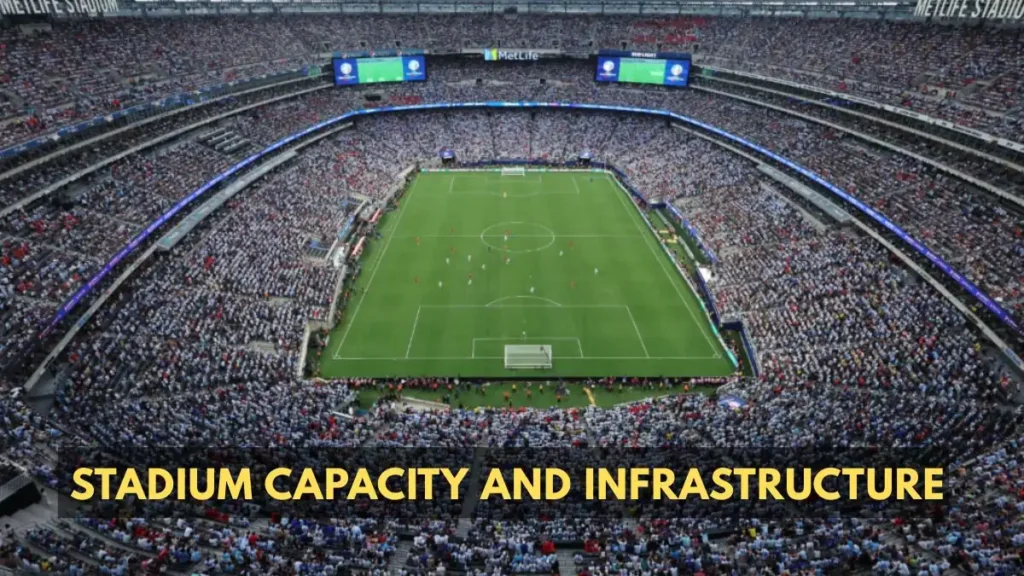
The USA is the main host nation and will stage the majority of the tournament, including all four semifinal and final fixtures. Eleven NFL stadiums — representing some of the most technologically advanced sports venues in the world — form the backbone of the 2026 World Cup.
4. MetLife Stadium — East Rutherford, New Jersey (New York)
Capacity: 82,500 | Key match: World Cup Final (July 19) | FIFA name: New York New Jersey Stadium
The stage for the greatest occasion in world football. MetLife Stadium in East Rutherford, New Jersey — home of both the NFL’s New York Giants and New York Jets — will host the 2026 FIFA World Cup Final on July 19. Opened in 2010. It is one of the largest 2026 FIFA World Cup Venues in the New York metropolitan area and one of the most famous sports arenas in the world.
New York/New Jersey is the epicentre of global attention every four years when the World Cup arrives, and hosting the final in North America’s largest media market ensures the 2026 tournament will reach an audience larger than any previous edition.
The stadium’s proximity to New York City means the surrounding streets, fan zones, and boroughs will be alive with football culture for the entire duration of the tournament.
5. AT&T Stadium — Arlington, Texas (Dallas)
Capacity: 94,000 | Key match: Semifinal (July 14) | FIFA name: Dallas Stadium
The largest stadium at the 2026 World Cup. Known colloquially as “The Death Star” by American sports fans, AT&T Stadium in Arlington is home to the NFL’s Dallas Cowboys and is a genuinely awe-inspiring venue. Its retractable roof, enormous video boards, and 94,000-seat capacity make it one of the most technically impressive sports venues on earth.
Dallas also has deep football heritage — the city hosted matches at the 1994 FIFA World Cup, and its huge Latino population means demand for tickets is extraordinary. The stadium hosts a semifinal on July 14, guaranteeing one of the biggest football occasions North America has ever seen.
6. Mercedes-Benz Stadium — Atlanta, Georgia
Capacity: 75,000 | Key match: Semifinal (July 15) | FIFA name: Atlanta Stadium
Home of the NFL’s Atlanta Falcons and MLS’s Atlanta United, Mercedes-Benz Stadium is widely considered the most architecturally stunning venue in American sport. Its retractable roof resembles the aperture of a camera lens and opens to the sky above — a design that has won global awards since the stadium opened in 2017.
The atmosphere inside for Atlanta United matches is already some of the most ferocious in American football. For a World Cup semifinal, it will be extraordinary.
7. SoFi Stadium — Inglewood, California (Los Angeles)
Capacity: 70,000 | Key match: US men’s national team group-stage opener | FIFA name: Los Angeles Stadium
Opened in 2020 and home to the NFL’s Los Angeles Rams and Los Angeles Chargers, SoFi Stadium is the most recently built venue in the tournament. Los Angeles is the world’s most diverse major city and arguably the most football-obsessed city in the United States — its Mexican, Central American, and South American communities ensure a passionate, multilingual crowd for every fixture.
The stadium will also serve as the centrepiece for the 2028 LA Olympics, making the 2026 World Cup a fitting dress rehearsal.
8. NRG Stadium — Houston, Texas
Capacity: 72,000 | FIFA name: Houston Stadium
Home of the NFL’s Houston Texans, NRG Stadium combines a retractable roof with a cavernous atmosphere and 72,000 seats.
Houston is one of the most ethnically diverse cities in the United States, with a vast Latin American community that makes it one of the most enthusiastic World Cup host cities on the entire schedule. Several group-stage matches will be played here, including fixtures featuring teams with large Houston fan bases.
9. Arrowhead Stadium — Kansas City, Missouri
Capacity: 73,000 | FIFA name: Kansas City Stadium
Home of the NFL’s Kansas City Chiefs, Arrowhead Stadium holds the Guinness World Record as the loudest stadium on earth. A reading of 142.2 decibels was recorded during a Chiefs game — a noise level that approaches the threshold of pain.
For a World Cup knockout match, the atmosphere inside Arrowhead will be genuinely unforgettable. Kansas City also hosts MLS sides Sporting KC and KC Current, underscoring a football culture that runs far deeper than the NFL alone.
10. Gillette Stadium — Foxborough, Massachusetts (Boston)
Capacity: 65,000 | Key match: Quarterfinal | FIFA name: Boston Stadium
Home of the NFL’s New England Patriots and MLS’s New England Revolution, Gillette Stadium has undergone significant renovation ahead of the World Cup. Boston is a city with a rich sporting history and a passionate, educated football fanbase.
The stadium hosts seven matches in total, including a quarterfinal — placing it among the most-used venues of the entire tournament.
11. Levi’s Stadium — Santa Clara, California (San Francisco Bay Area)
Capacity: 71,000 | FIFA name: San Francisco Bay Area Stadium
Home of the NFL’s San Francisco 49ers, Levi’s Stadium sits in the heart of Silicon Valley in Santa Clara. The Bay Area’s enormous South American and Mexican communities guarantee electric atmospheres for every fixture, and the region’s wealth and global connectivity make it one of the most commercially significant host cities of the tournament. The stadium hosts group-stage matches and knockout fixtures across its allocation.
12. Lumen Field — Seattle, Washington
Capacity: 69,000 | Key match: US men’s national team fixture and knockout games | FIFA name: Seattle Stadium
Home of the NFL’s Seattle Seahawks and MLS’s Seattle Sounders — one of the most successful and best-supported clubs in American football history — Lumen Field brings genuine football pedigree to the 2026 tournament.
Seattle’s Sounders regularly sell out 40,000-seat crowds in MLS, and the city’s football culture is arguably the deepest of any US host city. The stadium will host four group-stage matches and two knockout-stage games.
13. Lincoln Financial Field — Philadelphia, Pennsylvania
Capacity: 69,176 | FIFA name: Philadelphia Stadium
Home of the NFL’s Philadelphia Eagles, “The Linc” is renowned for one of the most intense and passionate atmospheres in American sport. Philadelphia previously hosted matches at the 1994 World Cup and welcomes the tournament back 32 years later.
The city’s large immigrant communities — Italian, Irish, Mexican, and many more — create a diverse, deeply engaged fanbase for every World Cup fixture.
14. Hard Rock Stadium — Miami Gardens, Florida (Miami)
Capacity: 65,000 | Key match: Third-place match | FIFA name: Miami Stadium
Home of the NFL’s Miami Dolphins, Hard Rock Stadium has also hosted Formula 1’s Miami Grand Prix and the Miami Open tennis tournament.
Miami is one of the most Latin-influenced cities in the United States, with enormous Cuban, Colombian, Venezuelan, and Brazilian communities that make it one of the most naturally football-passionate host cities of the entire tournament.
It hosts the third-place match, guaranteeing a last major occasion before the final weekend.
🇨🇦 Canada — 2 Venues

Canada makes its World Cup hosting debut in 2026, having qualified automatically as a co-host nation. Its two venues — in Vancouver and Toronto — represent the country’s two largest cities and its biggest football markets.
15. BC Place — Vancouver, British Columbia
Capacity: 54,000 | FIFA name: Vancouver Stadium
Home of the MLS’s Vancouver Whitecaps and the BC Lions of the Canadian Football League, BC Place is Canada’s largest covered stadium and one of the most iconic sports venues in the country.
It served as the centrepiece of the 2010 Winter Olympics in Vancouver and carries that Olympic legacy into its World Cup role. The stadium’s retractable roof ensures matches proceed regardless of the Pacific Northwest weather, and Vancouver’s cosmopolitan, football-literate population will make it a vibrant host city.
16. BMO Field — Toronto, Ontario
Capacity: 45,000 | FIFA name: Toronto Stadium
BMO Field in Toronto, one of the smallest 2026 FIFA World Cup Venues, is home to MLS’s Toronto FC and the CFL’s Toronto Argonauts. While its capacity may be modest, the atmosphere is electric, fueled by one of the most passionate fanbases in MLS.
Toronto itself is one of the most multicultural cities in the world, with football communities from nearly every nation represented across its vibrant boroughs.
The intimate scale of the ground compared to the NFL colosseums elsewhere in the tournament will give matches here a unique, cauldron-like feel.
Three Regions, One Tournament
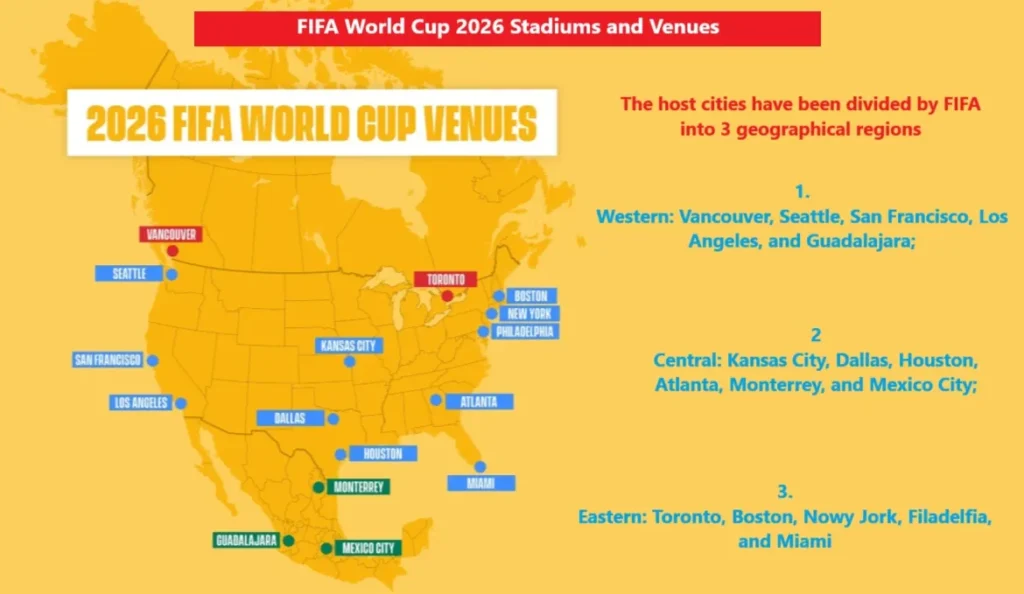
To minimise the travel burden on players and fans across a continent spanning three countries, FIFA divided the 16 venues into three geographic regions:
- Western Region: Vancouver, Seattle, San Francisco Bay Area, Los Angeles
- Central Region: Dallas, Kansas City, Houston, Mexico City, Guadalajara, Monterrey
- Eastern Region: New York/New Jersey, Boston, Philadelphia, Miami, Atlanta, Toronto
Teams play their group-stage matches within a single region, reducing transcontinental travel and allowing supporters to plan manageable trips across multiple fixtures.
The Most Spectacular Venue List in World Cup History
| FIFA Official Stadium Name | Host City & Region | Seating Capacity | Total Matches |
|---|---|---|---|
| Dallas Stadium (AT&T Stadium) | Arlington, Texas, USA | 94,000 | 9 Matches (Most of any venue) |
| Mexico City Stadium (Estadio Azteca) | Mexico City, Mexico | 83,000 | 5 Matches (Inc. Opening Match) |
| New York New Jersey Stadium (MetLife Stadium) | East Rutherford, New Jersey, USA | 82,500 | 8 Matches (Inc. The Final) |
| Atlanta Stadium (Mercedes-Benz Stadium) | Atlanta, Georgia, USA | 75,000 | 8 Matches (Inc. a Semifinal) |
| Kansas City Stadium (Arrowhead Stadium) | Kansas City, Missouri, USA | 73,000 | 6 Matches |
| Houston Stadium (NRG Stadium) | Houston, Texas, USA | 72,000 | 7 Matches |
| San Francisco Bay Area Stadium (Levi’s Stadium) | Santa Clara, California, USA | 71,000 | 6 Matches |
| Los Angeles Stadium (SoFi Stadium) | Inglewood, California, USA | 70,000 | 8 Matches (Inc. USMNT opener) |
| Philadelphia Stadium (Lincoln Financial Field) | Philadelphia, Pennsylvania, USA | 69,000 | 6 Matches |
| Seattle Stadium (Lumen Field) | Seattle, Washington, USA | 69,000 | 6 Matches |
| Boston Stadium (Gillette Stadium) | Foxborough, Massachusetts, USA | 65,000 | 7 Matches |
| Miami Stadium (Hard Rock Stadium) | Miami Gardens, Florida, USA | 65,000 | 7 Matches (Inc. 3rd Place Play-off) |
| BC Place Vancouver | Vancouver, British Columbia, Canada | 54,000 | 7 Matches |
| Estadio Monterrey (Estadio BBVA) | Guadalupe, Nuevo León, Mexico | 53,500 | 4 Matches |
| Estadio Guadalajara (Estadio Akron) | Zapopan, Jalisco, Mexico | 48,000 | 4 Matches |
| Toronto Stadium (BMO Field) | Toronto, Ontario, Canada | 45,000 | 6 Matches (Smallest venue) |
Key facts about the 2026 FIFA World Cup venues, organized by stadium

| Stadium | City | Key fact |
|---|---|---|
| Estadio Azteca | Mexico City | Will host the tournament opener on 11 June 2026 and becomes the first stadium to host World Cup matches in three editions. It is also set for five matches in total. |
| Estadio Akron | Guadalajara | Will host four matches, all in the group stage, including Mexico’s second game. It is the only 2026 venue not scheduled for a knockout match. |
| Estadio BBVA | Monterrey | Will host four matches: three group-stage games and one Round of 32 tie. |
| BMO Field | Toronto | Will host Canada’s opening match on 12 June 2026 and six matches overall, with a temporary capacity increase to about 45,736. |
| BC Place | Vancouver | Will host seven matches, including five group games and two knockout matches. Canada’s home group matches are scheduled there on 18 and 24 June. |
| SoFi Stadium | Los Angeles / Inglewood | Will host eight matches, including the U.S. opener on 12 June 2026. FIFA will temporarily rename it “Los Angeles Stadium” during the tournament. |
| Levi’s Stadium | San Francisco Bay Area / Santa Clara | Will host six matches: five group-stage games and one Round of 32 fixture, and will be renamed “San Francisco Bay Area Stadium” for FIFA. |
| Lumen Field | Seattle | Will host six matches in total: four group-stage games and two knockout matches. |
| AT&T Stadium | Dallas / Arlington | Will host nine matches, the most of any venue, including five group games, two Round of 32 matches, one Round of 16 match and one semifinal. FIFA will call it “Dallas Stadium.” |
| NRG Stadium | Houston | Will host seven matches, including five group games, one Round of 32 tie and one Round of 16 match. FIFA will use the name “Houston Stadium.” |
| Arrowhead Stadium | Kansas City | Will host six matches, including four group-stage games, one Round of 32 match and one quarterfinal. The venue is also due for renovations. |
| Mercedes-Benz Stadium | Atlanta | Will host eight matches, including five group games, one Round of 32 match, one Round of 16 match and one semifinal. FIFA will rename it “Atlanta Stadium.” |
| Hard Rock Stadium | Miami | Will host seven matches, including four group-stage games, one Round of 32 match, one quarterfinal and the third-place playoff. FIFA will call it “Miami Stadium.” |
| Gillette Stadium | Boston / Foxborough | Will host seven matches, including five group-stage games, one Round of 32 match and one quarterfinal. FIFA will rename it “Boston Stadium.” |
| Lincoln Financial Field | Philadelphia | Will host six matches, including five group-stage games and one Round of 16 match on 4 July 2026. FIFA will call it “Philadelphia Stadium.* |
| MetLife Stadium | New York / New Jersey | Will host the 2026 FIFA World Cup final on 19 July 2026 and will be known as “New York New Jersey Stadium* |
No World Cup has ever featured a lineup of venues with such scale, variety, and prestige. From the historic charm of Estadio Azteca, football’s oldest and most iconic stage, to the sleek modern designs of SoFi Stadium and Mercedes-Benz Stadium, from the thunderous energy of Arrowhead to the grand finale vibe of MetLife, the 2026 tournament is set to deliver an unforgettable feast for the senses.
Whether you are travelling to North America or watching from home, every venue on this list has a story worth knowing. The World Cup arrives on June 11. Make sure you know your stadiums.
FIFA World Cup 2026 round of 32 venues
United States Venues
| Venue & Location | Official Stadium Name | Round of 32 Match | Date (2026) |
|---|---|---|---|
| Los Angeles, CA | SoFi Stadium | South Africa vs Canada Spain vs Austria | June 28 July 2 |
| Dallas, TX | AT&T Stadium | Ivory Coast vs Norway Australia vs Egypt | June 30 July 3 |
| Houston, TX | NRG Stadium | Brazil vs Japan | June 29 |
| Boston, MA | Gillette Stadium | Germany vs Paraguay | June 29 |
| New York / New Jersey | MetLife Stadium | France vs Sweden | June 30 |
| Atlanta, GA | Mercedes-Benz Stadium | England vs DR Congo | July 1 |
| Seattle, WA | Lumen Field | Belgium vs Senegal | July 1 |
| San Francisco Bay Area, CA | Levi’s Stadium | USA vs Bosnia and Herzegovina | July 1 |
| Miami, FL | Hard Rock Stadium | Argentina vs Cape Verde | July 3 |
| Kansas City, MO | Arrowhead Stadium | Colombia vs Ghana | July 3 |
Mexico Venues
| Venue & Location | Official Stadium Name | Round of 32 Match | Date (2026) |
|---|---|---|---|
| Monterrey | Estadio BBVA (Estadio Monterrey) | Netherlands vs Morocco | June 29 |
| Mexico City | Estadio Azteca (Mexico City Stadium) | Mexico vs Ecuador | June 30 |
Canada Venues
| Venue & Location | Official Stadium Name | Round of 32 Match | Date (2026) |
|---|---|---|---|
| Toronto | BMO Field (Toronto Stadium) | Portugal vs Croatia | July 2 |
| Vancouver | BC Place (Vancouver Stadium) | Switzerland vs Algeria | July 2 |
FIFA World Cup 2026 round of 16 venues
United States Venues
| Venue & Location | Official Stadium Name | Round of 16 Match | Date (2026) |
| Philadelphia, PA | Lincoln Financial Field | Paraguay vs France | July 4 |
| Houston, TX | NRG Stadium | Canada vs Morocco | July 4 |
| New York / New Jersey | MetLife Stadium | Brazil vs Norway | July 5 |
| Dallas, TX | AT&T Stadium | Portugal vs Spain | July 6 |
| Seattle, WA | Lumen Field | United States vs Belgium | July 6 |
| Atlanta, GA | Mercedes-Benz Stadium | Argentina vs Egypt | July 7 |
Mexico Venues
| Venue & Location | Official Stadium Name | Round of 16 Match | Date (2026) |
| Mexico City | Estadio Azteca (Mexico City Stadium) | Mexico vs England | July 5 |
Canada Venues
| Venue & Location | Official Stadium Name | Round of 16 Match | Date (2026) |
| Vancouver | BC Place (Vancouver Stadium) | Switzerland vs Colombia | July 7 |
FIFA World Cup 2026 Quarterfinals venues
United States Venues
| Venue & Location | Official Stadium Name | Quarterfinal Match | Date (2026) |
| Boston, MA | Gillette Stadium | France vs Morocco | July 9 |
| Los Angeles, CA | SoFi Stadium | Spain vs Belgium | July 10 |
| Miami, FL | Hard Rock Stadium | Norway vs England | July 11 |
| Kansas City, MO | Arrowhead Stadium | Argentina vs Switzerland | July 11 |
FIFA World Cup 2026 Semifinals venues
| Venue & Location | Official Stadium Name | Semifinal Match | Date (2026) |
| Dallas, TX | AT&T Stadium | France vs Spain | July 14 |
| Atlanta, GA | Mercedes-Benz Stadium | England vs Argentina | July 15 |
FIFA World Cup 2026 Third-Place Match
| Match | Venue & Location | Official Stadium Name | Date (2026) |
| France vs England | Miami, FL | Hard Rock Stadium | July 18 |
FIFA World Cup 2026 Final
| Match | Venue & Location | Official Stadium Name | Date (2026) |
| Spain vs Argentina | New York / New Jersey | MetLife Stadium | July 19 |
What is the 2026 World Cup final stadium ticket?
Official FIFA ticket prices for the final can go as high as $32,970, while entry-level and resale prices range from around $8,000 to well over $2.3 million on secondary market seats.
Where is the 2026 World Cup final stadium located?
The final stadium is in East Rutherford, New Jersey, just outside New York City.
What is the 2026 World Cup final stadium capacity?
MetLife Stadium has a listed capacity of 82,500 seats.
Which stadium will host the 2026 World Cup semi-final?
The semifinals are set for AT&T Stadium in Arlington, Texas and Mercedes-Benz Stadium in Atlanta, Georgia. FIFA will use the names Dallas Stadium and Atlanta Stadium during the tournament.
How much are 2026 World Cup final tickets?
FIFA’s published ticket range for the tournament started at about $60 for group-stage matches and went up to about $6,730 for the final, with dynamic pricing also used on some tickets.
How can I buy 2026 World Cup final tickets?
Tickets are sold through FIFA’s official ticketing phases, and FIFA has also been expected to use an official resale platform. The final is one of the most expensive and hardest tickets to get.
What are the 2026 World Cup stadiums?
The tournament will be played across 16 stadiums in the United States, Canada and Mexico.
Where is the next World Cup 2026?
The next FIFA World Cup will be hosted by the United States, Canada and Mexico from June 11 to July 19, 2026.