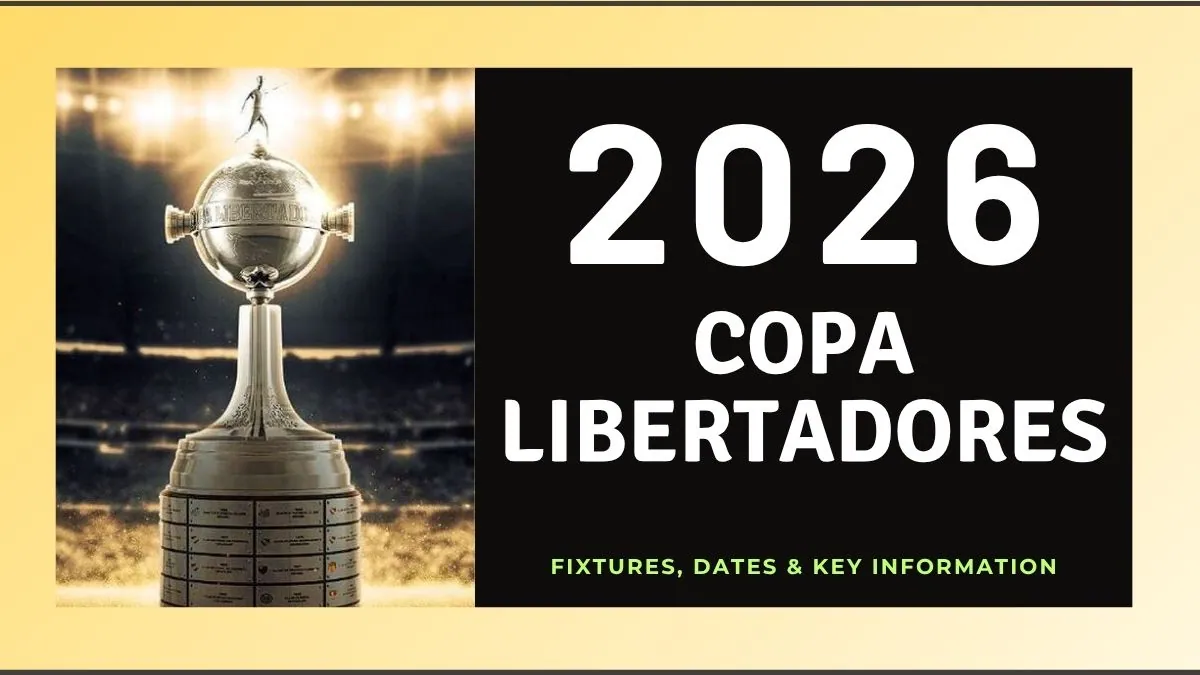
The 2026 Copa Libertadores is the 67th edition of South America’s biggest club competition, running from 3 February to 28 November 2026, with the final in Montevideo, Uruguay. It features 47 clubs from all 10 CONMEBOL countries, fighting not just for continental glory but also spots in the Recopa Sudamericana, FIFA Intercontinental Cup and the 2029 FIFA Club World Cup.
The group stage for the 2026 edition features 32 teams divided into 8 groups. The defending champions, Flamengo, headline Group A. As of April 6, 2026, the group stage is set to kick off, with all teams starting on an even level on points.
2026 Copa Libertadores: Key Phases & Schedule
- Preliminary Rounds: February 3 – March 19, 2026 (Elimination rounds for lower-ranked teams).
- Group Stage Draw: March 23, 2026.
- Group Stage Matches: April 7 – May 28, 2026 (The main 32-team battle).
- World Cup Break: June – July 2026 (Tournament pauses for the FIFA World Cup).
- Knockout Stages: Starts August 2026 (Round of 16, Quarter-finals, and Semi-finals).
- The Grand Final: November 28, 2026 (Single match in Montevideo).
Tournament overview
The 2026 Copa CONMEBOL Libertadores (commonly Copa Libertadores) is South America’s premier club tournament, and the 2026 edition is the 10th season since the competition was expanded from 38 to 47 teams and stretched across almost the entire calendar year.
The competition began on 3 February 2026 with the qualifying stages and will end with a single‑match final on 28 November 2026 in Montevideo, maintaining CONMEBOL’s recent tradition of a one‑off final at a neutral venue.
Number of teams and country slots
A total of 47 clubs from the 10 CONMEBOL member associations are participating in the 2026 Copa Libertadores edition. The slots are distributed as follows:
- Brazil: 7 league berths, effectively 8 representatives including the defending Libertadores champions.
- Argentina: 6 league berths, effectively 7 representatives including the defending Copa Sudamericana champions.
- Other 8 nations (Uruguay, Colombia, Paraguay, Chile, Ecuador, Peru, Bolivia, Venezuela): 4 clubs each.
Two extra automatic places go to:
- The 2025 Copa Libertadores champions (Flamengo, Brazil).
- The 2025 Copa Sudamericana champions (Lanús, Argentina).
This structure ensures Brazil and Argentina, who have dominated the competition in the expanded era, have the largest contingents: Brazilian sides have won 8 of the last 9 titles, including the last seven in a row, while an Argentine club won the remaining one.
Competition format
The 2026 Copa Libertadores format follows the now-standard structure introduced after 2017:
- Qualifying stages (Pré‑Libertadores)
- Played from 3 February to 12 March 2026.
- 19 teams compete in three rounds to produce 4 qualifiers for the group stage.
- First stage: 3 ties (6 teams).
- Second stage: 8 ties (16 teams, including first‑stage winners).
- Third stage: 4 ties; the 4 winners advance to the groups.
- Seeding is based on the CONMEBOL club ranking (Dec 2025), which factors in performance over the last 10 years, historical results, and recent domestic titles.
- Group stage
- Knockout rounds
- Round of 16, quarter‑finals, semi‑finals: two‑legged ties, home and away.
- Final: single match at a neutral venue – Estadio in Montevideo, Uruguay, on 28 November 2026.
Calendar and key dates (2026)

According to CONMEBOL’s official calendar and competition regulations:
- Qualifying stages
- Group stage (Matchdays 1–6)
- Matchday 1: 7–9 April 2026
- Matchday 2: 14–16 April
- Matchday 3: 28–30 April
- Matchday 4: 5–7 May
- Matchday 5: 19–21 May
- Matchday 6: 26–28 May
- Knockout phase
There is a pause between the group phase and knockout rounds to accommodate the 2026 FIFA World Cup in June–July, with CONMEBOL resuming the competition in August.
Groups
| Group A | Group B | Group C | Group D |
|---|---|---|---|
| 🇧🇷 Flamengo | 🇺🇾 Nacional | 🇧🇷 Fluminense | 🇦🇷 Boca Juniors |
| 🇦🇷 Estudiantes LP | 🇵🇪 Universitario | 🇧🇴 Bolívar | 🇧🇷 Cruzeiro |
| 🇵🇪 Cusco FC | 🇨🇱 Coquimbo Unido | 🇻🇪 Dep. La Guaira | 🇨🇱 U. Católica |
| 🇨🇴 Ind. Medellín | 🇨🇴 Deportes Tolima | 🇦🇷 Ind. Rivadavia | 🇪🇨 Barcelona SC |
| Group E | Group F | Group G | Group H |
|---|---|---|---|
| 🇺🇾 Peñarol | 🇧🇷 Palmeiras | 🇪🇨 LDU Quito | 🇪🇨 Ind. del Valle |
| 🇧🇷 Corinthians | 🇵🇾 Cerro Porteño | 🇦🇷 Lanús | 🇵🇾 Libertad |
| 🇨🇴 Santa Fe | 🇨🇴 Junior FC | 🇧🇴 Always Ready | 🇦🇷 Rosario Central |
| 🇦🇷 Platense | 🇵🇪 Sporting Cristal | 🇧🇷 Mirassol | 🇻🇪 Univ. Central |
How the group stage draw works
The group stage draw was held at CONMEBOL headquarters in Luque, Paraguay, on 19 March 2026, in a joint event that also drew the Copa Sudamericana groups.
Key points:
- 32 teams are divided into 4 pots of 8, based mainly on the CONMEBOL club ranking updated on 15 December 2025, plus automatic seeding for the defending champions.
- One team from each pot is drawn into each of the 8 groups (Groups A–H).
- Clubs from the same association cannot be in the same group, except when one arrived via the qualifying stages; this rule avoids domestic clashes early on.
- Brazilian giants like Flamengo and Palmeiras, along with Boca Juniors, Peñarol and Independiente del Valle, headline Pot 1, with strong clubs from Brazil, Argentina and the rest of the continent spread across Pots 2–4.
The draw event was streamed by CONMEBOL through partners such as ESPN, Disney and ge, reinforcing the competition’s broad media reach.
New regulations and tiebreak rules
For 2026, CONMEBOL has adjusted the group‑stage tiebreak criteria, placing head‑to‑head results as the first tiebreaker ahead of goal difference, aligning Libertadores more closely with UEFA‑style formats.
In practice, if two teams finish level on points:
- Points in matches between the tied teams (head‑to‑head).
- Then goal difference and goals scored if still level.
This change raises the stakes for direct clashes between contenders in the groups, giving “six‑point games” even more importance.
What the winner gets
Lifting the 2026 Copa Libertadores trophy unlocks several major rewards:
- A place in the 2027 Recopa Sudamericana, against the 2026 Copa Sudamericana winners.
- Automatic qualification for the 2026 FIFA Intercontinental Cup, FIFA’s single‑game global club title.
- A guaranteed spot in the 2029 FIFA Club World Cup, the expanded global club tournament.
- Automatic entry into the 2027 Copa Libertadores group stage as defending champions.
Given Brazil and Argentina’s recent dominance and the tournament’s length, managing squads across domestic leagues, Libertadores and national team windows has become a huge strategic challenge for coaches.
Who’s playing – big names and newcomers
By early April 2026, CONMEBOL and various media outlets confirmed that all 32 group‑stage teams were set, with Brazil and Argentina again heavily represented and a cluster of clubs from other nations trying to break the duopoly.
Key trends:
- Brazil sends a deep pack including Flamengo, Palmeiras, Cruzeiro, Corinthians and others, all capable of going deep.
- Argentina’s contingent includes Boca Juniors, Lanús (reigning Sudamericana champions), Rosario Central, Platense and Independiente Rivadavia, among others.
- Traditional powers like Nacional and Peñarol (Uruguay), Cerro Porteño and Libertad (Paraguay), Universitario and Sporting Cristal (Peru), Independiente del Valle and Barcelona SC (Ecuador) are also present, along with Venezuelan clubs such as La Guaira and Universidad Central.
- Several clubs are making their Libertadores debut, underlining the increased access the expanded format provides.
You can think of 2026 as another chapter in a long‑running battle: can anyone outside Brazil and Argentina finally break the title streak, or will the trophy stay in the two dominant leagues yet again?
Players to Watch: Stars, Wonderkids & Icons

The 2026 Copa Libertadores edition features a mix of returning European stars, South America’s most expensive talent, and the next generation of wonderkids. Here are the names you need to know:
The Superstars:
- Vitor Roque (Palmeiras)
- Lucas Paquetá (Flamengo)
- Memphis Depay (Corinthians)
Rising Talents (The Next Big Things)
- Breno Bidon (Corinthians)
- Matías Satas (Boca Juniors)
- Halam Loboa (Independiente Medellín)
How to follow the 2026 Copa Libertadores
The full 2026 Copa Libertadores fixtures list – including kickoff times, venues and TV details – is available via major global broadcasters and data sites such as ESPN’s Libertadores page and Flashscore.
How to Watch & Stream
Matches are carried across South America and internationally through CONMEBOL’s partners (including ESPN/Star+ and regional networks), with streaming of key events like the draw available on official platforms.
| Region | TV Channels | Streaming Platforms |
|---|---|---|
| United States | beIN SPORTS, beIN SPORTS en Español | beIN SPORTS CONNECT, Fubo, Fanatiz, Sling TV, YouTube TV |
| Canada | beIN SPORTS | Fubo, beIN SPORTS CONNECT |
| Brazil | TV Globo (Free-to-Air), ESPN | Disney+, Paramount+, Globoplay, Canal Goat (YouTube) |
| South America (Excl. Brazil) | Paramount (FTA), ESPN | Disney+, Paramount+, Star+, DirecTV GO |
| Mexico & Central America | ESPN | Disney+ |
| Australia & New Zealand | beIN SPORTS | beIN SPORTS CONNECT, Amazon Prime Video Channels |
| United Kingdom | BBC (Final only) | BBC iPlayer (Final only), Triller TV |
| Middle East & North Africa | beIN SPORTS | beIN CONNECT |
| Spain | Movistar+ | Movistar Plus+ |
Official Digital Tools
- Official App: Download the CONMEBOL Libertadores app on Google Play or the Apple App Store for real-time scores, exclusive videos, and breaking news.
- Social Media: Follow official accounts for live updates and highlights:
- X (formerly Twitter): @TheLibertadores
- Instagram: @libertadores
- Facebook: CONMEBOL Libertadores
All of the core facts above – dates, format, venues, distribution of teams and what’s at stake – are now locked in for the 2026 edition.