
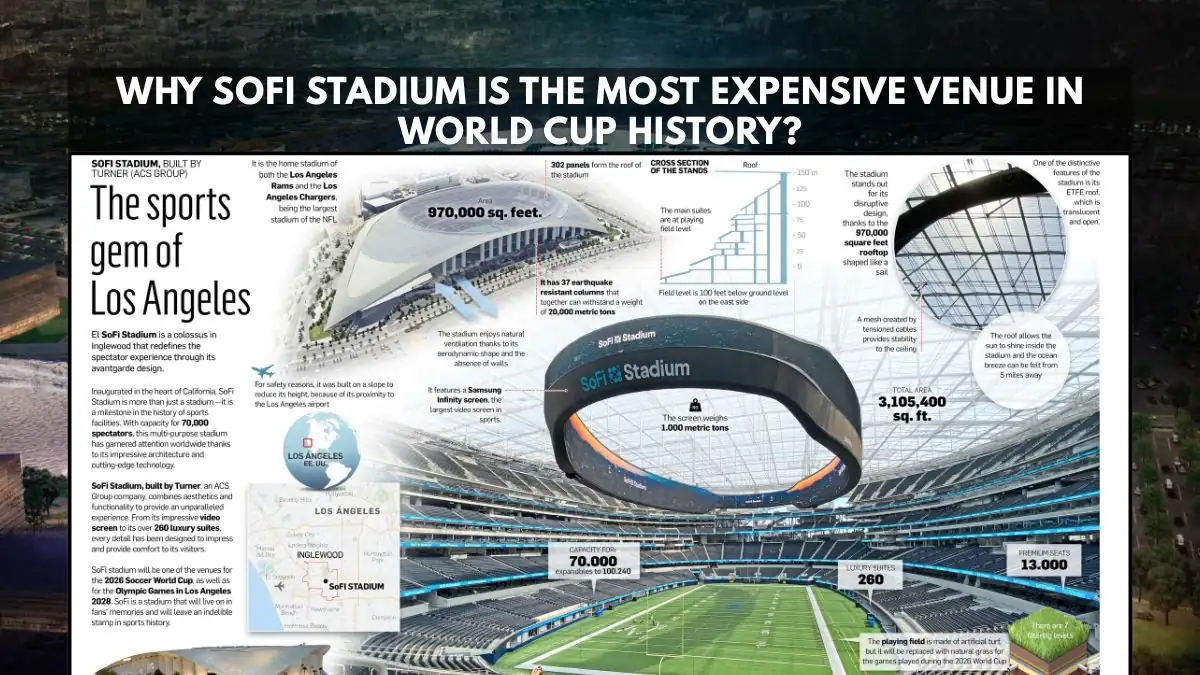
When the FIFA World Cup 2026 kicks off in Los Angeles, all eyes will be on SoFi Stadium. While every host city offers something unique, SoFi Stadium stands in a league of its own—not just because of its futuristic design, but because of its staggering $5.5 billion construction cost.
This makes it the most expensive stadium ever built and the most high-value venue in the history of the World Cup.
But what exactly does five billion dollars buy? From groundbreaking seismic engineering to a digital infrastructure that rivals Silicon Valley, here is why SoFi Stadium is a record-breaking marvel.
The FIFA World Cup is synonymous with massive crowds and historic atmosphere. Throughout the tournament’s history, we have seen legendary attendance records, such as the famous 1950 final at the Maracanã. As we look toward 2026, the focus shifts to Southern California.
Having already earned the title of the most expensive venue in World Cup history, SoFi Stadium is now positioned to potentially break modern-day attendance benchmarks. While its standard seating is impressive, the stadium’s architectural flexibility allows it to expand for marquee events.
Hosting the U.S. Men’s National Team’s opening match, SoFi is set to witness one of the largest and most enthusiastic soccer crowds ever recorded on North American soil.
Modifying SoFi Stadium for FIFA World Cup Soccer Standards

A Feat of Seismic Engineering
Located in Inglewood, California, SoFi Stadium sits in a region known for seismic activity. Building a massive structure that can hold 70,000+ fans in an earthquake zone is an expensive endeavor. Unlike traditional stadiums that are built into the ground, SoFi Stadium is essentially a giant ship floating in a pit.
The stadium is built 100 feet below ground level to comply with flight path restrictions from nearby LAX airport. To protect it from earthquakes, engineers utilized a “seismic isolation” system.
This allows the roof and the seating bowl to move independently of the surrounding ground. The cost of excavating millions of tons of dirt and installing these advanced shock absorbers added hundreds of millions to the final price tag.
The Iconic “Sail” Roof
The stadium’s roof is a masterpiece of modern architecture. It is a translucent canopy that covers not just the stadium, but also the adjacent YouTube Theater and the American Airlines Plaza.
- Size: The roof covers nearly 1 million square feet.
- Material: It is made of ETFE, a lightweight, transparent plastic that allows natural light in while protecting fans from the elements.
- Independence: The roof is a completely independent structure from the stadium bowl, supported by massive columns that are designed to withstand heavy wind and seismic shifts.
The Infinity Screen by Samsung
If there is one feature that defines the SoFi experience, it is the Infinity Screen. This double-sided, 4K LED video board is the largest of its kind in professional sports.
- Scale: It is 120 yards long—longer than the actual football pitch.
- Resolution: It features 80 million pixels, ensuring that every fan, regardless of where they sit, has a perfect view of the action.
- Weight: Hanging a 2.2-million-pound screen from the roof required additional structural reinforcement, contributing significantly to the stadium’s budget.
For World Cup fans, this screen will provide unparalleled match statistics, replays, and immersive graphics that will make even the most distant seat feel like the front row.
Hollywood Park: A City Within a City
SoFi Stadium is not an isolated building; it is the centerpiece of Hollywood Park, a 298-acre mixed-use development. The budget for the stadium was inextricably linked to the creation of this massive entertainment district, which includes:
- Luxury retail spaces and high-end restaurants.
- The 6,000-seat YouTube Theater.
- Extensive parklands and a man-made lake.
This “entertainment destination” model is what FIFA looks for in modern host cities, as it provides a self-contained ecosystem for international tourists and VIPs.
Modifying for FIFA: The Grass Challenge
Perhaps the most surprising cost factor for the 2026 World Cup is the modification of the stadium itself. SoFi Stadium was primarily designed for American Football (NFL), which requires a narrower field than FIFA-standard soccer.
To host World Cup matches, the stadium has had to undergo temporary renovations to widen the field level. This involves removing some of the high-value “field-level suites”—some of the most expensive real estate in the stadium—to make room for the larger soccer pitch and the necessary “run-off” space for players.
Additionally, like many other US venues, SoFi must transition from its standard synthetic turf to a high-tech natural grass pitch specifically for the tournament.
The Luxury Factor: High CPC Revenue Opportunities
For website owners and advertisers, SoFi Stadium represents the peak of luxury sports travel. The venue features more luxury suites and premium seating options than any other World Cup stadium. This attracts a high-spending demographic looking for:
- Private Jets to LAX: High-net-worth individuals traveling for the tournament.
- Luxury Hotels in Santa Monica and Beverly Hills: Fans looking for a premium stay.
- VIP Hospitality Packages: Buyers willing to pay five figures for a single match experience.
Frequently Asked Questions: SoFi Stadium World Cup 2026

Is SoFi Stadium the host of the 2026 World Cup Final?
No, the 2026 World Cup Final will be held at MetLife Stadium in New Jersey. However, SoFi Stadium will host the highly prestigious opening match for the U.S. National Team.
How many fans can SoFi Stadium hold for the World Cup?
While its standard capacity is roughly 70,000, it can be expanded to over 100,000 for major events. For the World Cup, the capacity is expected to be around 70,000 after modifications for the larger pitch.
Is SoFi Stadium near public transportation
While LA is famously a car-city, the “Park & GO” shuttle services and the Metro K Line provide access to the Inglewood area. Fans are encouraged to book transport well in advance.
Can I visit SoFi Stadium before the World Cup?
Yes, the stadium offers daily tours that allow fans to see the locker rooms, the Infinity Screen, and even go onto the field.