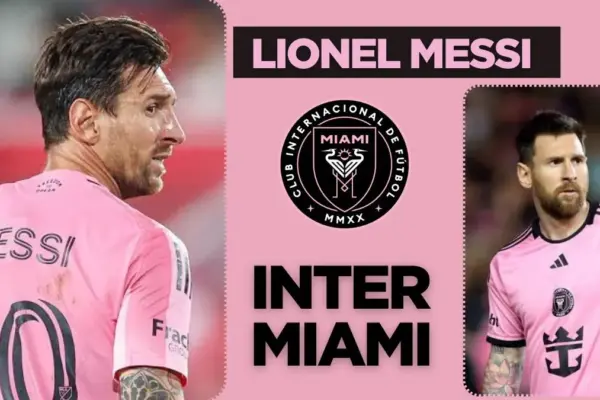
The Messi era at Inter Miami has been transformative for American soccer, but it’s also exposed the limitations of building a team around individual brilliance rather than collective excellence.
As the 2025 season progresses, the question isn’t whether Messi can deliver magic. it’s whether his teammates can finally rise to meet the moment.
Whenever Inter Miami faces adversity, all eyes turn to Lionel Messi. From crushing defeats in knockout competitions to defensive collapses in crucial moments, the expectation remains that the Argentine superstar will single-handedly rescue his team. But this dependency reveals a deeper issue plaguing Inter Miami: their inability to function as a cohesive unit when it matters most.
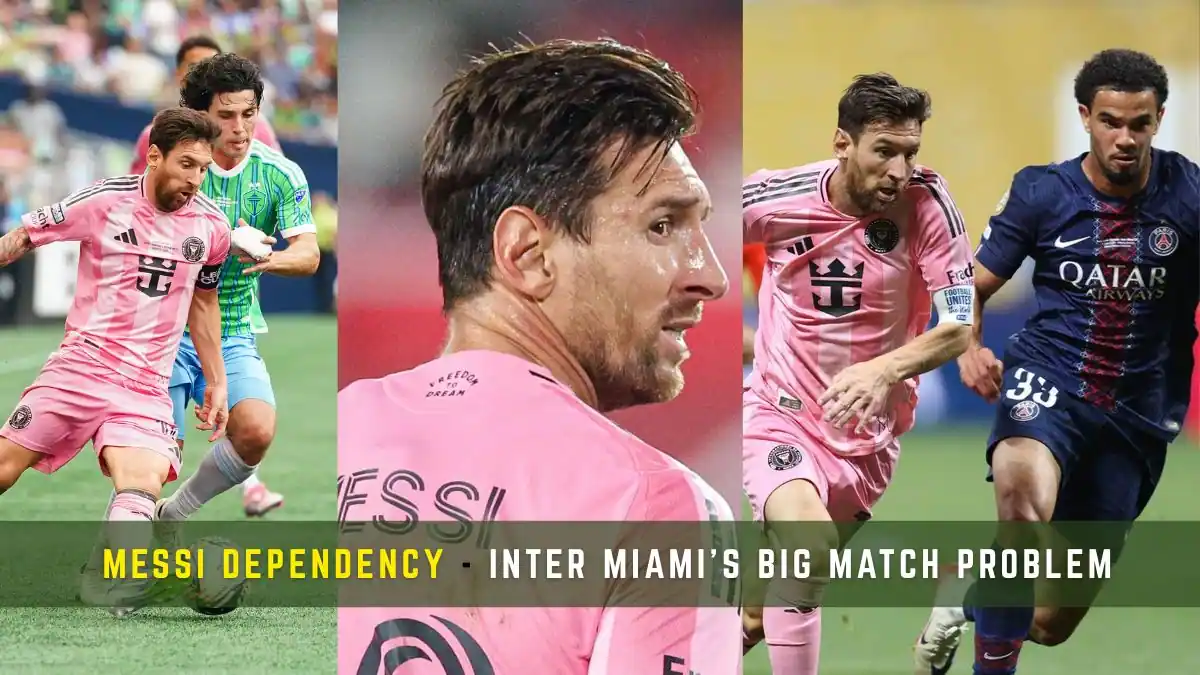
Messi Dependency: Inter Miami’s Big Match Problem

Inter Miami’s reliance on Messi isn’t just about goals and assists; it’s about the fundamental structure of how they play. Without Messi on the field, Inter Miami’s record tells a sobering story.
Since joining Inter Miami in July 2023, Messi’s goals and statistics have been impressive. His team has played 104 competitive matches, winning 56, losing 23, and drawing 25. However, when narrowed down to games Messi has actually played, the numbers improve dramatically: 39 wins, 13 losses, and 19 draws out of 71 appearances.
The statistics become even more revealing when examining Inter Miami’s performance without their talisman. In 2024, Miami played five games without Messi, collecting three losses, one draw, and just one win.
Their expected goals (xG) drop by 20% without him, and their conversion rate plummets from 18% to just 11%. This isn’t just correlation—it’s a fundamental tactical problem.
Coach Javier Mascherano has openly acknowledged this dependency, stating: “When you have a player like Messi, you’re clearly going to develop a dependency on him. It’s impossible not to depend on him”. But this admission highlights the coaching staff’s failure to develop systems that can function independently of one player.
Tactical Breakdown in High-Stakes Moments
Inter Miami’s struggles in big matches stem from systemic tactical flaws that become exposed when facing quality opposition. The team’s defensive vulnerabilities are particularly glaring—they’ve allowed 8.4 chances per game in 2025, with 30.7% being ‘big’ chances, the highest rate in MLS.
The defensive issues aren’t just statistical anomalies. After conceding 49 goals during their 2024 Supporters’ Shield-winning season, they allowed 21 goals in just 13 matches in 2025. Center-back Maxi Falcón averages just 0.68 aerial duel wins per 90 minutes, ranking in the bottom 3% of MLS center backs. Meanwhile, 38-year-old goalkeeper Oscar Ustari has the league’s worst goal prevention rate at -14.7%.
The European Perspective: Zlatan’s Brutal Assessment
Former LA Galaxy star Zlatan Ibrahimovic delivered perhaps the most candid assessment of Inter Miami’s limitations after their 4-0 Club World Cup defeat to PSG: “Messi plays with statues, not teammates. He’s surrounded by players who run as if they were carrying bags of cement”.
Ibrahimović’s critique cuts to the heart of the issue: “There are no coaches, no stars, not even players who understand how to move without the ball. If he were on a real team, any great team, you’d see the real lion”.
This assessment from someone who played alongside Messi at Barcelona and competed in MLS provides crucial context for American fans trying to understand why their team repeatedly fails in essential moments.
The American Soccer Fan’s Dilemma

For US soccer fans, the Messi phenomenon represents both the sport’s greatest opportunity and its most frustrating limitation. MLS attendance has hit record highs, with 11.45 million fans attending games in 2024—a 14% increase from 2022. Inter Miami alone saw its fan base increase by more than five times after Messi’s arrival.
However, this growth comes with unrealistic expectations. American fans, accustomed to seeing individual superstars elevate entire franchises in other sports, expect Messi to perform similar magic in soccer. The reality is more complex—soccer requires 11 players functioning as a unit, not one player carrying the team.
The dependency issue becomes particularly problematic in knockout competitions where tactical discipline and collective performance matter most.
Since Messi’s arrival, Inter Miami has been eliminated from major tournaments despite having the world’s best player: the 2024 MLS Cup playoffs (first-round exit), 2025 Concacaf Champions Cup (semifinal loss), 2025 Club World Cup (Round of 16), and now the 2025 Leagues Cup final loss.
| Competition | Match | Opponent | Result |
|---|---|---|---|
| 2025 League Cup | Final | Seattle Sounders | 0-3 Loss |
| 2025 Club World Cup | Round of 16 | PSG | 0-4 Loss |
| 2025 Concacaf Champions Cup | Semifinal | Vancouver Whitecaps | 1-5 Loss (agg) |
| 2024 MLS Cup Playoffs | First Round | Atlanta United | 2-3 Loss |
The Coaching Challenge
Mascherano’s tactical approach inadvertently encourages the Messi dependency. His system often sees Messi drop deep to collect the ball because his teammates struggle with progressive passing.
This creates a tactical vacuum: “When Leo is playing, we have a base of space that can open the game many times… When he’s not there, we need to look for different options”.
The problem intensifies in big matches where opponents can neutralize Messi through targeted man-marking and tactical fouling. When Seattle Sounders shut down Messi in the Leagues Cup final, Inter Miami had no alternative plan, resulting in a comprehensive 3-0 defeat.
The Long-Term Impact on American Soccer

The Messi experiment at Inter Miami reveals broader issues about how American soccer develops. His presence has elevated the sport’s profile nationwide, making him the Americans’ favorite athlete ahead of LeBron James and Patrick Mahomes. it may be teaching the wrong lessons about team sports.
Young American players and fans are learning that individual brilliance trumps tactical understanding and collective effort. This mentality doesn’t translate well to international competition, where teamwork and systematic play determine success.
The dependency also creates unrealistic pressure on Messi himself. At 37 years old, he’s expected to be the creative hub, defensive organizer, and primary goal threat simultaneously. Even for the greatest player in history, this burden becomes unsustainable in high-pressure moments.
The Path Forward
Inter Miami’s future success depends on developing systems that complement rather than depend on Messi. Other successful teams with ageing superstars—like Real Madrid with Modrić or Manchester City with De Bruyne create tactical frameworks that maximize their stars’ influence while maintaining collective strength.
The current approach of expecting Messi to solve every tactical problem isn’t sustainable and ultimately wastes his remaining years at the highest level. American soccer fans deserve better than a one-man show disguised as a team sport.
For Inter Miami to succeed in future big matches, they must address their defensive vulnerabilities, develop alternative creative outlets, and create tactical systems that function with or without their Argentine maestro.
Until then, fans will continue witnessing the frustrating spectacle of the world’s best player being let down by teammates who can’t match his standards when it matters most.