
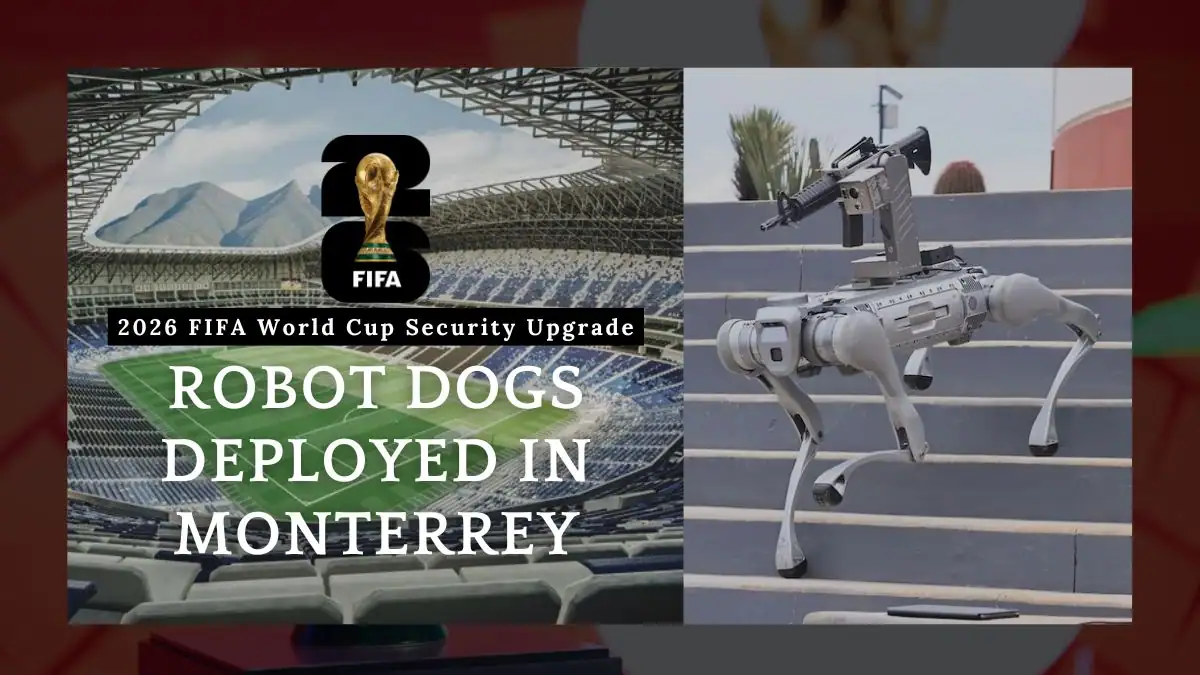
February 10, 2026 – In a groundbreaking move to enhance security for the 2026 FIFA World Cup, Mexican authorities have announced the deployment of advanced robot dogs to assist police in crowd control and high-risk operations.
The four-legged robotic units, purchased by the Guadalupe city council in the Monterrey metropolitan area, are designed to venture into dangerous zones, relay live video footage, and even issue commands via built-in loudspeakers.
This initiative, revealed today in a press conference by Guadalupe Mayor Hector Garcia, aims to bolster safety at BBVA Stadium (temporarily renamed Estadio Monterrey for the tournament), which will host multiple matches starting June 11.
With the World Cup co-hosted by the USA, Canada, and Mexico, this tech-forward approach could set a precedent for global event security amid rising concerns over crowd management.
How Robot Dogs Will Assist Police: Key Capabilities and Deployment Details
The robot dogs, acquired at a cost of 2.5 million pesos (approximately $145,000 USD), are equipped with cutting-edge features to support law enforcement without putting officers in immediate danger.
According to Mayor Garcia, these units will be used during initial interventions at World Cup venues and surrounding areas, reducing exposure to potential threats.
- Remote Surveillance and Navigation: The robots can navigate abandoned structures, climb stairs, and transmit real-time video to police teams, allowing for remote assessment of situations.
- De-Escalation Tools: Built-in loudspeakers enable the robots to issue commands, such as instructing suspects to drop weapons, as demonstrated in recent footage released by local authorities.
- Crowd Control Applications: In high-density areas around stadiums, the units will help monitor crowds, detect anomalies, and support rapid response to incidents like stampedes or unauthorized entries.
Guadalupe, part of the Monterrey region hosting World Cup games, plans to integrate the robots into broader security protocols. “These tools will help us ensure a safe environment for fans from around the world,” Garcia stated during the announcement.
This deployment builds on global trends, with similar robotic dogs already in use by police forces in Singapore, Italy, and the Netherlands for patrol and de-escalation tasks.
In the U.S., law enforcement has tested models from Boston Dynamics for hostage situations, though no specific plans for World Cup venues like Miami’s Hard Rock Stadium have been confirmed yet.
Security Context for the 2026 World Cup: Why Robot Dogs Now?

The 2026 tournament, featuring 48 teams and 104 matches across 16 cities, poses unique security challenges with an expected influx of 5-6 million visitors.
Monterrey’s BBVA Stadium will host group stage and knockout games, drawing massive crowds. Authorities cite the need for innovative tools amid concerns over unauthorized drones, cyber threats, and crowd violence—issues highlighted in recent preparations for events like the 2025 Club World Cup.
FIFA has emphasized advanced tech in its security blueprint, including AI Solutions for the 2026 FIFA World Cup, AI-driven surveillance and drone detection, but the robot dogs mark Mexico’s proactive step. Critics, however, raise concerns over privacy and the militarization of public events, echoing debates on robotic policing worldwide.
Implications for Fans and the Tournament
For World Cup attendees, this means enhanced safety measures but potential for more visible tech presence at venues. No disruptions to ticket sales or schedules are reported, with FIFA praising host nations’ preparations. 2026 FIFA World Cup Ticket demand remains sky-high, with over 150 million requests already processed.