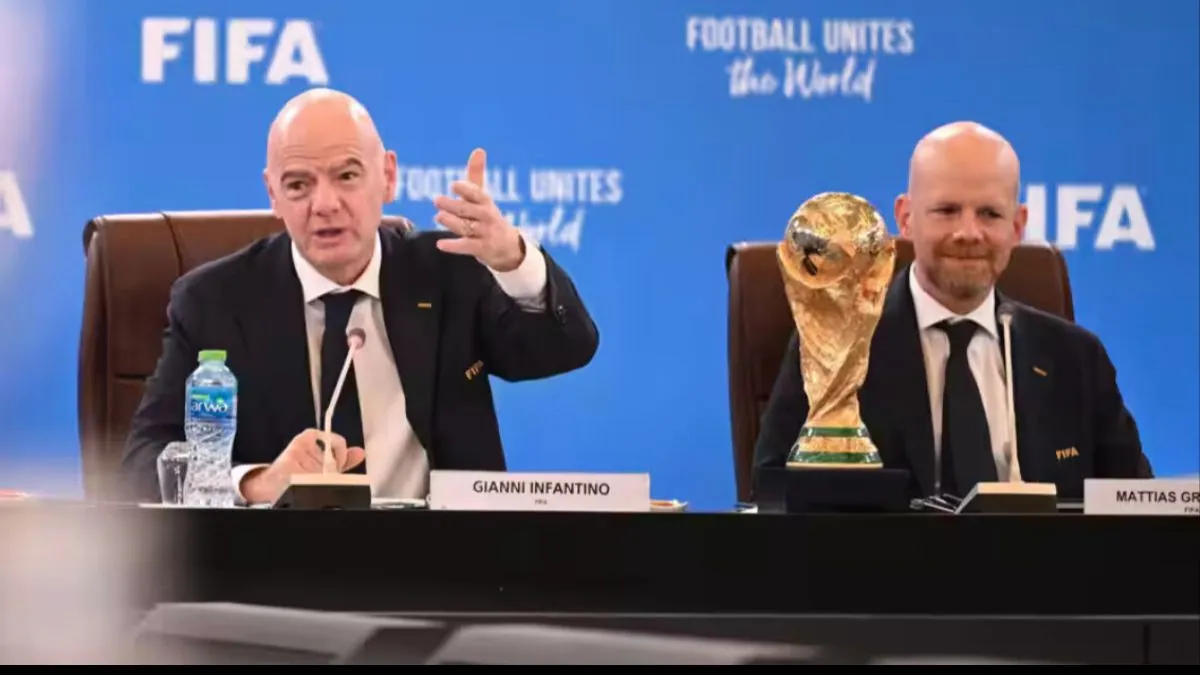
In a move that has redefined the economic landscape of global sports, the FIFA Council has officially approved a staggering $14 billion budget for the 2027–2030 commercial cycle. Announced today, March 21, 2026, during the council’s primary briefing in Zurich, this financial roadmap represents a nearly 30% increase over the previous cycle.
As the world prepares for the 2026 FIFA World Cup, this budget confirms that football is no longer just a sport—it is a multi-billion-dollar global juggernaut. From massive prize money hikes to a revolutionary investment in grassroots infrastructure, FIFA is putting its record-breaking profits to work.
The Revenue Engine: Where is the $14 Billion Coming From?
For years, critics and analysts have questioned whether FIFA could keep growing after expanding the World Cup to 48 teams. Today’s budget approval gives a clear answer: a big “yes.” The forecasted $14 billion in revenue is driven by three main factors:
- Expanded Broadcasting Rights: The 2026 World Cup’s 104-match format has allowed FIFA to negotiate record-breaking TV deals in the North American and Asian markets.
- The New Club World Cup: The revamped 32-team FIFA Club World Cup has become a “cash cow,” attracting high-tier sponsors who previously only focused on the Champions League.
- Digital and Gaming Revenue: Following the split from EA Sports, FIFA’s internal gaming and e-sports ventures have outperformed expectations, contributing significantly to the non-matchday revenue streams.
Prize Money Explosion: The $750 Million Pool

One of the most talked-about sections of today’s approval is the allocation for prize money. For the 2026 World Cup and the following cycle, FIFA has earmarked a total of $727 million to $750 million in distributions for participating nations.
- Participation Fee: Every nation that qualifies for the 2026 World Cup is now guaranteed a minimum of $10.5 million, up from $9 million in 2022.
- The Winner’s Share: The nation that lifts the trophy in New Jersey on July 19, 2026, will take home a record $52 million—the highest single-match prize in the history of the sport.
FIFA Forward 4.0: A Lifeline for Developing Nations
While the headlines focus on the billions, the real impact may be felt in the smaller member associations. The council has approved a $2.8 billion allocation for the “FIFA Forward 4.0” program.
This funding is specifically designed to bridge the gap between “footballing superpowers” and developing nations. Each of the 211 member associations will now be eligible for up to $9 million over the four-year cycle to fund local stadiums, academies, and coaching education. In regions like Southeast Asia, Africa, and Oceania, this money is expected to double the number of professional-grade training pitches by 2030.
Women’s Football: A Dedicated $1.2 Billion Fund
In a historic first, the FIFA Council has approved a standalone $1.2 billion budget specifically for the growth of women’s football. This isn’t just about prize money for the 2027 Women’s World Cup; it’s about a “bottom-up” commercial strategy.
The budget includes funding for a Global Women’s Club World Cup, set to debut in 2028, and a mandate that 25% of all FIFA Forward funds must be spent on female-specific infrastructure. This move is designed to make women’s football financially independent of the men’s game by the end of the decade.
The “Safe Hands” Policy: FIFA’s $4 Billion Reserve
Despite the heavy spending, FIFA is not leaving its future to chance. The council confirmed today that it will maintain a $4 billion emergency reserve. This “war chest” is designed to protect the organization against global economic downturns, future pandemics, or unforeseen cancellations of major tournaments.
“We are in a position of unprecedented financial strength,” the council’s financial report stated. “Our goal is to ensure that even in a crisis, the ball never stops rolling.”
Commercial Exclusivity and the “Clean Zone” Strategy
The $14 billion budget also relies heavily on strict commercial enforcement. As seen with the recent “Tailgating Bans” and strict “Clean Zone” regulations around stadiums, FIFA is moving toward a highly controlled commercial ecosystem. By eliminating “ambush marketing” and unmonitored fan gatherings, FIFA ensures that its official partners (Aramco, Coca-Cola, etc.) receive maximum value for their multi-million dollar investments.
The 2027-2030 Roadmap: What Happens Next?
With the budget approved, the focus now shifts to the execution of the 2026 World Cup. The success of this tournament is the “Proof of Concept” for the $14 billion projections. If the North American World Cup breaks attendance and viewership records as expected, analysts believe the $14 billion figure might actually be a conservative estimate.
FIFA Budget Breakdown at a Glance
| Category | Allocation (2027-2030) | Growth vs. Previous Cycle |
| Total Revenue Goal | $14.1 Billion | +28% |
| FIFA Forward Program | $2.8 Billion | +15% |
| Women’s Football | $1.2 Billion | +40% |
| Prize Money (WC 2026) | $727 Million | +12% |
| Emergency Reserves | $4.0 Billion | Stable |
Frequently Asked Questions (FAQs)

Where does FIFA get most of its money?
The majority of FIFA’s revenue (over 85%) comes from the sale of television broadcasting rights and marketing/sponsorship rights for the Men’s FIFA World Cup.
Does FIFA pay taxes on this $14 billion?
As a non-profit association based in Switzerland, FIFA is subject to Swiss tax laws. However, it receives significant tax exemptions in host countries as part of the “Government Guarantees” required to host a World Cup.
How much money do small countries get from this budget?
Under the FIFA Forward 4.0 program, even the smallest member associations can receive up to $2.25 million per year ($9 million per cycle) for football development projects.
Is the Club World Cup included in this $14 billion?
Yes. The projected revenue from the new 32-team Club World Cup format is a major pillar of the 2027–2030 financial strategy.