As we move into late August 2025, excitement is building for the FIFA World Cup 2026 European Teams qualifiers, which are set to resume next month. The UEFA qualification campaign for Europe’s 16 coveted spots in the expanded 48-team FIFA World Cup qualification has already begun for many nations, with crucial matches scheduled throughout September 2025.
Despite several months of qualifying action, no European team has yet secured their place at the 2026 World Cup. This is typical for UEFA qualifying campaigns, which follow a structured timeline extending through November 2025, with playoffs scheduled for March 2026.
FIFA World Cup 2026 European Teams Qualification
Table of Contents
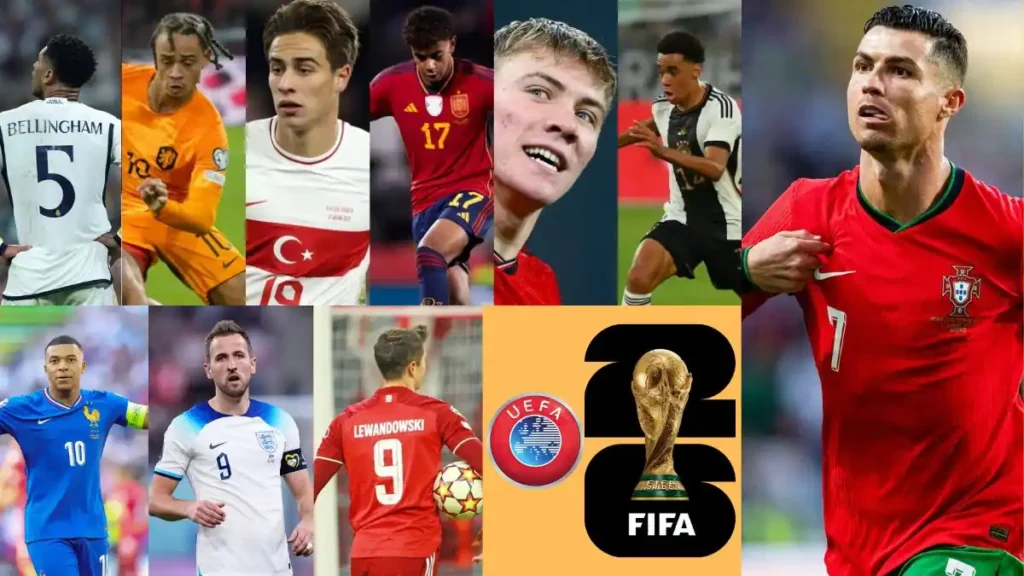
Spain, the 2024 European Champions, are among the heavy favorites to not only qualify but potentially win the entire tournament. Their group with Turkey, Georgia, and Bulgaria appears manageable, though Turkey presents a significant challenge.
Portugal is the winner of the 2024-25 Nations League final. Ronaldo leading the team and this is the last world cup of this star player.
Germany, seeking their first World Cup triumph since 2014, faces Slovakia, Northern Ireland, and Luxembourg in what should be a straightforward path to qualification.
England, under new manager Thomas Tuchel, begins a fresh era with high expectations. Their group with Serbia, Albania, Latvia, and Andorra positions them well for automatic qualification.
How European Qualifications Work?
The FIFA World Cup 2026 European teams’ qualification system allocates 16 spots to UEFA nations through a comprehensive two-stage process:
First Stage: Group Phase
- 12 groups comprising 4-5 teams each
- Teams play home-and-away matches in a round-robin format
- Group winners qualify directly for the World Cup (12 automatic spots)
- Group runners-up advance to the playoff stage
Second Stage: Playoffs
- 12 group runners-up join 4 best-ranked UEFA Nations League group winners
- These 16 teams are drawn into 4 playoff paths
- Single-leg semifinals and finals determine the final 4 European spots
- Playoffs scheduled for March 26-31, 2026
FIFA World Cup 2026 European teams qualification groups

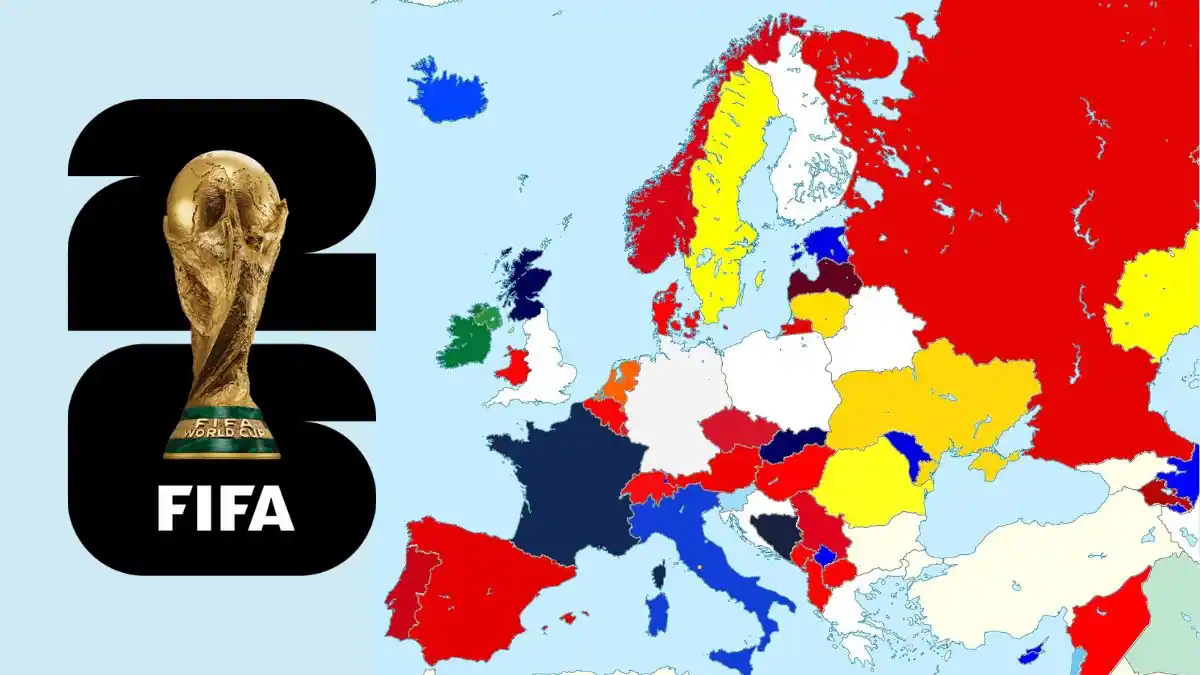
The draw conducted in Zurich on December 13, 2024, created these competitive groups: and the Final Draw to start first phase of FIFA World Cup 2026 will start from 5 December 2025.
| Group | Teams |
|---|---|
| Group A | Germany, Slovakia, Northern Ireland, Luxembourg |
| Group B | Switzerland, Sweden, Slovenia, Kosovo |
| Group C | Denmark, Greece, Scotland, Belarus |
| Group D | France, Ukraine, Iceland, Azerbaijan |
| Group E | Spain, Turkey, Georgia, Bulgaria |
| Group F | Portugal, Hungary, the Republic of Ireland, and Armenia |
| Group G | Netherlands, Poland, Finland, Lithuania, Malta |
| Group H | Austria, Romania, Bosnia and Herzegovina, Cyprus, San Marino |
| Group I | Italy, Norway, Israel, Estonia, Moldova |
| Group J | Belgium, Wales, North Macedonia, Kazakhstan, Liechtenstein |
| Group K | England, Serbia, Albania, Latvia, and Andorra |
| Group L | Portugal, Hungary, the Republic of Ireland, and Armenia |
FIFA World Cup 2026 European Teams Qualification Key Matches
UEFA Schedule in September 2025
The UEFA qualification campaign continues with Matchday 5 and 6 scheduled for early September:
September 4-6, 2025: Matchday 5 Highlights
- England vs Andorra – The Three Lions look to maintain their strong start
- Spain vs Bulgaria – European Champions begin their campaign
- Germany vs Slovakia – Four-time World Cup winners face tough opposition
- Italy vs Estonia – Azzurri seek redemption after missing recent World Cups
September 7-9, 2025: Matchday 6 Key Fixtures
- Germany vs Northern Ireland – Crucial Group A encounter
- Serbia vs England – Potential group decider in Group K
- Turkey vs Spain – High-stakes meeting in Group E
- Belgium vs Kazakhstan – Red Devils aim to bounce back
Current Group Standings: Early Leaders Emerge
Based on matches played through June 2025, several teams have established early advantages:
Top Performers in world cup qualification
- Norway leads Group I with 12 points from 4 matches, including a stunning 3-0 victory over Italy
- England sits atop Group K with 9 points after defeating Albania and Andorra
- The Netherlands dominates Group G with an 8-0 Demolition of Malta, highlighting their campaign
- Bosnia and Herzegovina leads Group H with a perfect record
Under Pressure in World Cup qualification
- Italy faces an uphill battle in Group I after their defeat to Norway
- Wales and Belgium are locked in a tight battle in Group J
- Croatia and Czech Republic are competing fiercely in Group L
Group B promises intense competition between Switzerland, Sweden, Slovenia, and Kosovo – with no clear favorite emerging. Group I has become a fascinating contest with Norway currently leading Italy, creating potential drama for the four-time World Cup winners.
2026 FIFA World Cup European qualifiers timeline and key dates
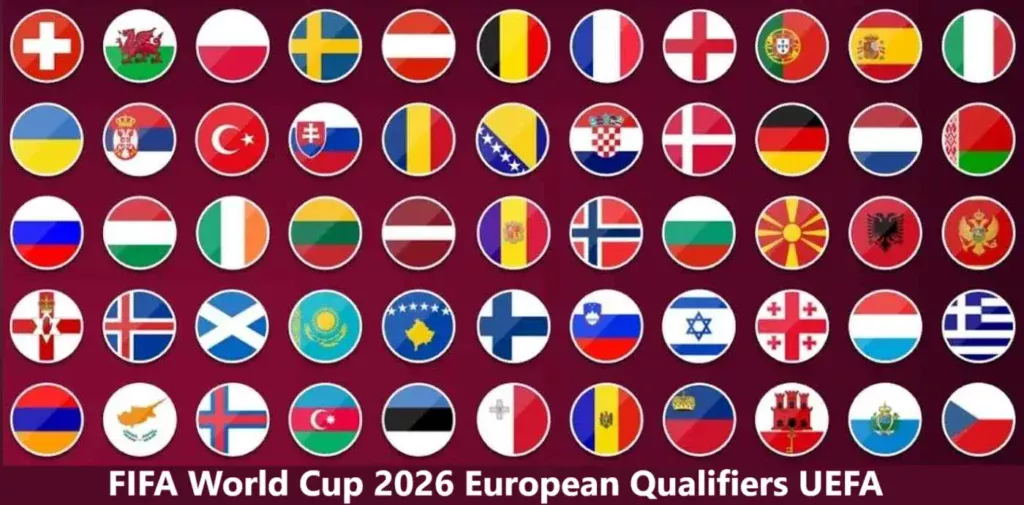
The European qualifying campaign follows this crucial timeline:
- September 4-9, 2025: Matchdays 5-6 resume qualification
- October 9-14, 2025: Matchdays 7-8 continue group stage
- November 13-18, 2025: Final group stage matches (Matchdays 9-10)
- March 26-31, 2026: Playoff semifinals and finals
- June 11-July 19, 2026: FIFA World Cup 2026 tournament
With the World Cup expanding to 48 teams, Europe receives its largest-ever allocation of 16 qualification spots. This represents a significant increase from previous tournaments, providing more opportunities for European nations to reach the global stage.
However, the competition remains fierce. Traditional powerhouses like France, Portugal, and the Netherlands will face genuine challenges in securing their spots, while smaller nations see unprecedented opportunities to reach their first World Cup.
As September approaches, European football fans can expect thrilling qualifying action with every match carrying significant weight toward the ultimate prize – a place at the 2026 FIFA World Cup in Canada, Mexico, and the United States.
The expanded tournament format means more dreams will be realized, but the path to qualification remains as challenging as ever for Europe’s finest football nations.