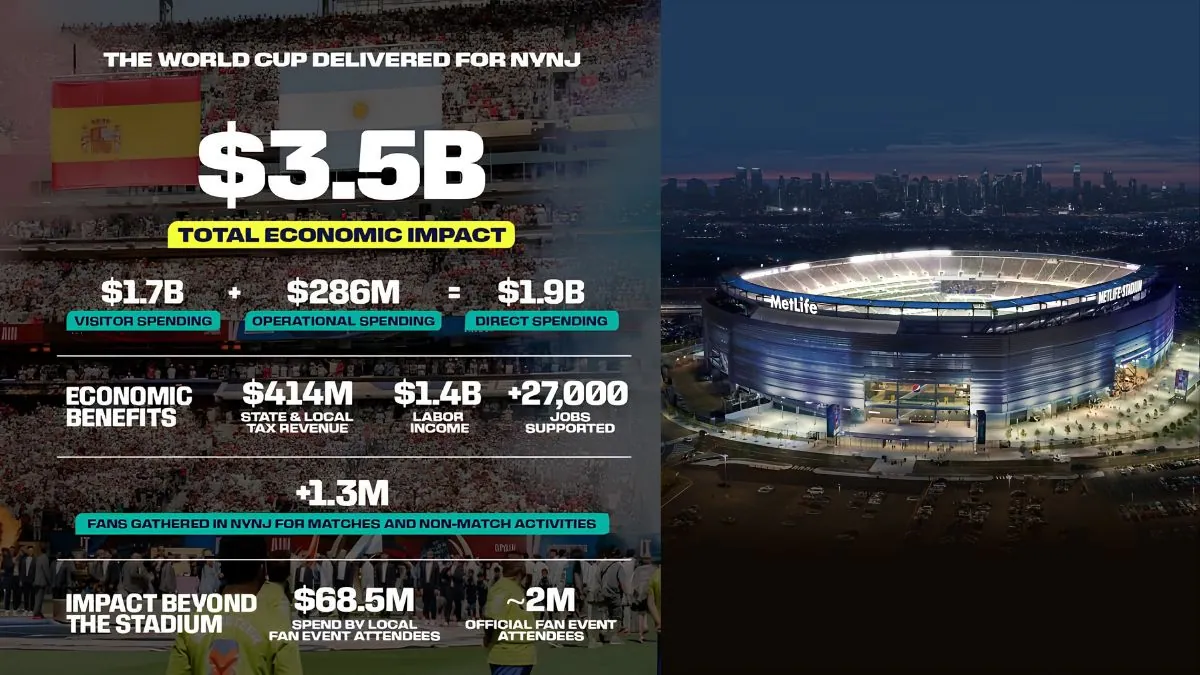
The 2026 FIFA World Cup delivered a major economic boost to the New York and New Jersey region, generating an estimated $3.5 billion in total economic impact, according to a post-tournament analysis released by New York Governor Kathy Hochul’s office. In June, FWCN reported that the FIFA World Cup 2026 will feature 48 teams, 104 matches, and 16 host cities across three countries, bringing significant economic impact to Mexico, Canada, and the USA, including New York and New Jersey Economies.
The figure, produced by Tourism Economics (an Oxford Economics company), exceeded the region’s original projection of $3.3 billion. It reflects spending linked to eight matches hosted at MetLife Stadium in East Rutherford, New Jersey — including the July 19 final — as well as Official Fan Events and related activities across both states.
Breaking Down the New York and New Jersey Economies with the $3.5 Billion Impact
The study found that World Cup activity produced approximately $1.9 billion in direct spending. This money then circulated through the regional economy, generating an additional $693 million in indirect business activity (purchases by suppliers) and $916 million in induced activity (spending by workers whose jobs were supported by the tournament). Combined, these effects produced the overall $3.5 billion total.
Key highlights from the report include:
- 27,424 full- and part-time jobs supported across the region
- $1.4 billion in total labor income
- $414.2 million in state and local tax revenue
More than 645,000 fans attended the eight matches at the stadium (temporarily branded New York New Jersey Stadium for the tournament). An additional 626,300 non-local visitors traveled to the area for fan zones, watch parties, and other World Cup programming.
Where the Money Was Spent in the FIFA World Cup
Direct visitor and operational spending was distributed across several major sectors:
| Category | Direct Spending |
|---|---|
| Lodging | $653 million |
| Food and beverage | $346 million |
| Retail | $264 million |
| Transportation | $200 million |
| Recreation & entertainment | $195 million |
Hotels, restaurants, bars, shops, taxis, ride-shares, and entertainment venues all recorded significant gains. The final and knockout matches, in particular, drove high occupancy rates and elevated prices in the hospitality sector.
Broader Regional Benefits
Governor Hochul highlighted the results as evidence that the New York–New Jersey region remains a premier destination for major global events. The tournament’s footprint extended well beyond the stadium, with free Official Fan Events and community programming held across all five New York City boroughs and parts of New Jersey and upstate New York.
Local officials and business groups noted that the economic activity reached a wide range of workers — from hotel staff and restaurant employees to transportation providers and small business owners. New York City Mayor Zohran Mamdani emphasized the distribution of benefits, stating that the numbers reflected gains for everyday workers across the city.
The report also credited higher-than-expected operational spending by the host committee, governments, and stakeholders, along with stronger attendance at fan events and a larger share of international visitors than initially forecast.
Context and Comparisons
The $3.5 billion impact covers only the New York–New Jersey host region. Other host cities and states released their own figures earlier. California, for example, estimated roughly $1.5 billion in statewide impact from its 14 matches, while Miami-Dade County reported strong hotel revenue gains from its seven games.
Independent analysts often view economic impact studies of mega-events with caution, pointing out that methods can differ and that some spending may not be truly new. Even so, the official post-event report offers the most thorough and authoritative accounting for the New York–New Jersey area.
Lasting Effects
Beyond the immediate numbers, officials argue the tournament reinforced the region’s global brand, tested large-scale event infrastructure, and created temporary employment opportunities that supported thousands of workers during the summer. State and local governments also collected hundreds of millions in tax revenue that can be directed toward public services.
As the final economic scorecard is released more than a month after Spain’s victory over Argentina in the final, the data confirm that hosting eight matches — including the biggest game in world football — produced a substantial short-term stimulus for one of the world’s largest metropolitan economies.
The $3.5 billion figure stands as the clearest official measure yet of how the 2026 FIFA World Cup translated into tangible economic activity across New York and New Jersey.