The 2026 FIFA World Cup is supposed to be a celebration for all soccer fans. But USA Travel Ban for supporters from dozens of countries — including four whose national teams qualified for the tournament — the doors to the United States are legally closed.
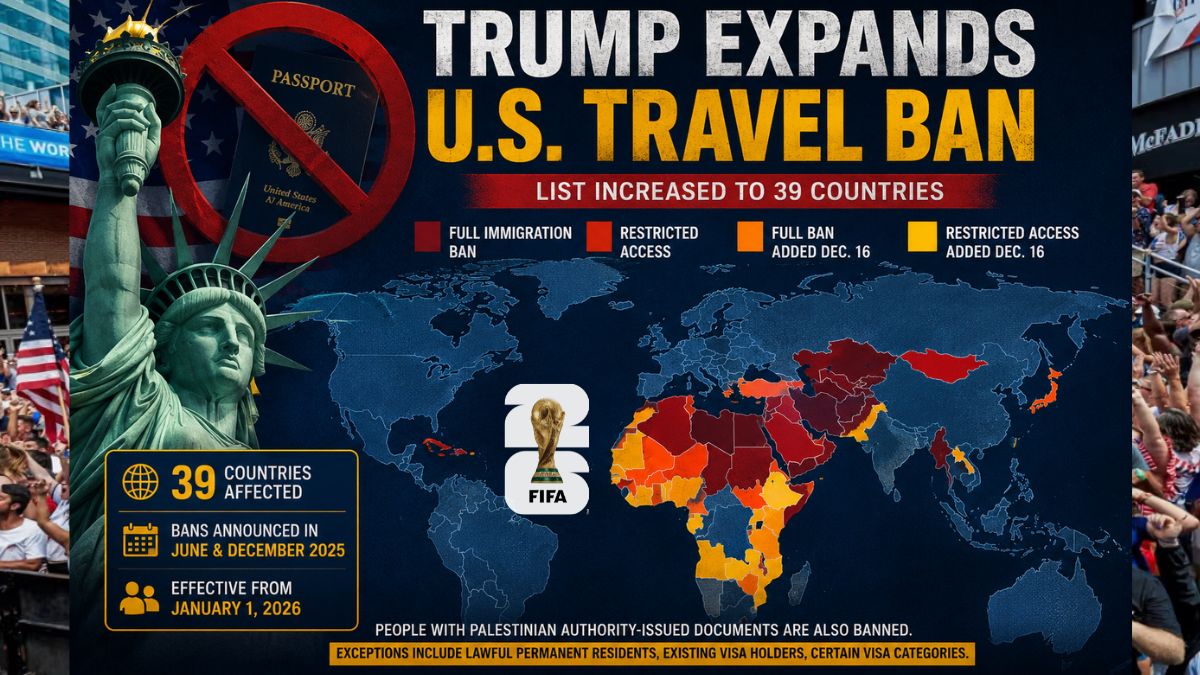
President Donald Trump’s administration issued two proclamations: one in June 2025, another in December 2025, together imposing entry restrictions on nationals from 39 countries.
Nineteen face a full ban. Twenty face partial restrictions. The combined effect? Roughly one in five countries on earth has some form of travel barrier to the United States right now — and for millions of Soccer fans, that barrier sits directly between them and a World Cup ticket they may have already paid for.
Here is everything you need to know — which countries are affected, what the exceptions actually cover, and what options remain for fans determined to watch their team play.
The USA Travel Ban: What Happened and When ?
On June 4, 2025, President Trump signed a proclamation restricting entry for nationals of 19 countries, primarily from the Middle East and Africa, citing deficiencies in security screening and information-sharing.
The restrictions took effect on June 9, 2025. Anyone from those countries without a valid visa issued before that date could no longer obtain a B-2 tourist visa — the standard visa for attending events like the World Cup.
On December 16, 2025, a second proclamation expanded the list to 39 countries. The new rules took effect on January 1, 2026 — roughly five and a half months before the tournament kicks off.
Additional reasons cited for the December expansion included high visa overstay rates, refusal to accept deported nationals back, and in some cases links to terrorism.
20% of all countries on earth — 39 out of 195 — now face travel restrictions to the United States. For World Cup 2026, this has a direct human impact on tens of millions of football fans.
The stated policy goal is to protect U.S. citizens from individuals who pose security risks. Critics, however, have pointed out that the bans sweep up entire nations without individual assessment — including small children, ordinary tourists, and football fans with legally purchased match tickets.
The Four World Cup Nations Whose Fans Are Barred
Of the 48 countries that qualified for the 2026 FIFA World Cup, four are subject to the travel bans. These are the fans who will feel the impact most acutely — their national team is playing in the United States, but the vast majority of their supporters cannot legally enter to watch.
| Country | Ban Type | Group | Matches in USA |
|---|---|---|---|
| Iran | Full ban | Group G (Belgium, Egypt, New Zealand) | Yes — all 3 in Los Angeles & Seattle |
| Haiti | Full ban | First World Cup since 1974 | Yes — all group matches in US |
| Senegal | Full ban | Group I (France, Norway + 1) | Yes — group matches in US |
| Côte d’Ivoire | Partial ban | Group E (Germany, Ecuador, Curaçao) | Yes (one match in Toronto, Canada) |
Iran — the most politically charged case

Iran’s situation is unlike any other. Beyond the standard travel ban affecting its citizens, Iran’s participation in the World Cup itself was thrown into doubt after U.S. and Israeli military strikes in late February 2026 killed Iran’s supreme leader. Iran’s sports minister initially declared the team would not participate.
As of mid-May 2026, Iran’s football federation has confirmed the team will “definitely” play — but the visa status of players with IRGC military service remains a live issue, and ordinary Iranian fans face an effectively total barrier to the United States.
Haiti — historic qualification, tragic backdrop
Haiti’s qualification for the 2026 World Cup was genuinely remarkable — their first appearance since 1974, achieved without being able to play home matches inside a country battered by gang violence and political collapse.
The cruel irony is that the fans who should be celebrating most cannot travel to the United States to see it happen. Haiti faces a full ban, and the Trump administration separately ended Temporary Protected Status for 340,000 Haitians living in the U.S., adding further complexity for diaspora communities who might otherwise have attended.
Senegal and Côte d’Ivoire
Both West African footballing nations were added to the expanded ban in December 2025, largely on visa overstay rate grounds. Senegal faces a full ban on B-1/B-2 tourist visas; Côte d’Ivoire faces a partial ban with similar practical effects for ordinary fans.
Their citizens cannot obtain the standard visitor visa required to attend a World Cup match in the United States. Notably, Côte d’Ivoire’s second group stage match is scheduled in Toronto — Canada has a strict vetting process but not a blanket ban, so some Ivorian fans may be able to attend that specific fixture.
Full List: All 39 Countries Under US Travel Restrictions

Below is the complete breakdown. Full bans affect both immigrant and non-immigrant (tourist) visas.
Partial bans primarily restrict immigrant visas, but in most cases also suspend B-1/B-2 tourist visas, which is what World Cup fans would need.
| Country | Ban type | World Cup qualifier? |
|---|---|---|
| Afghanistan | Full ban | No |
| Burkina Faso | Full ban | No |
| Burma (Myanmar) | Full ban | No |
| Chad | Full ban | No |
| Republic of the Congo | Full ban | No |
| Equatorial Guinea | Full ban | No |
| Eritrea | Full ban | No |
| Haiti | Full ban | Yes — Group stage in US |
| Iran | Full ban | Yes — Group G in US |
| Laos | Full ban | No |
| Libya | Full ban | No |
| Mali | Full ban | No |
| Niger | Full ban | No |
| Sierra Leone | Full ban | No |
| Somalia | Full ban | No |
| South Sudan | Full ban | No |
| Sudan | Full ban | No |
| Syria | Full ban | No |
| Yemen | Full ban | No |
| Angola | Partial ban | No |
| Antigua and Barbuda | Partial ban | No |
| Benin | Partial ban | No |
| Burundi | Partial ban | No |
| Côte d’Ivoire | Partial ban | Yes — Group E |
| Cuba | Partial ban | No |
| Dominica | Partial ban | No |
| Gabon | Partial ban | No |
| The Gambia | Partial ban | No |
| Malawi | Partial ban | No |
| Mauritania | Partial ban | No |
| Moldova | Partial ban | No |
| Namibia | Partial ban | No |
| Senegal | Full ban | Yes — Group I in US |
| Tanzania | Partial ban | No |
| Togo | Partial ban | No |
| Turkmenistan | Partial ban | No |
| Uganda | Partial ban | No |
| Vanuatu | Partial ban | No |
| Zimbabwe | Partial ban | No |
(Note: Palestinian Authority travel documents are also subject to the full ban under the December proclamation, regardless of the nationality of the holder.)
Full ban — 19 countries (entry essentially impossible for ordinary fans)
Afghanistan, Burkina Faso, Burma (Myanmar), Chad, Republic of the Congo, Equatorial Guinea, Eritrea, Haiti, Iran, Laos, Libya, Mali, Niger, Senegal, Sierra Leone, Somalia, South Sudan, Sudan, Syria, Yemen
(Note: Palestinian Authority travel documents are also subject to the full ban.)
Partial ban — 20 countries (B-1/B-2 tourist visas suspended in most cases)
Angola, Antigua and Barbuda, Benin, Burundi, Côte d’Ivoire, Cuba, Dominica, Gabon, The Gambia, Malawi, Mauritania, Moldova, Namibia, Tanzania, Togo, Turkmenistan, Uganda, Vanuatu, Zimbabwe + one additional country
Exceptions: Who Can Still Enter?
The proclamations include some exceptions, and understanding exactly who qualifies — and who does not — is critical for fans trying to make decisions.
Who is exempt from the ban
The following groups are carved out from the travel restrictions:
- U.S. lawful permanent residents (green card holders)
- Individuals with a valid visa issued before the ban took effect
- Athletes, coaches, and persons in a “necessary support role” traveling for the World Cup
- Immediate relatives of athletes (spouses, unmarried children under 21, parents)
- Diplomats in an official capacity
- Individuals whose travel is deemed to serve a “U.S. national interest” (described by State Dept as “quite rare”)
Who is NOT exempt — the critical limitations
The athlete exemption does NOT extend to fans, journalists, corporate sponsors, extended family members, or anyone else not directly part of the competing team’s delegation. A match ticket does not exempt you from the travel ban.
The “immediate relative” exception for athletes covers spouses, unmarried children under 21, and parents — under standard U.S. legal definitions.
It does not cover siblings, adult children, grandparents, or other family members who commonly travel to support players at major competitions. It is also unclear whether the exception extends to families of coaches and support staff as well as players.
The State Department calls the “national interest” exception something that will be “quite rare,” making it an unrealistic option for most fans.
The FIFA Pass and Visa Bond Program

The FIFA Pass system
In November 2025, the Trump administration announced the “FIFA Fast track Pass” — officially the Priority Appointment Scheduling System — which went live on January 20, 2026.
It allows fans with World Cup tickets to request a priority appointment for a B-1/B-2 visa interview at a U.S. consulate, ahead of regular applicants.
It is important to understand what the FIFA Pass does and does not do. It speeds up the appointment process — it does not guarantee visa issuance, and it does not override the travel ban.
A fan from Iran, Haiti, Senegal, or Côte d’Ivoire with a purchased World Cup ticket and a FIFA Pass application will still be denied a visa. The ban takes precedence.
The visa bond program
As of April 2, 2026, the U.S. State Department expanded its “Visa Bond Program,” requiring nationals from 50 countries to pay a bond of up to $15,000 before being permitted to travel to the United States temporarily for tourism or business.
Five World Cup qualified countries are among those affected by the bond requirement: Algeria, Cabo Verde, Côte d’Ivoire, Senegal, and Tunisia.
Following pressure from FIFA, the Trump administration confirmed in May 2026 that visa bonds will be waived for qualified fans who have purchased World Cup tickets and opted into the FIFA Pass system. Players and staff were already exempt. The waiver applies to fans from the 50 bond-program countries — but not to those under the full travel ban.
What this means for fans heading to Mexico or Canada
Here is a detail that offers a partial lifeline to some affected fans: the World Cup is co-hosted by the United States, Canada, and Mexico. Not all matches are played on U.S. soil.
Canada and Mexico have their own, separate entry requirements — and neither has imposed the same travel bans as the United States.
Fans from banned countries who can obtain entry to Canada or Mexico — and who have matches scheduled there — may still be able to attend those specific fixtures.
Canada has a strict vetting process and its own complications, but no blanket ban matching the U.S. proclamations. Mexico’s entry requirements are generally more accessible.
Côte d’Ivoire’s Group E fixtures include one match in Toronto, Canada. For Ivorian fans who can obtain Canadian entry, this represents a genuine opportunity to watch their team play. Iran’s matches, however, are all scheduled in Los Angeles and Seattle — entirely on U.S. soil. The same applies to Haiti and Senegal’s group stage games.
A match ticket does not guarantee admission to a host country, and fans should visit each host country’s government website today for entry requirements for Canada, Mexico and the United States.
FIFA official guidance to World Cup ticket holders
The 12 qualified nations also under wider US visa delays
Beyond the four teams whose fans face outright bans, an additional group of qualified nations has been caught up in broader U.S. visa processing delays and the January 2026 pause on immigrant visa processing for 75 countries.
According to reporting by The National, 12 World Cup-qualified nations — including Algeria, Brazil, Cape Verde, Colombia, Egypt, Ghana, Guatemala, Jordan, Morocco, Tunisia, and Uruguay — face some form of additional friction in visa processing that may affect fans’ ability to travel in time for the tournament.
These restrictions do not amount to a full ban, but they do mean longer wait times, potential last-minute denials, and significant uncertainty for supporters who may have already purchased flights and accommodation.
The bigger picture: sport, access, and who the World Cup is for

The 2026 World Cup was meant to be a statement — the biggest tournament in history, spread across three nations, welcoming 48 teams and billions of fans.
Trump himself called it “a once in a lifetime opportunity to showcase the beauty and the greatness of America” and promised to “welcome soccer fans from all over the globe.”
The travel bans sit in direct tension with that promise. According to researchers and economists, the affected nations skew heavily toward Muslim-majority, Black-majority, and African countries.
Critics from Amnesty International to the American Immigration Council have called the restrictions discriminatory in practical effect, even if not in stated intent. Amnesty International and dozens of civil and human rights groups issued a formal “World Cup travel advisory” warning fans about the U.S. climate.
Wharton School sports economist Kenneth Shropshire put it plainly: “How are we going to treat the Black and brown people of the world, that are simply fans coming to the United States to enjoy the World Cup?”
FIFA, for its part, has tried to project confidence while quietly pushing for concessions — securing the visa bond waiver for ticket holders and advocating for Iranian players’ access. But the fundamental architecture of the bans is beyond FIFA’s authority to change. FIFA controls the football. It does not control the border.
For fans from Haiti, Senegal, Iran, and Côte d’Ivoire, this is not an abstract policy debate. It is a concrete reality: their national team is playing in a World Cup on the other side of a door that has been locked from the inside.