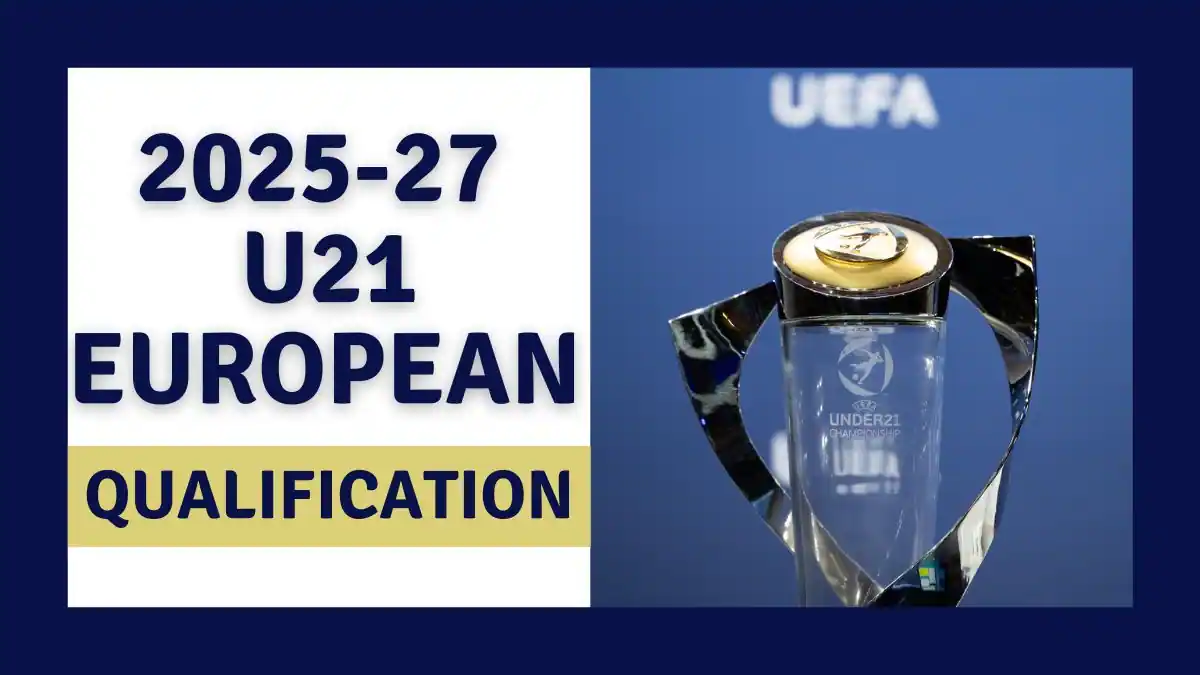
The 2025-27 UEFA European Under-21 Championship qualifying campaign is underway, with 51 nations competing for 14 spots to join co-hosts Albania and Serbia in the final tournament scheduled for summer 2027. This comprehensive 2025-27 U-21 European qualifying Schedule phase represents one of the most competitive youth tournaments in European football.
The 2025-27 U-21 European Championship qualifying serves as a crucial pathway for young players to gain international experience and potentially advance to senior national teams.
Many previous UEFA U-21 champions have gone on to achieve success at the senior level, making this tournament a vital stepping stone in European football development.
The competition’s format ensures smaller nations have realistic chances of progression while maintaining the high competitive standards expected in UEFA competitions.
With Albania and Serbia hosting the final tournament in summer 2027, the qualifying phase is sure to bring more excitement as teams compete for a spot in Europe’s top youth football competition.
England are the reigning champions of the 2025 U-21 European tournaments, having secured back-to-back titles by defeating Germany in the 2025 final and Spain in the 2023 final. It is one of the top UEFA qualification tournaments for the Summer Olympics.
2025-27 U-21 European qualifying tournament Format and Structure

The 2025-27 U-21 European qualifying process consists of two main phases designed to ensure the most competitive teams advance to the final tournament:
Qualifying Group Stage
- 51 teams divided into nine groups
- Six groups of six teams and three groups of five teams
- Home-and-away round-robin format
- Nine group winners qualify directly
- Best runner-up (excluding results vs sixth-placed teams) qualifies directly
- Eight other runners-up advance to play-offs
Play-offs
- Eight teams drawn into four ties
- Home-and-away two-legged matches
- Four winners complete the 16-team final tournament
Qualifying Schedule and Key Dates
The U-21 EURO qualifying Schedule dates are held in multiple international windows:
2025 Qualifying Windows
- 5-10 June 2025 – Tournament launch
- 4-9 September 2025 – First full round of matches
- 9-14 October 2025 – Current ongoing window
- 13-18 November 2025 – Final 2025 matches
2026 Qualifying Windows
- 26-31 March 2026 – Spring fixtures
- 24 September-6 October 2026 – Final qualifying matches
Play-offs
- 9-17 November 2026 – Eight teams compete for the final four spots
2025-27 U-21 European qualifying Teams

Group A: Finland, Spain, Romania, Kosovo, Cyprus, San Marino
Group B: Portugal, Czechia, Bulgaria, Azerbaijan, Gibraltar, Scotland
Group C: Faroe Islands, Switzerland, Iceland, Estonia, France, Luxembourg
Group D: Slovakia, Republic of Ireland, England (holders), Moldova, Kazakhstan, Andorra
Group E: Poland, Italy, Montenegro, Sweden, North Macedonia
Group E: Poland, Italy, Montenegro, Sweden, North Macedonia
Group F: Greece, Germany, Northern Ireland, Georgia, Latvia, Malta
Group G: Norway, Israel, Netherlands, Bosnia and Herzegovina, Slovenia
Group H: Ukraine, Croatia, Hungary, Türkiye, Lithuania
Group I: Denmark, Austria, Belgium, Belarus, Wales
Standings
All nine group winners and the runner-up from the standings qualify for the Play-offs round of the UEFA U21 Euro tournaments.
Group A: Finland, Spain, Romania, Kosovo, Cyprus, San Marino
Finland and Spain currently lead with maximum points after impressive September performances. Finland secured a commanding 7-0 victory over San Marino and won 5-0 in Cyprus.
Group B: Portugal, Czechia, Bulgaria, Azerbaijan, Gibraltar, Scotland
Portugal tops the group with strong performances, while Scotland faces an uphill battle to secure qualification from this competitive group.
Group C: Faroe Islands, Switzerland, Iceland, Estonia, France, Luxembourg
In a surprising turn, the Faroe Islands lead the standings with nine points from three matches, having upset Estonia 2-1 in their opening fixture.
Group D: Slovakia, Republic of Ireland, England (holders), Moldova, Kazakhstan, Andorra
England, the defending champions, face stiff competition in this group, with Kazakhstan securing the tournament’s first qualifying victory (1-0 vs Andorra).
Group E: Poland, Italy, Montenegro, Sweden, North Macedonia, Armenia
A highly competitive group featuring traditional European powerhouses, Poland and Italy, vying for the top spots.
Group F: Greece, Germany, Northern Ireland, Georgia, Latvia, Malta
Germany enters as the top seed in this group, with Northern Ireland set to play three home qualifiers at The Oval in Belfast.
Group G: Norway, Israel, Netherlands, Bosnia and Herzegovina, Slovenia
The Netherlands leads this five-team group, with strong competition from Norway and other regional rivals.
Group H: Ukraine, Croatia, Hungary, Türkiye, Lithuania
Despite ongoing challenges, Ukraine continues to compete in this qualifying campaign alongside Croatia and Hungary.
Group I: Denmark, Belgium, Austria, Wales, Belarus
Denmark made an impressive start with a 6-2 victory over Wales, while Belgium and Austria remain strong contenders for qualification.
Path to Final Tournament
The UEFA U21 qualification structure ensures competitive balance while rewarding the strongest performers:
- Direct Qualification (10 teams):
- Nine group winners
- Best runner-up across all groups
- Play-off Route (4 teams):
- Eight remaining runners-up compete in two-legged ties
- Four winners join direct qualifiers
- Automatic Qualification (2 teams):
- Albania and Serbia as co-hosts
Key Players and Rising Stars

The UEFA U21 qualifying campaign showcases Europe’s brightest young talents, with players born on or after 1 January 2004 eligible to participate. This age restriction ensures the tournament features the next generation of European football stars.