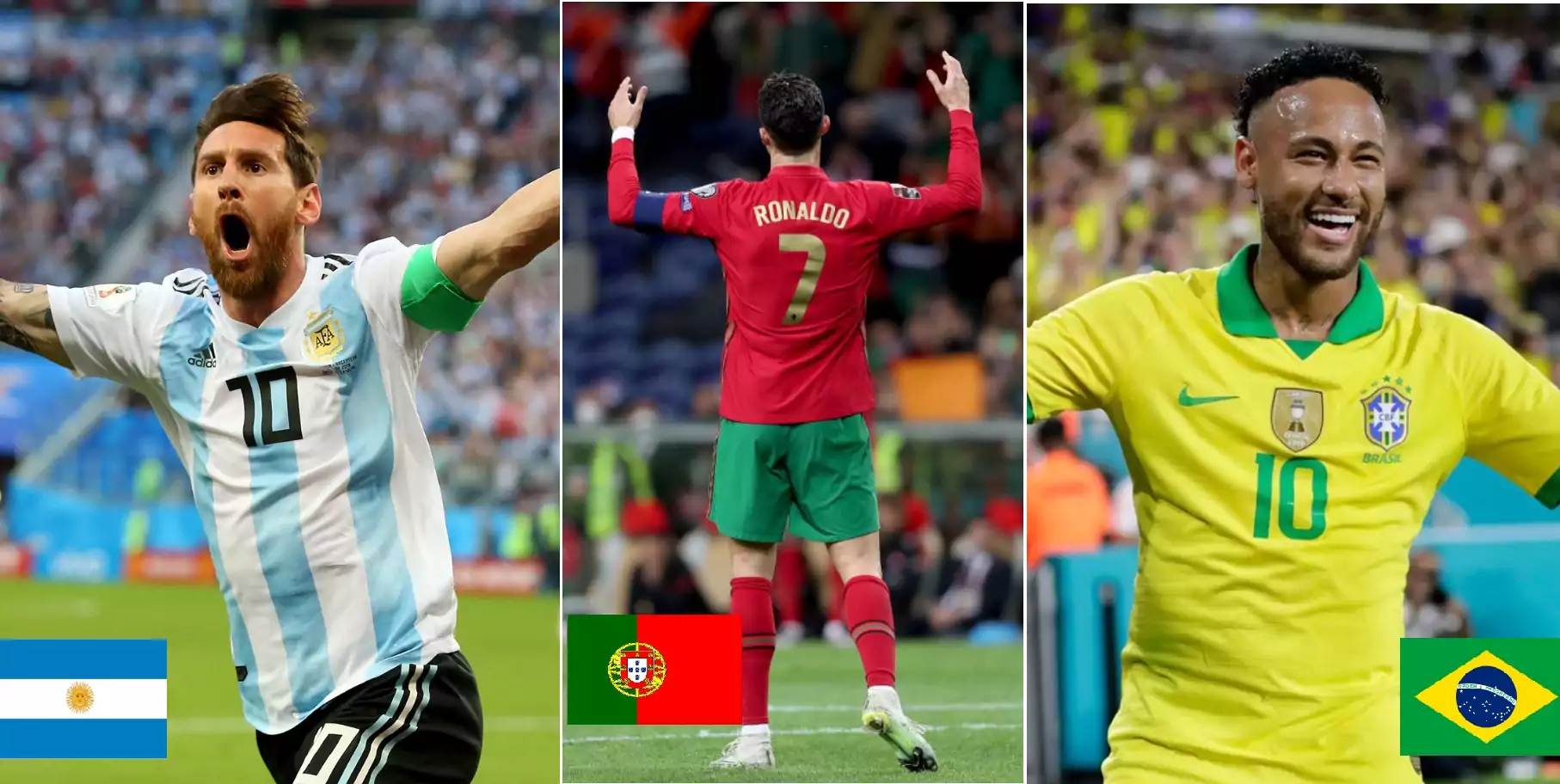
The 2026 FIFA World Cup will feature an expanded lineup of 48 teams, and the official draw will place every nation into four seeding pots ahead of the tournament. Scheduled for December 5, 2025, at the Kennedy Center in Washington, D.C., the draw will determine how teams are distributed across the competition’s new 12-group format.
Understanding how the World Cup pots system works is essential, as it directly influences which countries get favorable group-stage paths and which ones face tougher opponents early on.
The seeding process is based largely on the FIFA World Ranking, ensuring competitive balance and transparency as football’s biggest tournament prepares for its most ambitious edition yet.
2026 FIFA World Cup Pots Allocation & Draw Format
Table of Contents
What Are Pots? Understanding the Seeding System
The 2026 FIFA World Cup Pots system is FIFA’s method of dividing all 48 qualified teams into four tiers based on their FIFA World Ranking. Each group will contain exactly one team from each pot, ensuring competitive balance throughout the tournament.
Tournament Structure:
- Total Teams: 48
- Total Pots: 4
- Teams per Pot: 12
- Total Groups: 12
- Teams per Group: 4 (one from each pot)
Drawing Procedure:
Each of the 12 groups will feature one team selected from Pot 1, one from Pot 2, one from Pot 3, and one from Pot 4. This ensures that every group has a mix of top-ranked, mid-tier, and lower-ranked teams.
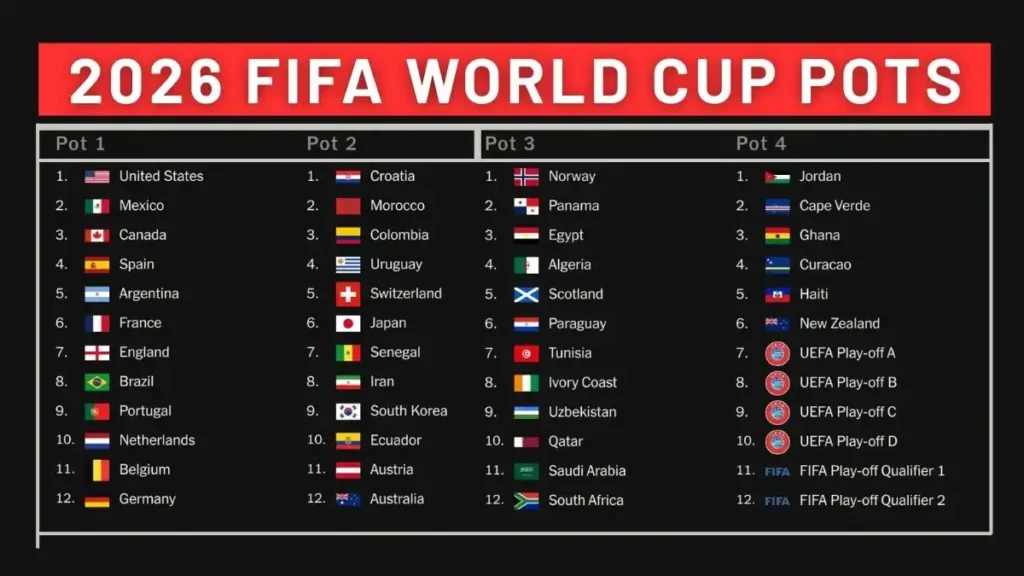
- Pot 1: Canada, Mexico, USA, Spain, Argentina, France, England, Brazil, Portugal, Netherlands, Belgium, Germany
- Pot 2: Croatia, Morocco, Colombia, Uruguay, Switzerland, Japan, Senegal, Iran, South Korea, Ecuador, Austria, Australia.
- Pot 3: Norway, Panama, Egypt, Algeria, Scotland, Paraguay, Tunisia, Côte d’Ivoire, Uzbekistan, Qatar, Saudi Arabia, and South Africa.
- Pot 4: Jordan, Cabo Verde, Ghana, Curaçao, Haiti, New Zealand, European Play-Off A, B, C and D, FIFA Play-Off Tournament 1 and 2
Which countries have qualified for the World Cup 2026?
As of now, 42 teams have qualified for the FIFA World Cup 2026 –
- Asia: Australia, Iran, Japan, Jordan, Qatar, Saudi Arabia, South Korea, Uzbekistan
- Africa: Algeria, Cape Verde, Egypt, Ghana, Ivory Coast, Morocco, Senegal, South Africa, Tunisia
- Europe: Austria, Belgium, Croatia, England, France, Germany, Netherlands, Norway, Portugal, Scotland, Spain, Switzerland
- North America: Argentina, Brazil, Colombia, Ecuador, Paraguay, Uruguay, Curacao, Panama, Haiti
- South and Central America: Canada, Mexico and the USA (Co-hosts), Panama, Haiti, and Curaçao
When is the FIFA World Cup 2026 scheduled?
The group stage schedule of the tournament begins on June 11, and the final match will be held in MetLife Stadium on July 19, 2026.
FIFA World Cup 2026 Final Draw pots
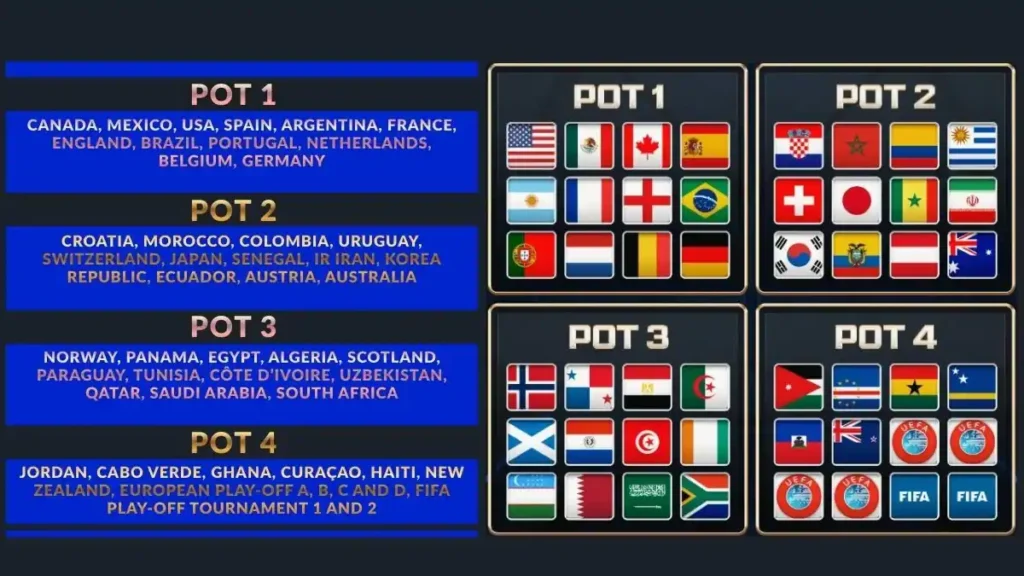
Pot 1: The Elite Teams (12 Teams)
Composition of Pot 1
Guaranteed Pot 1 Spots:
- 3 Host Nations (Automatic): United States, Mexico, Canada
- 9 Highest-Ranked Qualified Teams: Based on FIFA World Rankings as of November 19, 2025
Pot 1 Teams (Projected)
| Team | Confederation | Status |
|---|---|---|
| Spain | UEFA | World #1 Ranking |
| Argentina | CONMEBOL | South American Champion |
| France | UEFA | European Elite |
| England | UEFA | Top European |
| Portugal | UEFA | UEFA Finalist |
| Netherlands | UEFA | European Powerhouse |
| Brazil | CONMEBOL | South American Legend |
| Belgium | UEFA | European Elite |
| Germany | UEFA | European Champion |
| United States | CONCACAF | Host Nation |
| Mexico | CONCACAF | Host Nation |
| Canada | CONCACAF | Host Nation |
Special Pot 1 Rules:
- Mexico was automatically assigned to Group A (A1)
- Canada was automatically assigned to Group B (B1)
- The United States was automatically assigned to Group D (D1)
- Nine other Pot 1 teams distributed to remaining groups (C1, E1, F1, G1, H1, I1, J1, K1, L1)
Purpose of Pot 1
Pot 1 teams are the world’s elite and include the three host nations. Being in Pot 1 generally guarantees easier group opponents, though the three hosts receive pre-determined group placements to ensure they play in their home countries.
Pot 2: Strong European and Qualified Teams (12 Teams)
Composition of Pot 2
Allocation Criteria:
- Teams ranked 13-24 in FIFA World Rankings among qualified teams
- Primarily European and South American powerhouses outside Pot
- The Confederation’s diversity to prevent group clustering
Pot 2 Teams
| Team | Confederation | Status |
|---|---|---|
| Croatia | UEFA | European Runner-up |
| Morocco | CAF | African Qualifier |
| Ecuador | CONMEBOL | South American |
| Colombia | CONMEBOL | South American |
| Uruguay | CONMEBOL | South American Force |
| Switzerland | UEFA | European Quality |
| Japan | AFC | Asian Champion |
| Senegal | CAF | African Representative |
| Australia | AFC | Asian-Pacific |
| Iran | AFC | Asian Qualifier |
| South Korea | AFC | Asian Force |
| Austria | UEFA | European Quality |
Purpose: Pot 2 represents the tournament’s second-tier teams, creating balanced groups with Pot 1 while avoiding top-heavy matchups.
Pot 3: Mid-Tier Teams (12 Teams)
Composition of Pot 3
Allocation Criteria:
- Teams ranked 25-36 in FIFA World Rankings among qualified teams
- Mix of European, South American, African, and Asian teams
- Emerging football nations and consistent performers
Pot 3 Teams
| Team | Confederation | Status |
|---|---|---|
| Uzbekistan | AFC | Asian Qualifier |
| Saudi Arabia | AFC | Asian Qualifier |
| Panama | CONCACAF | Central American |
| South Africa | CAF | African Qualifier |
| Paraguay | CONMEBOL | South American |
| Egypt | CAF | African Representative |
| Scotland | UEFA | European Qualifier |
| Algeria | CAF | African Qualifier |
| Qatar | AFC | Asian Qualifier |
| Tunisia | CAF | African Qualifier |
| Norway | UEFA | European Qualifier |
| Ivory Coast | CAF | African Representative |
Purpose: Pot 3 creates balanced competitive matchups by mixing mid-tier teams, ensuring groups have a blend of established and emerging football nations.
Pot 4: Emerging and Playoff Teams (12 Teams)
Composition of Pot 4
Allocation Criteria:
- Lowest-ranked qualified teams (ranked 37+ in FIFA World Rankings)
- UEFA Nations League playoff winners (uncertain pot assignment)
- Inter-confederation playoff winners (AFC, CAF, CONCACAF, CONMEBOL, OFC)
- Emerging football nations
Pot 4 Teams
| Team | Confederation | Status |
|---|---|---|
| Jordan | AFC | Asian Qualifier |
| Cape Verde | CAF | African Qualifier |
| Ghana | CAF | African Representative |
| Curaçao | CONCACAF | Caribbean |
| Haiti | CONCACAF | Caribbean |
| New Zealand | OFC | Oceania Champion |
| European Play-Off A | UEFA | To Be Determined |
| European Play-Off B | UEFA | To Be Determined |
| European Play-Off C | UEFA | To Be Determined |
| European Play-Off D | UEFA | To Be Determined |
| Playoff Winners 1 | – | To Be Determined |
| Playoff Winners 2 | – | To Be Determined |
Playoff Uncertainty:
- Final Pot 4 composition depends on playoff outcomes in March 2026
- UEFA playoff winners will be placed in Pot 4 (or ranked-based pots per proposals)
- Inter-confederation playoff winners will occupy the remaining Pot 4 slots
Purpose: Pot 4 teams are generally the lowest-ranked qualifiers and represent emerging football nations, playoff winners, and smaller confederation representatives.
Draw Date and Procedure – Official Draw Information

- Draw Date: Friday, December 5, 2025
- Draw Time: 12:00 PM ET / 9:00 AM PT / 5:00 PM GMT
- Location: John F. Kennedy Center for the Performing Arts, Washington, D.C.
- Broadcast: Live on FOX, FOX Sports, streaming platforms
Draw Procedure Process:
- Each team has their name printed on a slip of paper
- Papers are folded and placed into plastic balls numbered 1-4 (representing each pot)
- The draw officials mix the plastic balls.
- Teams are selected one by one and placed into specific groups
Group Assignment Rules:
- One team from each pot goes into each group
- Mexico is assigned to Group A (A1)
- Canada is assigned to Group B (B1)
- The United States was assigned to Group D (D1)
- Remaining 9 Pot 1 teams fill Groups C, E, F, G, H, I, J, K, L (as C1, E1, F1, etc.)
- No more than 2 teams from the same confederation per group (UEFA exception allows up to 2 European teams)
2026 FIFA World Cup Pots Considerations: Why They Matter
Easier vs Harder Draws
Easiest Possible Draw (Pot 1 perspective):
- Pot 1 team + lowest Pot 2 team + Pot 3 team + Pot 4 team
- Generally features weaker opposition
Hardest Possible Draw (Pot 4 perspective):
- Pot 1 powerhouse + Pot 2 strong team + Pot 3 team + Pot 4 team
- Difficult matchups for emerging nations
Historical “Group of Death” Examples
2022 Qatar: Germany, Japan, Spain, Costa Rica
2018 Russia: Argentina, Iceland, Croatia, Nigeria
2014 Brazil: England, Italy, Uruguay, Costa Rica; Germany, Portugal, Ghana, USA
Prediction: With the expanded 48-team format and 12 groups, plenty of exciting matchups are bound to happen, though true “Groups of Death” are less likely due to the balanced distribution from the pot system.
FIFA World Ranking Determination
Ranking Timeline
Critical Date: FIFA World Rankings released on November 19, 2025, will determine pot allocation
Likely No Updated Rankings: Between November 19 and December 5 draw, FIFA is unlikely to release new rankings, meaning November 19 rankings will be used for final pot assignments
Ranking Criteria:
- Recent match results and performance
- Strength of opposition faced
- Points accumulated in qualification matches
- Regional confederation considerations
Confederation Distribution Across Pots

UEFA (Europe): 16 Teams Total
- Pot 1: Spain, France, England, Portugal, Netherlands, Belgium, Germany + 3 more UEFA elite
- Pot 2: Croatia, Italy (playoff), Austria, Switzerland, Denmark (playoff)
- Pot 3: Turkey (playoff), Poland (playoff), Scotland + others
- Pot 4: Remaining UEFA playoff winners
Challenge: With 16 European teams and 12 groups, UEFA will have multiple teams in some groups (maximum 2 per group)
CONMEBOL (South America): 6 Teams
Distribution: Argentina (Pot 1), Uruguay (Pot 2), Colombia (Pot 2), Paraguay (Pot 3), Chile (Pot 3), Bolivia (Playoff/Pot 4)
Advantage: Fewer South American teams ensure a maximum of one per group
CONCACAF (North America/Central America): 6 Teams
Guaranteed: United States (Host, Pot 1), Mexico (Host, Pot 1), Canada (Host, Pot 1)
Teams: Panama, Haiti, and Curaçao
Challenge: Three hosts in predetermined groups require careful distribution of other CONCACAF teams
CAF (Africa): 9 Teams
Projected Teams: Senegal, Egypt, Morocco, Ivory Coast, Algeria, Tunisia, Ghana, Cape Verde, South Africa
Distribution: Spread across Pot 2-4 to prevent African clustering
AFC (Asia): 8 Teams
Projected Teams: Japan, Iran, South Korea, Australia, Uzbekistan, Qatar, Saudi Arabia, Jordan
Distribution: Mix of developed (Japan, South Korea) and emerging (Uzbekistan, Qatar) Asian football nations
OFC (Oceania): 1 Team
Representative: New Zealand (Pot 4)
2026 FIFA World Cup Pots Playoff Impact
Unconfirmed Teams Before Draw
Six teams will be unknown during the December 5 draw:
- 4 UEFA Playoff Winners (determined March 2026)
- 2 Inter-Confederation Playoff Winners (determined March 2026)
Placeholder System
How It Works:
- Playoff spots held as placeholders during the draw
- Placeholders assigned to likely pots based on potential winners’ FIFA rankings
- Actual teams inserted once qualified in March 2026
Example: If Italy, a highly ranked team, wins the UEFA playoff, they’ll take the Pot 2 spot; but if a lower-ranked team comes out on top, Pot 4 is where they’ll most likely end up.
Group Stage Confederation Rules
No Same-Confederation Matchups (Mostly)
Rule: Teams from the same confederation cannot be drawn in the same group (except UEFA)
UEFA Exception:
- Maximum 2 European teams per group allowed
- With 16 UEFA teams and 12 groups, some groups must feature 2 European teams
- Cannot mathematically avoid this situation
Rationale: Ensures geographic diversity, prevents continental clustering, and balances tournament competitiveness
Timeline to Draw and Group Stage
| Event | Date |
|---|---|
| FIFA Ranking Update | November 19, 2025 |
| Playoff Teams Qualification | March 2026 |
| Final 48 Teams Confirmed | March 2026 |
| Official Draw | December 5, 2025 |
| Group Stage Begins | June 11, 2026 |
| Group Stage Concludes | June 27, 2026 |
| Round of 32 Begins | June 28, 2026 |
| Tournament Final | July 19, 2026 |
Strategic Implications for Teams
Pot 1 Teams: Advantages vs Disadvantages
| Advantages | Generally face a weaker Pot 3-4 opposition More predictable group composition Home advantage (for hosts) Pre-determined group placement (hosts) |
| Disadvantages | Cannot avoid facing other Pot 1/Pot 2 powerhouses Tournament favorites face increased pressure Knockout draw against other top seeds |
Pot 4 Teams: David vs Goliath Potential
| Advantages | Possibility of upsetting Pot 1-3 teams Lower pressure and expectations Tournament momentum possible |
| Disadvantages | Likely face Pot 1 powerhouse Difficult path to advancement Limited group stage control |