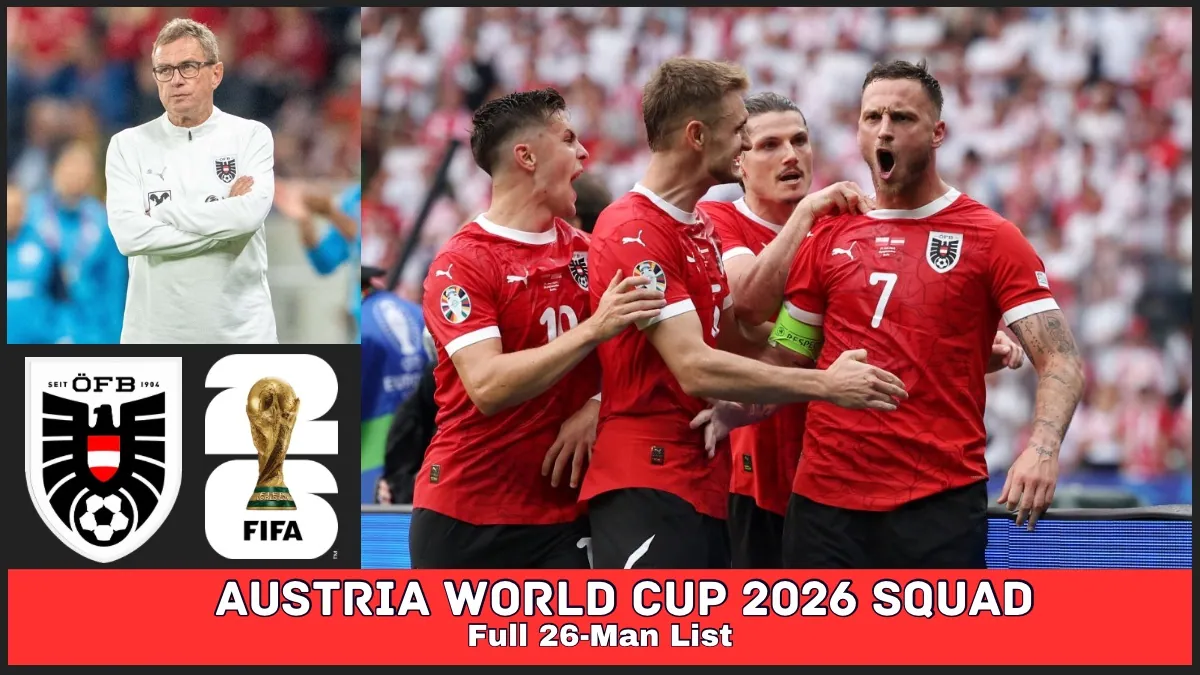
After a wait of 28 long years, Austria is back on football’s biggest stage. Ralf Rangnick officially named Austria World Cup 2026 Squad of 26-man squad for the 2026 FIFA World Cup on May 18, 2026.
The announcement ends nearly three decades of hurt since Austria last appeared at a World Cup in France 1998 — and signals the arrival of a confident, well-organised European side ready to prove they belong among the best in the world.
Led by Real Madrid captain David Alaba and record scorer Marko Arnautović, Austria head to North America with a squad that blends battle-hardened experience with exciting new talent.
Austria is in Group J with Argentina, Jordan and Algeria. Here is everything you need to know about the Austria World Cup 2026 Squad, key players, matches and more.
Austria’s Official Full 26-Man World Cup 2026 Squad
Ralf Rangnick’s final selection, officially confirmed Austria World Cup 2026 Squad on May 18, 2026:
- Goalkeepers: Alexander Schlager (Red Bull Salzburg), Florian Wiegele (Viktoria Plzeň), Patrick Pentz (Brøndby)
- Defenders: David Affengruber (Elche), Kevin Danso (Tottenham Hotspur), Stefan Posch (Mainz 05), David Alaba (Real Madrid, captain), Philipp Lienhart (SC Freiburg), Phillipp Mwene (Mainz 05), Alexander Prass (TSG Hoffenheim), Marco Friedl (Werder Bremen), Michael Svoboda (Venezia)
- Midfielders: Xaver Schlager (RB Leipzig), Nicolas Seiwald (RB Leipzig), Marcel Sabitzer (Borussia Dortmund), Florian Grillitsch (Braga), Carney Chukwuemeka (Borussia Dortmund), Romano Schmid (Werder Bremen), Christoph Baumgartner (RB Leipzig), Konrad Laimer (Bayern Munich), Patrick Wimmer (VfL Wolfsburg), Paul Wanner (PSV Eindhoven), Alessandro Schöpf (Wolfsberger AC)
- Forwards: Marko Arnautović (Red Star Belgrade), Michael Gregoritsch (FC Augsburg), Saša Kalajdžić (LASK)
The Historic Return: Austria’s 28-Year World Cup Absence
To understand just how significant this moment is for Austrian football, you have to wind the clock back to France 1998. That was the last time the red-and-white of Austria graced a World Cup stage. Nearly three decades of near-misses, disappointments, and painful play-off defeats followed — until now.
Austria’s qualification for 2026 came in dramatic circumstances. It was Michael Gregoritsch’s equaliser in the dying minutes of their European qualifier — thirteen minutes from time — that secured their group victory and punched their ticket to North America. The scenes that followed were electric. A nation that had waited 28 years finally had its moment.
Under Ralf Rangnick, who turned down the Bayern Munich job to continue his project with the national team, Austria have undergone a genuine transformation. Rangnick’s high-pressing, tactically disciplined style has turned this squad into one of Europe’s most competitive sides — as their qualification run emphatically proved.
Rangnick’s Bold Choices: Youth Meets Experience
The most talked-about aspect of Austria’s squad announcement was Rangnick’s decision to include two newly naturalised dual-national talents — Paul Wanner and Carney Chukwuemeka.
Wanner, the PSV Eindhoven prodigy, and Chukwuemeka, the Borussia Dortmund midfielder, both committed their international futures to Austria this year and have been fast-tracked directly into the World Cup squad. It is a bold, forward-thinking move that signals Rangnick is building not just for the present, but for the future.
“With 14 of the 26 players playing in German leagues, the Austrian team has a decidedly German vibe,” — a reflection of the deep cultural and football ties between the two neighbouring nations. Nine players have at least 50 international caps, giving Austria a wealth of experience throughout the squad.
There were also notable absentees through injury — Tobias Lawal (Genk) and Maximilian Wöber (Werder Bremen) both missed out through fitness issues, heartbreak for two players who had featured in recent squads.
Key Players to Watch in the Austria World Cup 2026 Squad

David Alaba — The Captain and Talisman
There is no Austrian player more important to this squad than David Alaba. The Real Madrid defender is not just Austria’s captain — he is their most decorated, most experienced, and most influential player by some distance. Alaba has won everything there is to win at club level, including multiple Champions League titles with Bayern Munich and Real Madrid.
His ability to read the game, lead by example, and perform on the biggest stages is exactly what Austria will need in a group containing Argentina and Algeria.
At 32, Alaba enters this tournament with a point to prove after injury disruptions in recent seasons. When fit, there are few defenders in the world with his combination of technical quality and leadership. Austria’s defensive record — allowing their opponents to complete just 73.8% of their passes since Euro 2024, the lowest mark of any team in the World Cup field — is a direct reflection of Rangnick’s system and Alaba’s presence.
Marko Arnautović — The Veteran Leader
At 37 years old, Marko Arnautović is Austria’s all-time leading scorer and one of European football’s most iconic figures. The Inter Milan forward has had a career that has taken him from Stoke City and West Ham to the San Siro — and now, remarkably, to a World Cup. This will almost certainly be his final tournament appearance, and Arnautović will want to leave the biggest stage with a performance that lives long in Austrian football memory.
His physical presence, technical quality, and sheer experience make him invaluable to Rangnick’s setup. He is not just a striker — he is the emotional heartbeat of this squad.
Marcel Sabitzer — The Midfield Engine
Borussia Dortmund’s Marcel Sabitzer is arguably the most technically complete player in Austria’s squad. A dynamic, two-way midfielder capable of scoring, creating, and pressing relentlessly — Sabitzer epitomises everything Rangnick demands from his players. He will be the fulcrum of Austria’s midfield in North America, responsible for both controlling possession and driving Austria forward in transition.
Konrad Laimer — The Bayern Press Machine
Bayern Munich’s Konrad Laimer is one of the most physically intense midfielders in European football. His ability to win the ball back high up the pitch and immediately transition into attack is central to how Rangnick wants Austria to play. Against sides like Argentina, who love to dominate possession, Laimer’s pressing intensity will be absolutely critical.
Carney Chukwuemeka & Paul Wanner — The New Generation
The two wildcard inclusions are perhaps the most intriguing names in Austria’s squad. Chukwuemeka — who has yet to win his first cap for Austria — is an intensely talented attacking midfielder, capable of the spectacular.
Wanner, the PSV prodigy, has more than enough talent to start in a World Cup. Both players could announce themselves on the global stage in North America. Their decision to commit to Austria over England and Germany respectively is a significant statement of intent about where this squad is heading.
Kevin Danso — The Premier League Rock
Tottenham Hotspur’s Kevin Danso is the only player in Austria’s squad currently playing in the Premier League — and he is one of the most physically imposing defenders at the tournament.
Strong in the air, dominant in one-on-one situations, and excellent with the ball at his feet, Danso gives Austria a defensive profile that can handle even the most dangerous attackers.
Austria’s Group J Fixtures — FIFA World Cup 2026

Austria have been drawn into Group J alongside defending champions Argentina, Algeria, and World Cup debutants Jordan. It is a challenging draw, but one Rangnick’s side will approach with confidence.
🇦🇹 Austria vs 🇯🇴 Jordan — June 17, 2026 | Levi’s Stadium, Santa Clara, California
🇦🇷 Argentina vs 🇦🇹 Austria — June 22, 2026 | AT&T Stadium, Arlington, Texas
🇩🇿 Algeria vs 🇦🇹 Austria — June 27, 2026 | Arrowhead Stadium, Kansas City, Missouri
The opener against Jordan — a World Cup debutant — represents Austria’s best opportunity to get off to a flying start and establish early momentum. The match against Argentina will be the defining challenge of their group stage, while the final game against Algeria could prove decisive in determining who advances.
Before the World Cup begins, Austria will also play a warm-up friendly against Tunisia.
Austria’s World Cup History — A Proud Footballing Nation
Austria may be returning after 28 years away, but theirs is a proud World Cup history that many casual fans overlook:
- 1954 (Switzerland): Austria’s finest hour — a third-place finish at the World Cup, playing some of the most attacking football of the era.
- 1978 (Argentina): Austria reached the second group stage and famously beat West Germany 3-2 in a dramatic match.
- 1982 (Spain): Qualification achieved but eliminated in the group stage.
- 1990 (Italy): Group stage exit.
- 1998 (France): Their last World Cup before 2026 — group stage exit.
Now, 28 years later, Rangnick’s Austria arrive with far greater tactical sophistication than any of their predecessors. The goal is not just to participate — it is to reach the knockout rounds for the first time since 1954.
Can Austria Cause an Upset in Group J?
On paper, Argentina — with Lionel Messi and a squad full of world-class talent — are the runaway favourites to win Group J. But Austria will not simply roll over. Rangnick’s side have the defensive organisation to frustrate even the most attack-minded teams, and the quality in midfield to punish any opponent on the counter.
Algeria, who themselves knocked out Germany in 2014, present a genuine threat. And Jordan, as debutants, will be motivated and dangerous in their opening match against Austria. This group will be far more competitive than many expect.
Austria’s predicted XI:
- GK: Patrick Pentz
- DF: Stefan Posch, Kevin Danso, David Alaba, Phillipp Mwene
- MF: Nicolas Seiwald, Konrad Laimer, Marcel Sabitzer, Christoph Baumgartner
- FW: Marko Arnautović, Michael Gregoritsch, Saša Kalajdžić, Patrick Wimmer
If Austria can build on their opening win against Jordan, a strong performance against Argentina could set up a last-16 place — and that is very much within this squad’s capabilities.
When did Austria last play at a World Cup?
Austria last appeared at the FIFA World Cup in France 1998 — a gap of 28 years before their return in 2026.
Who is Austria’s coach for the 2026 World Cup?
Ralf Rangnick, the German tactical innovator who turned down the Bayern Munich job to continue building with Austria’s national team.
Who is Austria’s captain at the 2026 World Cup?
David Alaba, the Real Madrid defender, captains Austria at the tournament.
Who is Austria’s all-time leading scorer in the squad?
Marko Arnautović is Austria’s all-time record scorer and leads the attacking line at 37 years old.
Which group is Austria in at the 2026 World Cup?
Austria are in Group J alongside defending champions Argentina, Algeria, and Jordan.
When does Austria play their first World Cup 2026 match?
Austria open their campaign against Jordan on June 17, 2026, at Levi’s Stadium in Santa Clara, California.
Who are the newly naturalised players in Austria’s squad?
Paul Wanner (PSV Eindhoven) and Carney Chukwuemeka (Borussia Dortmund) both recently committed their international futures to Austria and have been included in the World Cup squad.