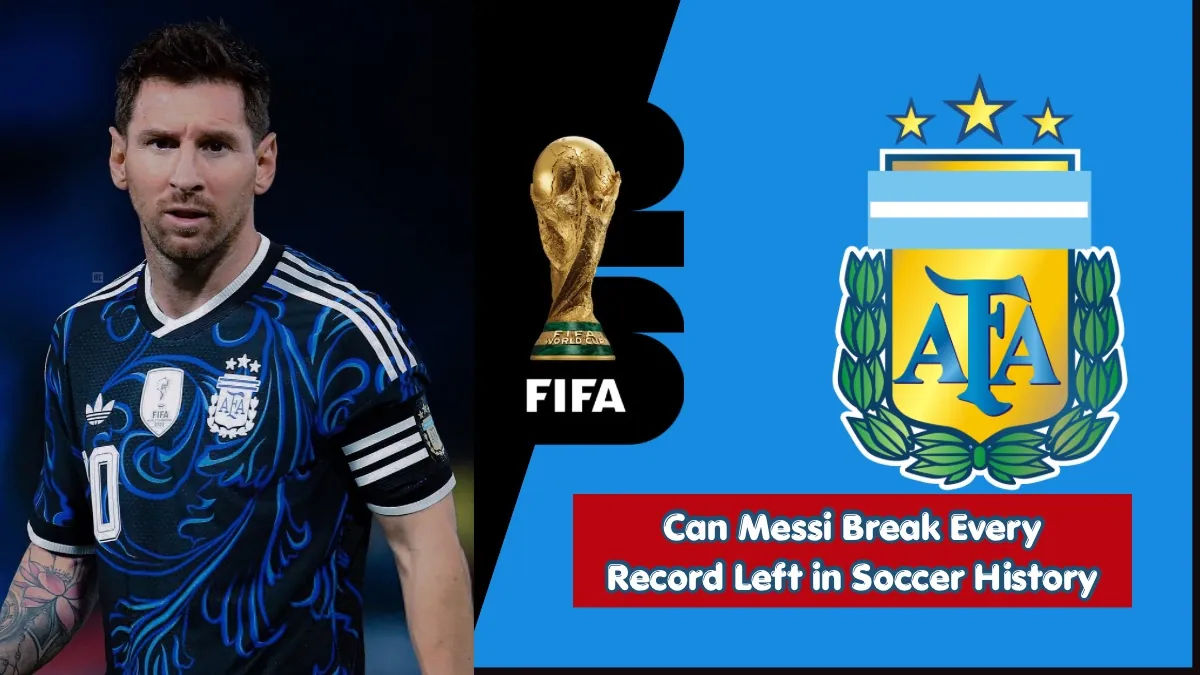
He turns 39 two days after Argentina’s second group game. His boots are already named “El Último Tango.” And he is three goals away from a record that has stood since 2014. For Lionel Messi, the 2026 FIFA World Cup is not just another tournament — it is football’s most anticipated farewell tour.
Can Messi break every record: Goals, History & Everything That’s at Stake

Every World Cup Messi has played in has carried weight. The fresh-faced teenager in 2006 who came off the bench to score a stunning chip against Serbia.
The heartbreak of 2014’s extra-time final defeat. The lonely trudge through 2018. And then, 2022 — the one the entire football world had been willing him toward, finally delivered on a night in Lusail that will be replayed for as long as the game is played.
But 2026 is different in a way none of those were. This one comes with a clock attached. Not just metaphorically — the Adidas boot campaign for the tournament is literally called “El Último Tango.”
The last dance. His own federation has him in a provisional squad list that reads like the final chapter of a story that began when most of his current teammates were in primary school.
He has not officially confirmed this will be his last World Cup dance. He has been careful about that. In a Sky Sports interview, he said: “I would like to be there, to be well and be an important part of helping my team, if I am there.
I’m going to assess that on a day-to-day basis.” But his Inter Miami contract runs to 2028, he is still being selected for every Argentina window, and Scaloni has made no secret that Messi is the heartbeat of everything he builds.
Barring injury, number 10 will walk out at Arrowhead Stadium on June 16 against Algeria, and the football world will hold its breath.
Key Stats Entering 2026
- 26 World Cup appearances
- Most in history
- 13 World Cup goals
- Needs 4 more to beat Klose’s 16 goals
- 2,314 minutes played
- World Cup record
- 11 Man of the Match awards at World Cups
- World Cup record
- Only player to win the Golden Ball twice
- 2014 and 2022)
- Only player to assist in five different World Cups
- 2006, 2010, 2014, 2018, and 2022
- 121 successful World Cup dribbles
- All-Time Record
- 6th – World Cup appearance
- First in history for any male player
Tournament by tournament — 20 years of World Cup history

2006 – Germany — debut, one goal, Age 18
Came off the bench to score a brilliant chip against Serbia. Argentina was eliminated by Germany in the quarters on penalties. The world caught its first World Cup glimpse of what was coming.
2010 – South Africa — 5 games, 0 goals
Already the world’s best player, yet goalless across five appearances. Argentina swept aside all group opponents before Maradona’s side were dismantled 4–0 by Germany in the quarters. The number that haunted a generation.
2014 – Brazil — 4 goals, Golden Ball, final heartbreak
Four goals in the group stage including a brace against Nigeria. Carried Argentina to the final almost single-handedly — then watched Mario Götze break hearts with an extra-time winner. Won the Golden Ball in defeat. One of football’s most poignant images.
2018 – Russia — 1 goal, knocked out by France
A tournament of chaos and near-misses. One of football’s great individual goals against Nigeria — the chest control, the turn, the finish — in a group they nearly didn’t escape. Then a thrilling 4–3 defeat to France in the last 16, featuring a young Mbappé’s breakout moment.
2022 – Qatar — 7 goals, Golden Ball, World Champion 🏆
The greatest World Cup ever played, headlined by the greatest player who ever lived. Seven goals including a penalty and a rolling finish in the final against France — a 3–3 draw settled on penalties. Five Man of the Match awards. The golden trophy finally lifted. The career bookended.
2026 – USA/Canada/Mexico — the record-breaking finale?
Group J: Algeria (June 16, Kansas City), Austria (June 22, Dallas), Jordan (June 27, Dallas). The path to a second consecutive title — and the records — begins here.
The records he already owns — untouchable
Before we get to what he can still achieve, it is worth pausing on what he has already done. Some of these records were broken in 2022 and will not be touched by anyone currently playing.
The World Cup creates countless records, but the big question is: Can Messi break every record? Here are a few records that Lionel Messi could potentially break.
Most World Cup appearances — 26 matches Outright record
More World Cup appearances than any male player in history. He surpassed Germany’s Lothar Matthäus during the 2022 tournament and now sits four ahead of second place. Every match he plays in 2026 extends this record further.
Most minutes played — 2,314 Outright record
He broke Italy’s Paolo Maldini’s record of 2,217 minutes during the 2022 final. Every minute at 2026 is uncharted territory.
Most Man of the Match awards — 11 Outright record
No player has been named Player of the Match more than Messi at World Cups. Remarkably, five of those 11 came in Qatar alone.
Only player to win the Golden Ball twice Unique record
2014 in defeat, 2022 in triumph. No male player has ever won the World Cup’s Best Player award more than once.
Only player to assist in five different World Cups Unique record
Cristiano Ronaldo scored at five World Cups but never matched Messi’s creative record. An assist in 2026 would extend this to six consecutive tournaments.
Most successful dribbles in World Cup history — 121 Outright record
His 46 successful dribbles at the 2014 World Cup alone rank third all-time in a single tournament — behind only Maradona (53 in 1986) and Jairzinho (47 in 1970).
The records he can still break — the 2026 targets

The big one: Miroslav Klose’s all-time scoring record
This is the record the entire football world is watching. Miroslav Klose retired from international football having scored 16 goals across four World Cups — a mark that has stood since Germany’s third-place finish at Brazil 2014. Messi enters 2026 with 13 goals. He needs four to break the World cup record outright. Three to match it.
All-time World Cup top scorers:
| Player | Goals |
|---|---|
| Miroslav Klose (record) | 16 |
| Ronaldo (Brazil) | 15 |
| Gerd Müller | 14 |
| Lionel Messi (entering 2026) | 13 |
| Just Fontaine | 13 |
Can Messi break every record? He scored seven goals in Qatar. He scored eight goals in South American qualification — finishing as the competition’s top scorer.
In a 48-team format with potentially seven matches (compared to seven in Qatar), Argentina have a genuinely favourable group in J.
Messi needs to average roughly one goal every two games across a full tournament run — that is not an unreasonable ask from a player still operating at this level.
For context on the scale of the task: Klose scored his 16 goals across four tournaments spanning 12 years (2002–2014). Messi has three chances to score four more — meaning he needs roughly his average output from any other recent tournament. Qatar alone got him halfway there.
First Male Player to Appear in Six World Cups
Five players have appeared in five World Cups: Matthäus (Germany), Carbajal and Márquez and Guardado (Mexico), and Ronaldo (Portugal). No male player has ever appeared in six. If Messi takes the field in any match in 2026, he becomes the first.
Mexico’s goalkeeper Guillermo Ochoa could also reach six, but was unused in 2006 and 2010 — Messi’s participation would be unambiguous.
Scoring at six consecutive World Cups
Ronaldo scored at each of his five World Cups (2006–2022). Messi scored at 2006, 2014, 2018, and 2022, but was goalless in 2010.
He cannot claim the “consecutive” scoring record across all six — but scoring at a sixth separate tournament would still be an extraordinary data point for the ages.
A Third Golden Ball
Messi already holds the record for most Golden Ball awards with two. A third would not only extend his own record — it would be one of the most statistically improbable achievements in football history.
For it to happen, Argentina would need a deep run and Messi would need a tournament at least approaching Qatar 2022. Neither is beyond the realm of possibility.
Most World Cup Penalty Shootout Goals
Messi and Croatia’s Luka Modrić have each scored in three World Cup penalty shootouts.
A goal in a fourth shootout for either player would be a record outright. Argentina’s history in knockout football suggests they may well end up in at least one more.
The all-time scoring table if Messi hits the record
| Player | Country | Tournaments | Goals |
|---|---|---|---|
| Lionel Messi (target) | Argentina | 6 | 17 |
| Miroslav Klose | Germany | 4 | 16 |
| Ronaldo (R9) | Brazil | 4 | 15 |
| Gerd Müller | Germany | 2 | 14 |
| Just Fontaine | France | 1 | 13 |
| Lionel Messi (current) | Argentina | 5 | 13 |
Argentina’s Group J — The Path to Glory
On paper, Argentina drew about as favourable a group as a defending champion could hope for. Group J pairs them with Algeria (ranked 28th), Austria (making their first 21st-century World Cup appearance), and Jordan (making their tournament debut).
Argentina open against Algeria on June 16 at Arrowhead Stadium in Kansas City. Messi turns 39 on June 24 — two days after their second match against Austria in Dallas. Their final group game is against Jordan, also in Dallas on June 27.
- June 16 — Argentina vs Algeria, Arrowhead Stadium, Kansas City
- June 22 — Argentina vs Austria, AT&T Stadium, Dallas (Messi turns 39 on June 24)
- June 27 — Argentina vs Jordan, AT&T Stadium, Dallas
Recent history is not kind to defending champions. Three of the last four title holders were eliminated in the group stage. Argentina will be conscious of that — and Scaloni’s side has been preparing accordingly, with Messi featuring in both March 2026 friendlies.
The road to a second consecutive title would require Argentina to navigate the knockout rounds in a 48-team format that goes: Round of 32, Round of 16, Quarter-finals, Semi-finals, Final.
That is potentially seven matches. If Argentina go the distance, Messi could play up to seven games — more than enough runway to break every remaining record.
Can Argentina win back-to-back?
Only Italy (1934, 1938) and Brazil (1958, 1962) have ever retained the World Cup. Argentina are trying to do what no team has done in over six decades.
The squad that won in Qatar remains largely intact — Emiliano Martínez in goal, Otamendi and Romero in defence, Mac Allister and Enzo Fernández in midfield, Lautaro Martínez and Julián Álvarez alongside Messi in attack.
Angel Di María — the man whose extra-time goal in the Qatar final is one of the great World Cup moments — retired from international football in 2024 and is the only notable absentee from the 2022 starting XI.
The spine of the team is a year older but carries the weight of knowing exactly what winning feels like.
“I hope I can be there. I’ve said before that I’d love to be there. At worst, I’ll be there watching it live, but it will be special. The World Cup is special for everyone, for any country, especially for us, because we live it in a completely different way.”
— Lionel Messi, February 2026
What comes after — and why this moment is irreplaceable
Messi has spoken publicly about life after football. He has ruled out management — “I don’t see myself as a coach” — and spoken instead of wanting to own a club: “I like the idea of being a manager, but I’d prefer to be an owner. I’d like to have my own club, start from the bottom, and make it grow.” His Inter Miami contract runs until 2028, and there is a genuine possibility he is still playing professionally at 41.
But a World Cup at 41 is a different conversation entirely. This is, almost certainly, it.
What makes 2026 irreplaceable is not just the records on offer, though the top-scoring record would be the crowning statistical achievement of the most decorated career in football history.
It is the context. The defending champions, playing in North America, with Messi as their aging, beloved captain, trying to do something no team has done in 64 years. With the world watching, knowing this is probably the last time.
There is a Spanish word for it — despedida. A farewell. The kind that carries everything the relationship ever meant, compressed into one final act.
Four goals to make history. Seven matches to win the world. Thirty-nine years old and still the most important footballer on the planet.
This is Messi’s last tango. And the music is just beginning.