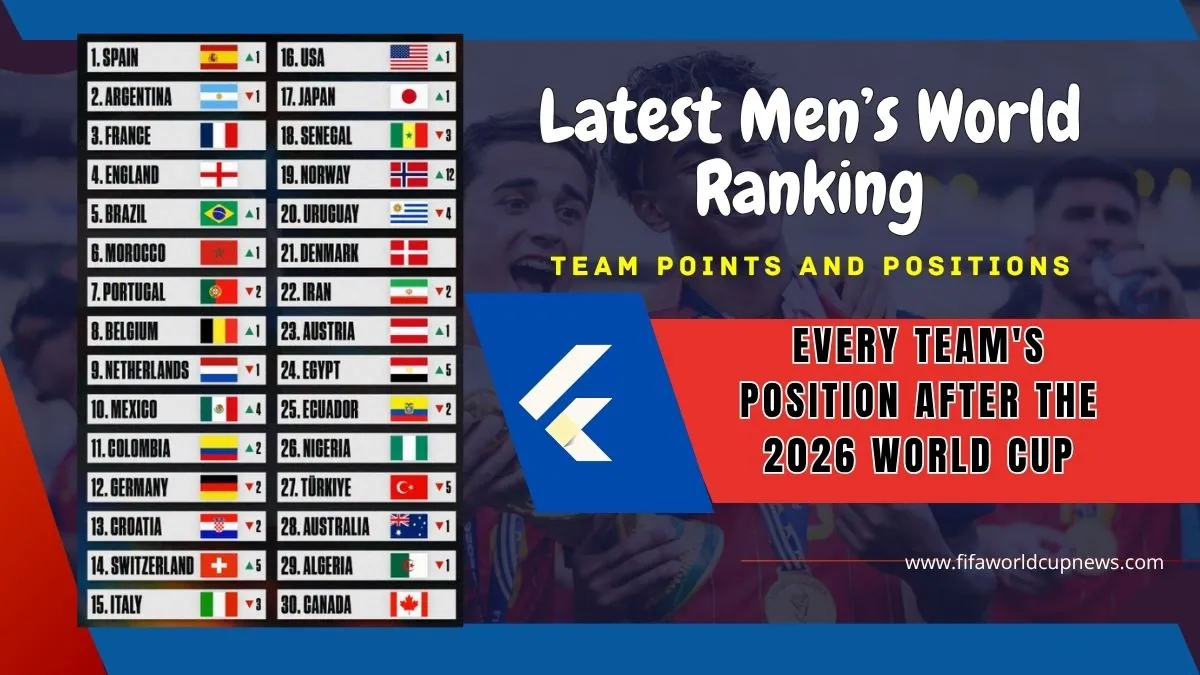
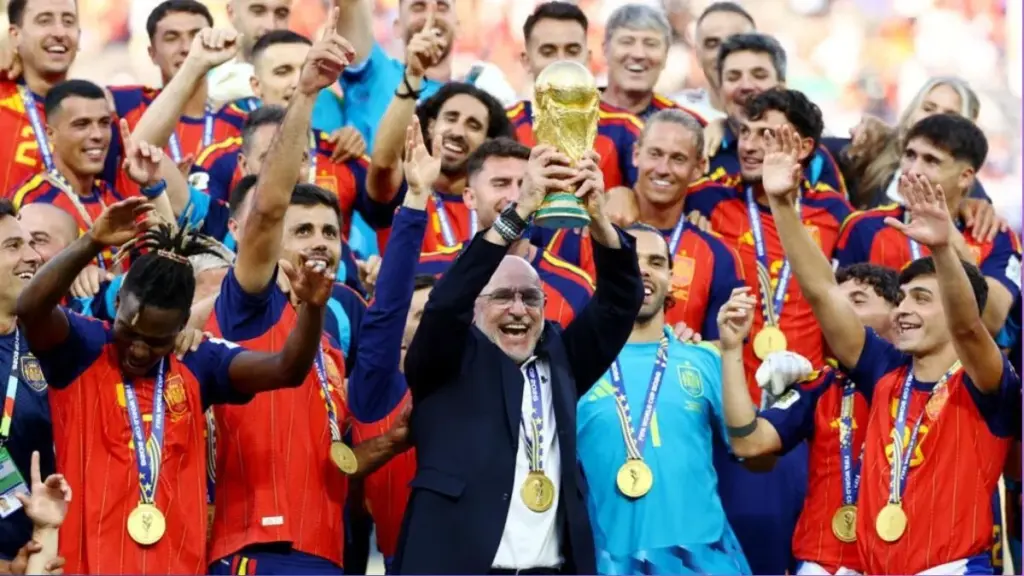
The curtain came down on an unforgettable and historic FIFA World Cup 2026 as Spain earned a coveted second star and reclaimed pole position in the FIFA/Coca-Cola Men’s World Ranking.
The rankings released on July 20, 2026, the morning after the final at MetLife Stadium, reflect the most consequential reshuffling of the top ten since Argentina climbed to number one following their 2022 Qatar triumph.
Spain moved up, Norway made the biggest jump in the entire top 20, and a host nation that entered the tournament ranked fifteenth has now broken into the top ten for the first time in years.
Official FIFA World Rankings After the 2026 World Cup
The 2026 tournament produced an unusually clear hierarchy at the top of men’s international soccer. Spain, Argentina, France, and England reached the semifinals and emerged as FIFA’s four highest-ranked teams afterwards.
This marked the first time the two lists had aligned since the World Cup began in 1930. Together, the four nations have won eight World Cup titles.
| Rank | Team | Points | Change | World Cup Finish |
|---|---|---|---|---|
| 1 | Spain | 1995.88 | Up 1 | Champions |
| 2 | Argentina | 1970.37 | Down 1 | Runners-Up |
| 3 | France | 1948.97 | No change | Third Place |
| 4 | England | 1922.83 | No change | Fourth Place |
| 5 | Brazil | 1804.92 | Up 1 | Quarter-Final |
| 6 | Morocco | 1803.99 | Up 1 | Quarter-Final |
| 7 | Portugal | 1787.85 | Down 2 | Round of 16 |
| 8 | Belgium | 1778.36 | Up 1 | Round of 16 |
| 9 | Netherlands | 1775.54 | Down 1 | Round of 32 |
| 10 | Mexico | 1754.30 | Up 4 | Quarter-Final |
1. Spain — World Champions, New Number One
La Roja supplant runners-up Argentina as the planet’s top men’s team after beating them 1-0 in extra time in the final. Spain entered the tournament ranked second and leave it at the summit.
Winning eight matches and conceding just one goal throughout the entire competition is the kind of statistical record that makes the ranking movement feel entirely logical.
Rodri, Unai Simón, Pau Cubarsí, and a squad that never needed to play at its maximum to beat most opponents — that combination of depth and organisation is exactly what the points system is designed to reward.
2. Argentina — Runners-Up Drop One
Spain knocked Argentina off its perch atop the rankings after Sunday’s 1-0 victory, with Lionel Messi and Co. falling to number two.
Despite reaching the final and finishing runners-up, Argentina lose the top spot they held coming into the tournament. The FIFA points system rewards the winner and adjusts every other team accordingly, meaning even finishing second to the new champions results in a net loss.
Argentina remain comfortably ahead of third-placed France, but the gap between them and Spain at the top is now real and will likely persist until the next major competition cycle.
3. France — Third Place, Third in Rankings
France entered the tournament ranked third and leave it in third, their position in the rankings mirroring their position on the pitch almost exactly.
France remains in third despite losing to England in the third-place contest 6-4, a result that produced one of the tournament’s most entertaining matches but ultimately cost them nothing in ranking terms.
Mbappé’s Golden Boot and ten goals across eight matches ensure France carry significant momentum into the next cycle, and their ranking reflects a team that remains one of the most dangerous in the world.
4. England — Unchanged at Fourth
England finish the tournament exactly where they started it in the rankings, though the experience of reaching a World Cup semi-final for the first time since 1990 carries weight beyond a number.
The biggest mover inside the top 20 is Norway after it advanced to the quarterfinals before losing to England 2-1. That quarter-final win over Norway, and the semi-final against France before their third-place finish, represents England’s deepest World Cup run in 36 years. The ranking does not move, but the belief inside this squad has shifted considerably.
5. Brazil — Up One
Brazil managed to climb one spot in the FIFA ranking despite being eliminated by Norway in the quarter-finals, a result that raised questions about Carlo Ancelotti’s side heading into a new qualification cycle.
That they move upward at all reflects the strength of their performances before the Norway loss and the fact that several nations ranked above them entering the tournament performed worse. Brazil remain the nation with the most World Cup titles and one of only five to have ever won it.
6. Morocco — Up One
Morocco’s quarter-final exit produced a ranking rise, confirming their status as Africa’s most credible football nation at the global level.
Morocco’s fourth-place finish in 2022 remains the best result any African or Asian team has produced, and while 2026 ended a round earlier, their presence in the last eight for the second consecutive tournament is a statement about the growth of the Moroccan programme under Walid Regragui.
7. Portugal — Down Two
Portugal drop two spots to number seven after a Round of 16 exit that left the nation wondering whether the Cristiano Ronaldo era has ended without the one trophy that eluded him throughout his career.
The squad has genuine quality beyond Ronaldo in João Neves, Vitinha, and Rafael Leão, but a team expected to go further than the Round of 16 cannot emerge from the tournament with a higher ranking than the one they carried into it.
8. Belgium — Up One
Belgium’s campaign ended in the Round of 16, but their group stage form — particularly Kevin De Bruyne’s final tournament before retirement — was strong enough to deliver a modest ranking rise. Belgium moved up one spot to eighth.
9. Netherlands — Down One
The Netherlands also suffered a slight decline compared to where they stood at the start of the tournament.
A Round of 32 exit to Morocco on penalties, after holding a lead, was the kind of result the points system penalises. They drop one place to ninth.
10. Mexico — Back in the Top Ten
Tournament co-hosts Mexico are back in the top ten for the first time since March 2022, climbing four positions after reaching the quarter-finals on home soil.
For a nation whose football federation has faced years of criticism and declining results, a quarter-final appearance as co-host represents genuine progress. The jump of four places is the largest upward movement of any top ten team in this update.
Biggest Movers
Norway sits in the number 19 spot after a massive 12-spot leap, the biggest single movement of any team in the top 20.
Erling Haaland’s first major tournament debut, followed by a quarter-final run that ended against England, transformed Norway’s ranking from an afterthought to a genuine top-twenty presence.
Colombia moved up two spots to eleventh. Germany dropped two spots to twelfth after a quarter-final exit. Uruguay fell four places to twentieth following their group-stage elimination.
The USA moved up one spot to sixteenth after their Round of 16 exit, a modest rise that reflects a decent group-stage campaign undermined by the knockout-round departure. Japan are seventeenth after also moving up one position.
Top 30 Latest Men’s World Ranking Teams
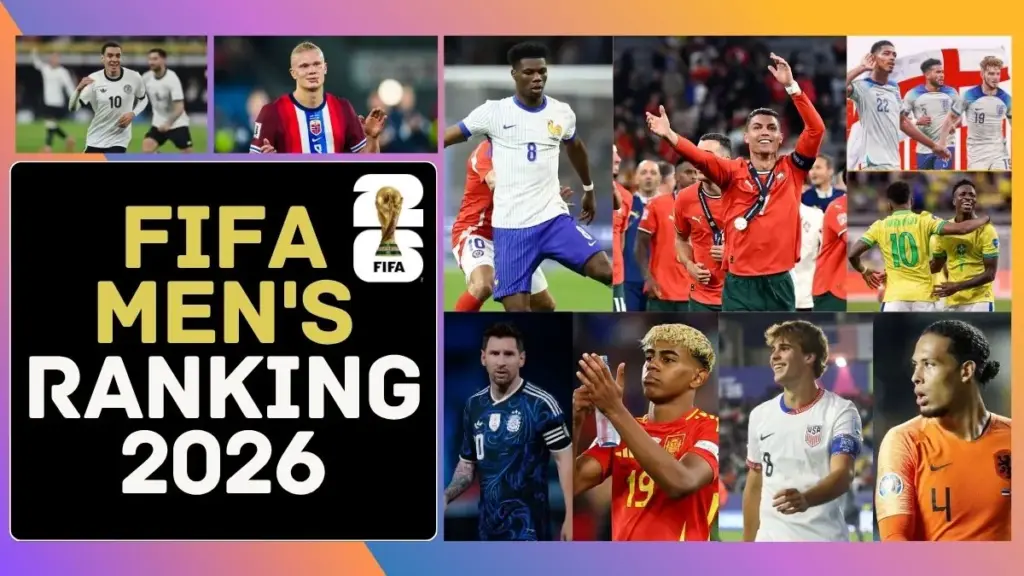
| Rank | Team | Points |
|---|---|---|
| 1 | Spain | 1995.88 |
| 2 | Argentina | 1970.37 |
| 3 | France | 1948.97 |
| 4 | England | 1922.83 |
| 5 | Brazil | 1804.92 |
| 6 | Morocco | 1803.99 |
| 7 | Portugal | 1787.85 |
| 8 | Belgium | 1778.36 |
| 9 | Netherlands | 1775.54 |
| 10 | Mexico | 1754.30 |
| 11 | Colombia | 1739.89 |
| 12 | Germany | 1726.22 |
| 13 | Croatia | 1723.05 |
| 14 | Switzerland | 1710.88 |
| 15 | Italy | 1704.73 |
| 16 | United States | 1690.33 |
| 17 | Japan | 1673.68 |
| 18 | Senegal | 1653.43 |
| 19 | Norway | 1651.29 |
| 20 | Uruguay | 1634.70 |
| 21 | Denmark | 1619.47 |
| 22 | IR Iran | 1609.85 |
| 23 | Austria | 1598.82 |
| 24 | Egypt | 1597.04 |
| 25 | Ecuador | 1592.59 |
| 26 | Nigeria | 1585.02 |
| 27 | Türkiye | 1582.54 |
| 28 | Australia | 1581.51 |
| 29 | Algeria | 1576.80 |
| 30 | Canada | 1571.34 |
What Comes Next
Despite difficult periods for traditional powers such as Germany and Italy, Europe remains the dominant region in men’s international soccer. Nine of FIFA’s top 15 teams represent Europe, including three of the four 2026 World Cup semifinalists.
The next official FIFA rankings update is scheduled for October 7, 2026, when Nations League and qualifying matches begin reshaping the hierarchy again.
Spain sit at the top of world football for the first time since 2025, and with the youngest squad of any 2026 semi-finalist, the expectation inside the federation is that they will not be moving downward anytime soon.
FIFA rankings are updated after every official international window. The next update following the 2026 World Cup is scheduled for October 7, 2026. For complete World Cup results, award winners, and historical rankings data, follow FIFA World Cup News.