When people think of Canadian sports, they think of the NHL and frozen ponds. However, if you look at the local parks from Vancouver to Halifax, you won’t see pucks; you’ll see soccer balls in Canadian Sports.
Today, soccer has more registered players in Canada than ice hockey, thanks to its accessibility, global appeal, and the rise of world-class Canadian superstars.
The future of soccer in Canada relies heavily on youth development. Across every province, local academies are seeing record-breaking registration numbers.
With better infrastructure and coaching, the next generation is prepared to keep Canada on the global soccer map long after the 2026 World Cup ends
With over a million registered players, soccer has become Canada’s most popular sport. From its beginnings in 1876 to the exciting vision for the 2026 World Cup, the game has evolved in remarkable ways.
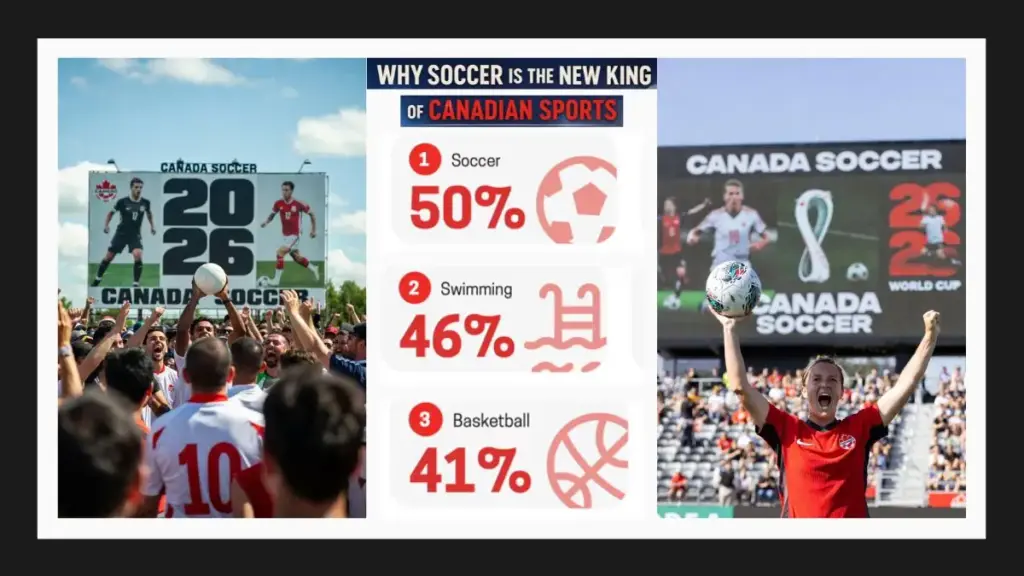
The Numbers of Canadian Sports: Participation vs. Viewership (2025-2026)
Canada is no longer just a “Hockey Nation.” It is a Sporting Nation. With the World Cup 2026 currently uniting the country, the trajectory of soccer is only going up.
Whether you’re a casual fan or a professional scout, the eyes of the world are firmly fixed on the Great White North.
While Hockey still dominates TV ratings, Soccer wins the “boots on the ground” battle.
| Sport | Participation (Youth/Adult) | Primary Fanbase |
| Soccer | ~1 Million Registered Players | Diverse, Youth-Heavy, Multi-cultural |
| Ice Hockey | ~513,000 Registered Players | Deep-rooted Tradition, High Viewership |
| Basketball | ~350,000 Registered Players | Urban, Gen-Z, Millennial |
- Report – Led programming, values that have long defined soccer in Canada
A Brief History: From 1876 to the World Stage
Soccer isn’t new to Canada; it’s just finally getting the spotlight it deserves.
- The Roots (1876): The first modern-rule game was played in Toronto in 1876. By 1885, Canada actually defeated the USA 1-0 in the first-ever international match in North America.
- The 1986 Breakthrough: Canada’s Men’s team qualified for their first FIFA World Cup in Mexico 1986. Though they didn’t score a goal, it set the foundation.
- The Sinclair Era: For decades, the Women’s National Team carried the torch. Led by Christine Sinclair (the world’s all-time leading international goal scorer), they won Olympic Gold in 2021, proving Canada could be a global soccer superpower
The “Alphonso Davies” Effect

The narrative shifted permanently in 2022. For the first time in 36 years, the Canadian Soccer Men’s National Team (Les Rouges) qualified for the FIFA World Cup in Qatar.
- Star Power: Players like Alphonso Davies (Bayern Munich) and Jonathan David (Lille OSC) have become household names not just in Canada but globally.
- The “Soccer Factory”: Cities like Brampton, Ontario, have gained a reputation as “soccer factories,” producing elite talent that competes in the English Premier League, La Liga, and the Bundesliga.
Vision World Cup 2026: Hosting the World

As we move through 2026, Canada is co-hosting the 2026 FIFA World Cup alongside the USA and Mexico. This isn’t just a tournament; it’s a massive economic and cultural engine.
Key Vision Highlights:
- Host Cities: Toronto (BMO Field) and Vancouver (BC Place) will host a total of 13 matches.
- Economic Impact: The tournament is projected to generate over $3.8 Billion in national economic return and create over 24,000 jobs.
- “Canada Celebrates”: A nationwide program ensures that even if you aren’t in Toronto or Vancouver, “Fan Zones” and community celebrations will be within a two-hour drive for 75% of Canadians.
The Future of Canadian Sports: Professional Growth

The “Vision” includes making soccer a sustainable career path within Canada.
- CPL (Canadian Premier League): Since 2019, the CPL has given domestic players a professional stage, bridging the gap between youth academies and the National Team.
- The Northern Super League: Launched in 2025, Canada’s first professional women’s league is finally giving female athletes a home-soil professional path.
- MLS Presence: Toronto FC, Vancouver Whitecaps, and CF Montréal continue to draw massive crowds, proving that the North American “Soccer War” is being won by the fans.