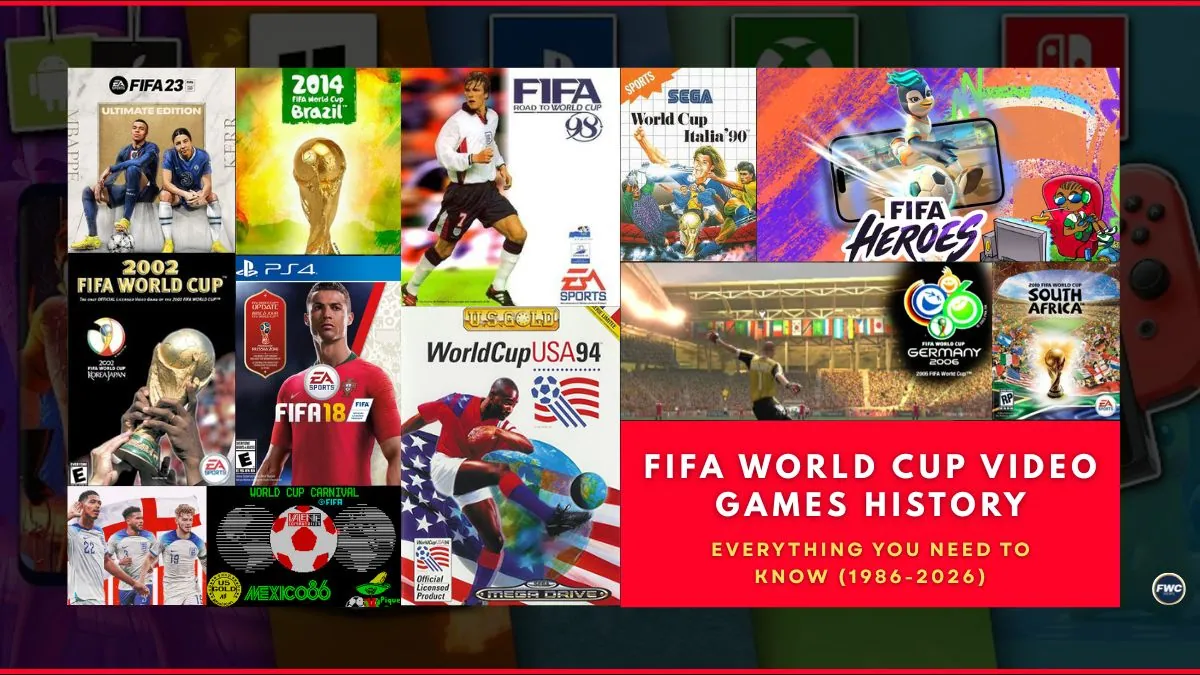
The FIFA World Cup has captivated billions of football fans worldwide for decades, and video games have played an essential role in bringing the tournament’s excitement into homes across the globe. Since the 1986 World Cup, FIFA has licensed official World Cup video games that allow players to experience the drama, passion, and glory of the world’s most prestigious football tournament.
This comprehensive guide explores the complete history of FIFA World Cup video games, from the controversial beginnings with World Cup Carnival in 1986 to the innovative FIFA Heroes game announced for 2026.
Whether you’re a retro gaming enthusiast, a football fanatic, or simply curious about how World Cup games have evolved, this article covers everything you need to know.
The Early Years (1986-1994): Rocky Beginnings
World Cup Carnival (Mexico ’86) – The Troubled Start
The first officially licensed FIFA World Cup video game launched in 1986 for the Mexico World Cup, but it got off to an infamous start. Published by British company U.S. Gold, World Cup Carnival was released for the Commodore 64, ZX Spectrum, and Amstrad CPC platforms.
The Controversy: Due to internal mismanagement and poor planning, U.S. Gold failed to develop an original game despite having plenty of time.
As the tournament approached, they made a desperate decision to acquire the rights to an older game called World Cup Football by Artic, rebrand it with FIFA licensing, and rush it to market.
The Result: The gaming community, retailers, and critics heavily criticized this approach. The game featured only limited playable teams (10 on Commodore 64 and Amstrad, 24 on Spectrum), basic graphics with inaccurate team kits shown in garish colors, and simplistic gameplay that felt outdated even for 1986 standards. This marked one of the worst starts for any major sports gaming franchise.
Italia ’90 – Multiple Contenders
The 1990 World Cup in Italy saw a confusing landscape of both official and unofficial games competing for players’ attention.
Virgin Mastertronic’s Official Game: Virgin Mastertronic secured the official license and released the legitimate Italia ’90 game for Amiga, Atari ST, ZX Spectrum, Commodore 64, Amstrad CPC, PC, and MSX platforms. The game featured only 4 playable teams but offered a top-down, bird’s-eye view that became iconic for the era.
Unofficial Competition: Several publishers released unofficial Italia ’90 games to capitalize on World Cup fever, including Codemasters’ budget title Italia 1990 and Simulmondo’s Italy 90 Soccer. U.S. Gold even released its own unofficial version despite having published the previous tournament’s official game.
Legacy: For many gamers in the UK and Ireland, Italia ’90 came bundled with Sega Megadrive consoles alongside classics like Sonic and Streets of Rage II, making it many players’ first taste of virtual football.
World Cup USA ’94 – Original But Uninspired
U.S. Gold secured the official license once again for the 1994 World Cup in the United States. This time, they actually created an original game rather than rebranding existing software.
Key Features:
- Released on Sega Megadrive, Super Nintendo, and numerous other platforms
- Bird’s-eye view gameplay similar to Italia ’90
- Animated referee windows that appeared whenever decisions were made
- All 24 qualified teams plus 8 additional nations (Scotland, England, Wales, Portugal, France, Japan, Denmark, and Australia)
Reception: While World Cup USA ’94 was technically original, it failed to significantly improve upon Italia ’90 despite being released four years later. The gameplay felt stale, and the innovations were minimal, leading to disappointment among critics and players who expected more substantial evolution.
The EA Sports Revolution (1997-2014): The Golden Era
FIFA: Road to World Cup 98 (1997) – The Game Changer
In 1997, everything changed. Electronic Arts, which had already established itself with the successful FIFA International Soccer series starting in 1993, acquired the exclusive FIFA World Cup license for all regions except Japan.
Rather than waiting for the 1998 tournament, EA integrated World Cup content into their annual FIFA release.
Revolutionary Features:
- Included all 172 national teams registered with FIFA at the time
- Full qualifying campaign mode leading to the World Cup finals
- Complete tournament simulation from qualification to the final
- Integrated into FIFA 98’s already acclaimed gameplay engine
Cultural Impact: The game is perhaps most remembered for its iconic intro featuring Chumbawamba’s “Tubthumping” (“I GET KNOCKED DOWN!”), which became synonymous with the World Cup experience for an entire generation of gamers.
2002 FIFA World Cup (Korea/Japan)
EA Sports released their first standalone World Cup game for the 2002 tournament in Korea and Japan, setting a template that would continue for over a decade.
Platform Availability:
- Microsoft Windows
- PlayStation
- PlayStation 2
- GameCube (launch title in Europe)
- Xbox
Notable Features:
- Amalgamation of FIFA 2002 and FIFA 2003 game engines
- Power bar mechanics for shots and crosses with steeper learning curve
- Accurate national team kits and player likenesses
- All official 2002 World Cup stadiums
- Original soundtrack performed by the Vancouver Symphony Orchestra
- Stricter refereeing compared to standard FIFA games
Innovation: This marked the beginning of EA’s strategy to release dedicated World Cup titles alongside their annual FIFA series, giving fans specialized tournament experiences.
2006 FIFA World Cup (Germany)
Released in April 2006, the Germany World Cup game expanded the scope significantly beyond previous editions.
Comprehensive Coverage:
- 127 national teams included
- Complete tournament finals mode
- All six regional qualification rounds fully playable
- Create-a-player feature allowing customization
Gameplay Enhancements:
- Minor but meaningful improvements over FIFA 06
- Global Challenge Mode with 40 scenarios based on classic World Cup matches
- Enhanced Penalty Shoot-Out mode for more realistic experiences
- Authentic tournament atmosphere with official stadiums and presentation
This edition demonstrated EA’s commitment to creating comprehensive World Cup experiences that went beyond simply recreating the finals tournament.
2010 FIFA World Cup South Africa
The South Africa edition represented a significant technological leap, taking full advantage of seventh-generation console capabilities.
Platform Release:
- PlayStation 3
- Xbox 360
- Wii
- PlayStation Portable (PSP)
- iPod Touch and iPhone
- Released April 27, 2010 (North America) and April 30, 2010 (Europe/Asia)
Groundbreaking Features:
- 199 of 204 national teams that participated in qualification
- All 10 official South African World Cup venues recreated
- Altitude fatigue system affecting player performance in high-altitude matches
- Home advantage mechanics for teams accustomed to altitude
- Complete African cultural integration in presentation and atmosphere
Authentic African Experience: The game became famous for incorporating vuvuzela horn sounds that dominated the 2010 World Cup broadcasts, along with South African drum corps and regional stadium chants. EA Sports sent teams to South Africa to record actual match atmosphere to capture authentic audio.
Game Modes:
- Captain Your Country mode (returning feature)
- Scenario mode with 55 playable historical World Cup moments
- Virtual Pro import from FIFA 10
- Online multiplayer through PlayStation Network and Xbox Live
- Two-button control scheme for accessibility
Soundtrack: 28 tracks by artists from 21 countries celebrating African culture, headlined by K’naan’s “Wavin’ Flag (World Cup Celebration Mix).”
2014 FIFA World Cup Brazil
The Brazil edition was EA’s last standalone World Cup game, though they didn’t know it at the time.
Platform Strategy (and Controversy): Initially released only for PlayStation 3 and Xbox 360 on April 15, 2014 (North America) and April 17, 2014 (Europe), EA made the controversial decision to skip eighth-generation consoles (PlayStation 4 and Xbox One) and PC.
The rationale was that many regions, especially host nation Brazil, hadn’t widely adopted the newer consoles yet. However, this decision generated significant backlash from the gaming community.
EA’s Response: Due to criticism, EA released a free update for FIFA 14 on PlayStation 4 and Xbox One on May 29, 2014, adding a World Cup game mode. They also updated FIFA Online 3 with World Cup content.
Key Features:
- 203 national teams from World Cup qualification
- All 12 official Brazil World Cup stadiums
- Complete qualification rounds playable for third time in series history
- Road to Rio de Janeiro campaign mode
- Enhanced fan and coach reactions during matches
- FIFA President Sepp Blatter presenting trophy to winners
- Official World Cup anthem “We Are One (Ole Ola)” by Pitbull, Jennifer Lopez, and Claudia Leitte
Gameplay Improvements:
- Enhanced dribbling mechanics from FIFA 14
- Improved passing accuracy and first-touch control
- EA Sports Talk Radio with pundits commenting on progress
- Story of Qualifying and Story of the Finals modes integrated with EA Sports Football Club
Reception: The game received mixed reviews, with critics praising the immersive atmosphere but criticizing the platform limitations and gameplay that felt too similar to FIFA 14.
The DLC Era (2018-2022): From Standalone to Free Updates
2018 FIFA World Cup Russia – The Transition
The 2018 World Cup marked a significant shift in EA’s strategy. Instead of releasing a standalone game, EA provided the World Cup content as a free expansion for FIFA 18.
What Changed:
- Free downloadable content (DLC) instead of separate purchase
- Released May 2018 for PlayStation 4, Xbox One, Windows, and Nintendo Switch
- Mobile update released June 6, 2018
- FIFA Online 4 update released May 31, 2018
Content Included:
- All 32 participating teams from Russia 2018
- All 12 official tournament stadiums recreated
- Complete World Cup tournament mode
- FIFA Ultimate Team World Cup content
- Custom tournament options
What Was Missing: No qualifying rounds or road to the World Cup mode – players could only experience the finals tournament itself with the 32 qualified nations.
Impact: This represented EA’s acknowledgment that standalone World Cup games had become difficult to justify at full price, especially when the core FIFA game already offered most necessary features. The free DLC approach was praised by players and set the template for future World Cup content.
FIFA 23 World Cup Qatar 2022 – The Controversial Edition
The Qatar 2022 World Cup update for FIFA 23 continued the free DLC trend but arrived amid controversy surrounding both the real-world tournament and the in-game implementation.
Release Timeline:
- World Cup mode launched November 9, 2022
- FIFA Ultimate Team content began November 11, 2022
- Live World Cup mode activated November 21, 2022 (aligned with tournament start)
- Women’s World Cup mode promised for 2023
Platform Availability: PlayStation 5, Xbox Series X|S, PlayStation 4, Xbox One, and PC. Notably absent: Nintendo Switch.
Game Modes Included:
Tournament Mode:
- Play as any of 32 qualified nations through authentic tournament
- Customization options to rearrange groups
- Ability to add 15 popular nations that didn’t qualify (including Italy, Norway, and Scotland)
- Offline single-player and online multiplayer options
Your FIFA World Cup:
- Choose a team and follow their actual tournament progress
- Inherit real-world results into Tournament Mode
- Write alternative history for your chosen nation
Live Tournament Mode:
- Updated with real-time data from actual World Cup matches
- Play matches with authentic lineups from official games
- Available November 21 – December 18, 2022
Online Tournaments:
- Compete through knockout stages against other players
- Start from Round of 16
- Progress through to virtual final
Presentation Enhancements:
- New maroon menu design matching Qatar World Cup branding
- Confetti themes in team colors
- Pre-match fan animations and celebrations
- Updated team kits for all 32 nations
- Qatar World Cup stadiums (though only 2 of 8 included)
- Official match balls, referee kits, and tournament branding
FIFA Ultimate Team Integration:
- Path to Glory cards that upgrade based on team progression
- 30 unique World Cup Heroes and Icons (November 11-December 23)
- FUT Heroes designed in collaboration with Marvel
- World Cup Swaps program
- No standalone Ultimate Team World Cup mode (unlike 2014)
Reception and Criticism:
The FIFA 23 World Cup mode received mixed-to-negative reviews from the community:
Positive Aspects:
- Free update accessible to all FIFA 23 owners
- Solid core FIFA 23 gameplay
- Integration with real tournament progress
- Customization options for non-qualified teams
Major Criticisms:
- Only 2 official stadiums included (versus all stadiums in previous games)
- Squad file issues causing online connection problems
- Inaccurate squad selections (players like Callum Wilson and James Maddison missing despite being called up; Jesse Lingard inexplicably included)
- Online mode limited to knockout rounds only
- Felt bare-bones compared to standalone releases
- Mode described as “worst World Cup offering a FIFA game has ever produced” by some critics
- Connection issues plaguing online tournaments
The End of an Era: FIFA 23 represented the final FIFA-branded game from EA Sports, as their partnership with FIFA ended after this release. Starting in 2023, EA’s football series continues as EA Sports FC.
The Post-EA Era (2026): FIFA’s New Beginning
FIFA Heroes (2026 FIFA World Cup)
On October 2, 2025, FIFA announced FIFA Heroes as the official video game for the 2026 FIFA World Cup, marking FIFA’s first major video game release since parting ways with EA Sports.
Development:
- Developed by New York-based studio ENVER in partnership with Solace
- Complete departure from simulation-focused gameplay
- Scheduled for 2026 release to coincide with the World Cup
Platform Availability:
- PlayStation consoles
- Xbox consoles
- Nintendo Switch
- iOS mobile devices
- Android mobile devices
Revolutionary Approach:
Unlike previous World Cup games that aimed for realistic football simulation, FIFA Heroes embraces an arcade-style, fantasy approach to football gaming.
Core Gameplay:
- 5-a-side matches instead of traditional 11v11
- Arcade action with dynamic physics
- Pitch-shattering power moves and special abilities
- Fast-paced, accessible gameplay for all skill levels
- Reminiscent of beloved arcade classics like FIFA Street
Unique Character Roster:
FIFA Heroes allows players to create multiverse dream teams featuring:
- Official FIFA World Cup mascots from throughout tournament history
- Legendary football players and personalities
- Iconic fictional characters from films and television shows
2026 World Cup Integration:
The game features a dedicated FIFA World Cup 2026 mode showcasing the three official host nation mascots:
Maple – Canadian moose mascot representing Canada Zayu – Mexican jaguar mascot representing Mexico
Clutch – American bald eagle mascot representing the United States
Each mascot comes equipped with unique super abilities and special moves, adding strategic variety to the arcade gameplay.
Game Modes:
- PvE (Player vs Environment) career challenges
- PvP (Player vs Player) multiplayer battles
- FIFA World Cup 2026 tournament mode
- Squad building with multiverse team combinations
Strategic Partnerships:
- Official smartphone partner: Motorola
- Part of FIFA’s broader FIFAe digital football and esports portfolio
The Vision:
Christian Volk, FIFA’s Director of Gaming and Esports, explained that FIFA Heroes aims to unite people through football while creating multiverse teams that mix treasured fictional heroes, favorite players, and FIFA mascots. The goal is to introduce football’s joy to a new generation while rekindling nostalgia for longtime fans.
Kyle Joyce, Director of Solace, emphasized that the development team focused on capturing what makes football compelling: speed, drama, and rivalry.
Strategic Significance:
FIFA Heroes represents FIFA’s bold statement about its future in digital entertainment independent of EA Sports. Rather than competing directly in the simulation space with EA Sports FC (formerly FIFA), FIFA Heroes carves out its own niche in the arcade category, allowing FIFA to:
- Appeal to younger audiences with accessible gameplay
- Leverage unique intellectual property assets
- Create cross-generational appeal
- Build a scalable platform for future World Cups
Evolution of Gameplay and Technology
Graphics and Presentation (1986-2026)
1980s-1990s:
- Basic 2D sprites and simple colors
- Top-down, bird’s-eye view perspectives
- Limited animations and sound effects
- No player names or accurate kits
Late 1990s-2000s:
- Introduction of 3D graphics
- Motion-captured player movements
- Licensed team kits and logos
- Commentary integration
- Stadium atmosphere audio
2010s:
- Photorealistic player faces
- Advanced physics engines
- Dynamic weather systems
- Authentic broadcast presentation
- Cultural elements (vuvuzelas, regional chants)
- Coach and spectator reactions
2020s-Present:
- Ray tracing and next-gen graphics
- Hypermotion technology
- Real-time tournament updates
- Social media integration
- Cross-platform play
- Live service models
Gameplay Philosophy Shifts
Simulation Era (1997-2023): EA Sports focused on creating increasingly realistic football experiences with:
- Tactical depth and formation systems
- Realistic ball physics and player momentum
- Authentic tournament structures
- Career and management modes
- Ultimate Team card collecting
Arcade Renaissance (2026): FIFA Heroes returns to accessible, fun-focused gameplay:
- Simplified controls for casual players
- Spectacular special moves and abilities
- Fantasy team building
- Fast-paced 5v5 action
- Cross-generational appeal
Platform Evolution Through the Decades
1986-1994: Home Computer Era
- Commodore 64, ZX Spectrum, Amstrad CPC
- Amiga, Atari ST
- Limited by 8-bit and 16-bit processing power
1994-2002: Console Transition
- Sega Megadrive, Super Nintendo
- PlayStation, Nintendo 64
- Introduction of 3D gaming
2002-2010: DVD-Generation Consoles
- PlayStation 2, Xbox, GameCube
- Increased storage enabling more content
- Online multiplayer introduction
2010-2014: HD and Online Integration
- PlayStation 3, Xbox 360
- High-definition graphics
- Robust online features and DLC
2014-2022: Modern Console Era
- PlayStation 4/5, Xbox One/Series X|S
- 4K resolution support
- Integration with mobile platforms
- Free-to-play and live service models
2026: Cross-Platform Future
- Console, PC, and mobile parity
- Cloud gaming compatibility
- Cross-play between all platforms
The FIFA vs EA Sports Split: What Happened?

In 2022, FIFA and EA Sports announced the end of their exclusive licensing partnership after nearly three decades of collaboration. This monumental split fundamentally changed the landscape of football gaming.
The EA Sports Perspective: EA Sports continued their football franchise under the new name EA Sports FC starting in 2023, retaining most club licenses, player likenesses, and league partnerships. They lost only the FIFA name and World Cup branding.
The FIFA Perspective: FIFA retained their World Cup intellectual property and is building a new gaming ecosystem with different partners. FIFA Heroes represents their first major move in establishing an independent presence in video gaming.
Impact on World Cup Games:
- Future EA Sports FC games will not feature official FIFA World Cup branding
- FIFA can create World Cup games with new developers
- Competition may drive innovation in football gaming
- Players have more diverse options
Licensing and Regional Variations
Throughout history, FIFA World Cup video game licensing has been complex:
Japan Exceptions:
- Konami frequently secured Japanese rights for World Cup games
- Created titles like Jikkyō World Soccer and World Soccer Jikkyō Winning Eleven
- Released internationally as International Superstar Soccer without FIFA branding
Regional Publishers:
- Different publishers handled various territories
- Sega released World Cup ’98 France: Road to Win for Saturn in Japan
- Various mobile and online versions for Asian markets
Licensing Challenges:
- Some national teams unavailable due to “various reasons”
- Player associations sometimes restrict usage
- Kit manufacturers requiring separate deals
- Stadium naming rights complications
Most Memorable Features Across Generations
Best Innovations:
- Full qualification campaigns (2006, 2010, 2014)
- Scenario modes recreating classic matches
- Virtual Pro/Captain Your Country career modes
- Live tournament updates matching real-world results
- Cultural authenticity (vuvuzelas, regional atmosphere)
- Marvel collaboration for FUT Heroes (2022)
- Multiverse team building (2026)
Biggest Disappointments:
- World Cup Carnival’s rebranded plagiarism (1986)
- Missing next-gen console support (2014)
- Limited stadium selection (2022)
- Squad file accuracy issues (2022)
- Removal of qualification modes (2018, 2022)
The Future of FIFA World Cup Video Games
As we approach the 2026 FIFA World Cup across the United States, Mexico, and Canada, the future of World Cup gaming looks dramatically different than it did even five years ago.
What to Expect:
- Continued evolution of FIFA Heroes with potential sequels
- EA Sports FC will likely create World Cup content without official FIFA branding
- Multiple competing World Cup games from different publishers
- Increased focus on mobile and cross-platform experiences
- Integration with esports and competitive gaming
- Virtual reality and augmented reality possibilities
- Blockchain and NFT integration (potentially)
Innovation Opportunities:
- Women’s World Cup parity with men’s tournament
- Enhanced accessibility features for players with disabilities
- AI-powered dynamic difficulty and personalization
- User-generated content and mod support
- Integration with fantasy football platforms
- Social viewing parties and streaming features
Cultural Impact and Legacy
FIFA World Cup video games have profoundly influenced how millions of people engage with the world’s most popular sporting event.
Generational Memories: For many, World Cup games provided their first exposure to international football, introducing players to teams, nations, and cultures they might never have encountered otherwise. The ability to take underdog nations to glory or relive iconic moments created lasting memories alongside the real tournaments.
Educational Value: World Cup games inadvertently taught geography, as players learned about nations, their flags, kits, and players. The games sparked interest in international relations and cultural diversity through the universal language of football.
Community Building: From early multiplayer battles to modern online tournaments, World Cup games brought people together. Local multiplayer sessions during actual World Cups created traditions, while online modes connected players across continents.
Preservation: These games serve as time capsules, preserving squads, stadiums, and tournament formats that might otherwise be forgotten. They document the evolution of the sport and gaming technology simultaneously.
Conclusion
From the troubled beginnings of World Cup Carnival in 1986 to the innovative arcade approach of FIFA Heroes in 2026, FIFA World Cup video games have undergone a remarkable 40-year evolution. These games have consistently captured the passion, drama, and global unity that define the World Cup experience.
The EA Sports era (1997-2023) brought unprecedented realism and comprehensive features, creating beloved experiences for millions of players worldwide. Now, as FIFA charts its own course with new partners, the franchise enters an exciting new chapter that emphasizes accessibility, creativity, and cross-generational appeal.
Whether you prefer the simulation depth of classic EA World Cup titles or the arcade action promised by FIFA Heroes, World Cup games continue to offer unique ways to celebrate football’s greatest tournament. As technology advances and gaming evolves, future World Cup games will undoubtedly find new ways to bring the beautiful game to life.
The 2026 FIFA World Cup in North America will mark not just a new tournament but a new era for World Cup gaming. As FIFA Heroes launches alongside the real-world competition, it will write the next chapter in this fascinating four-decade history.
Stay tuned for updates as we approach 2026, and prepare to experience the World Cup in ways we’ve never imagined!