On June 11, 2026, the opening whistle blows at Estadio Banorte in Mexico City, and 5 billion people around the world tune in to watch the most-watched sporting event on the planet. The football is breathtaking.
The spectacle is unmatched. And invisibly, in the atmosphere above every stadium, every airport, every team hotel across three countries and 16 cities, the numbers tell a story football’s governing body would rather you didn’t read.
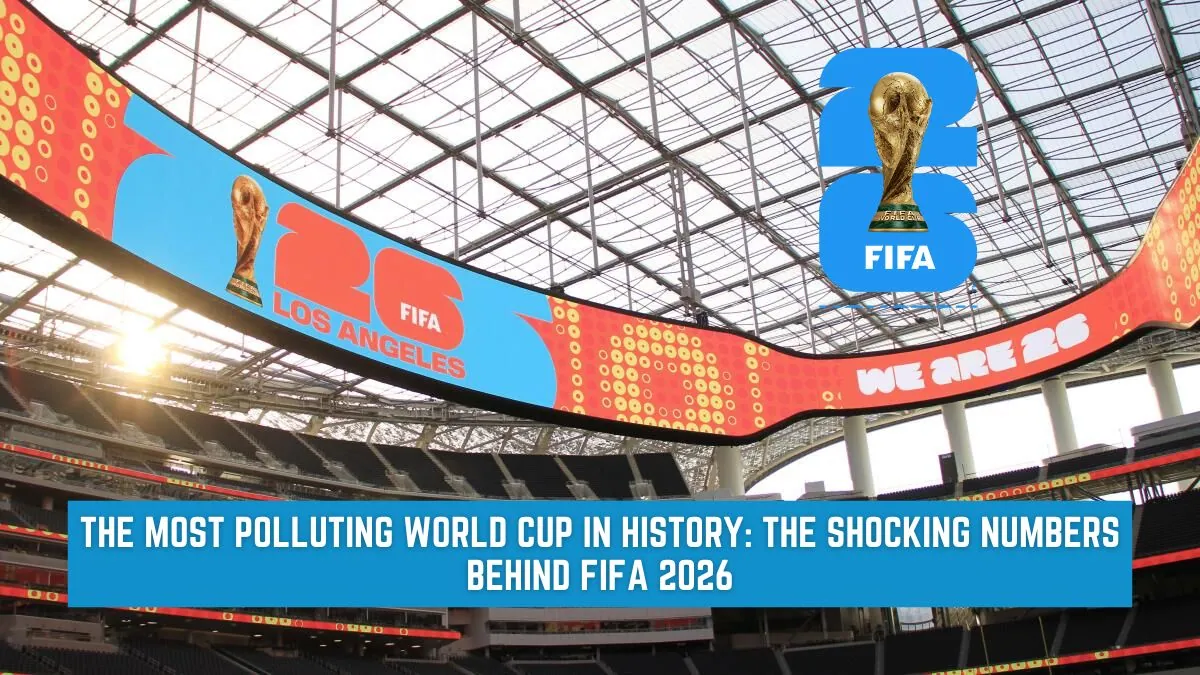
The 2026 FIFA World Cup is — by every metric that climate scientists use to measure these things — the Most Polluting World Cup event in human history.
That is not hyperbole from environmental campaigners. It is the conclusion of a peer-reviewed study, FIFA’s Climate Blind Spot: The Men’s World Cup in a Warming World, published by Scientists for Global Responsibility (SGR) in collaboration with the Environmental Defense Fund, the Sport for Climate Action Network, and the New Weather Institute. The numbers are precise, sourced, and deeply uncomfortable.
The Headline Figure: 9 Million Tonnes of CO2
The 2026 FIFA Men’s World Cup is projected to generate over 9 million tonnes of carbon dioxide equivalent (CO2e) — making it the most polluting World Cup to date.
To put that in context:
- That figure is equivalent to nearly 6.5 million average British cars being driven for an entire year.
- It is almost double the average for the last four World Cup finals — Qatar 2022, Russia 2018, Brazil 2014, and South Africa 2010.
- Qatar 2022 — previously the most criticised World Cup for its environmental impact — is estimated to have generated up to 5.25 million tonnes of CO2e. The FIFA 2026 tournament surpasses that by more than 70%.
And that 9 million figure may itself be an underestimate. In high-end scenarios, the total could reach 13.7 million tonnes, with air travel alone accounting for as much as 7.7 million tonnes.
| Emission Source (Million tCO2e) | 2010–2022 Average | 2026 North America | 2030 Spain/Portugal/Morocco | 2034 Saudi Arabia |
|---|---|---|---|---|
| Air Transport | 1.82 | 7.72 | 4.78 | 4.75 |
| Stadium Construction | 1.89 | 0.00 (Existing only) | 0.27 | 2.97 (11 new venues) |
| Other Sources | 1.00 | 1.30 | 1.04 | 0.83 |
| Total Carbon Footprint | 4.71 | 9.02 | 6.09 | 8.55 |
| Increase vs. Historical Avg. | Baseline | +92% | +29% | +82% |
Number 1: 48 Teams, 104 Matches, 16 Cities — Why the Format Is the Problem

Every other number in this article flows from one decision: FIFA’s expansion of the World Cup from 32 to 48 teams.
The 2026 World Cup is a 34-day event spread across 48 teams, 104 matches, and 16 host cities in three countries. That’s 40 more matches than any previous tournament, 16 more teams flying in from across the globe, and a geographic footprint that stretches from Monterrey, Mexico to Vancouver, Canada — a distance of over 4,000 kilometres.
For comparison, the 2022 Qatar World Cup fitted all 64 matches into a country roughly the size of Yorkshire. Fans could travel between stadiums by metro. Teams had training camps within a 30-minute drive of any venue.
At the 2022 World Cup, stadiums were located relatively close together, linked by metro and buses. At the 2026 World Cup, the Bosnia and Herzegovina squad — and their fans and families — will have to travel more than 5,000km from Toronto to Los Angeles to Seattle.
Algeria will rack up about 4,800km journeying from Kansas City to San Francisco and back. Czechia start in Guadalajara before heading to Atlanta and then Mexico City, notching more than 4,500km.
The shortest distance between any two FIFA 2026 stadiums — from MetLife in New Jersey to Lincoln Financial Field in Philadelphia — is 95.5 miles. Most teams’ itineraries cover thousands of miles. One team’s potential path, modelled by Fossil Free Football, runs: Toronto → Los Angeles (2,175 miles) → Seattle (932 miles) → and then another 2,500 miles in the knockout rounds.
There is, realistically, no way to do that journey without flying. FIFA’s decision to expand the tournament and spread it across a continent has effectively locked in a climate footprint that no amount of host-city recycling or LED lighting can offset.
Number 2: Air Travel — 7.7 Million Tonnes in the Worst Case
Air travel alone could account for as much as 7.7 million tonnes of CO2 in the high-end emissions scenario.
This covers:
- Fan travel — millions of supporters flying internationally and domestically to attend matches
- Team travel — 48 national squads plus coaching staff, medical teams, and officials moving between host cities
- Media and broadcast crews — thousands of journalists, camera operators, producers flying in from every continent
- FIFA officials, sponsors, and commercial partners — a travelling circus of corporate guests whose carbon footprint rarely makes the coverage
The report was “driven by a high reliance on air travel and significant increase in the quantity of matches.” No single factor contributes more to the 2026 World Cup’s emissions than the simple, unavoidable need to fly across a continent that is not served by high-speed rail connections between its major cities.
Number 3: The Aramco Problem — 30 Million Additional Tonnes
Here is the number that stops you cold: 30 million tonnes of CO2e.
That is the estimated additional climate cost of just one FIFA sponsorship deal — the partnership signed in 2024 between FIFA and Aramco, the Saudi state-owned oil company.
The sponsored emissions attributed to FIFA — such as the estimated 30 million tonnes of CO2e induced by the FIFA-Aramco deal for 2026 — are larger than the emissions generated by the entire tournament itself.
Aramco, the Saudi state oil company and the largest corporate polluter in history (responsible for over 4% of all historic emissions since 1965), became a “major worldwide partner” in a deal reportedly worth $100 million per year.
The mechanism is straightforward: Aramco’s partnership gives it advertising access to a potential global audience of up to 6 billion viewers. With up to 6 billion viewers expected, FIFA’s partnerships carry huge global influence. That audience will receive promotional messages that will boost demand for highly polluting products.
The result: FIFA’s sponsorship deal with Aramco, the Saudi state-owned oil company, could induce an additional 30 million tonnes of CO2e in 2026 alone through sales linked to promotion of the company.
To be clear about the scale of this figure: the tournament itself generates roughly 9 million tonnes. The Aramco sponsorship, in a single year, is projected to induce more than three times that amount in additional emissions through the commercial activity it stimulates.
Number 4: 6 Stadiums Facing Extreme Heat, 8 Requiring Intervention

The climate crisis is not just a number in a report. It is a physical reality that players, fans, and stadium workers at the 2026 World Cup will experience in their bodies.
Six of the 16 FIFA 2026 World Cup stadiums face extreme heat stress during the tournament, and half — 8 out of 16 — require immediate environmental intervention to prevent harm to players and fans.
AT&T Stadium in Dallas experiences 37 days a year above 95°F (35°C), with a July wet-bulb temperature of 83.5°F (28.6°C) — which exceeds FIFA’s own safety thresholds.
Wet-bulb temperature is not the same as air temperature. It accounts for humidity alongside heat, measuring the actual physiological stress placed on the human body. A wet-bulb temperature of 83.5°F doesn’t just feel uncomfortable — at that level, sustained physical exertion becomes genuinely dangerous.
Four stadiums need what the researchers call “critical intervention,” according to the report.
Fans, stadium workers, volunteers, media crews, and local residents could all face more intense heat and health risks during the event. “The only interest is in protecting athletes on the field, with basically no consideration for fans, staff, the media, and volunteers working in the stands or on the streets,” said study author Dr. Madeleine Orr.
The precedent is already documented. The 2024 Copa América in the US saw an assistant referee collapse due to heat. That tournament covered a fraction of the geography and lasted half the time of the 2026 World Cup.
90% of North American fans surveyed believe the World Cup should prioritise sustainability — yet the structural decisions that make the heat crisis worse were made before a single fan was asked.
Number 5: The Bid Book Promise vs Reality — A 150% Overshoot
This number is perhaps the most pointed illustration of the gap between FIFA’s promises and reality.
In their original bid book, the three prospective host nations for the 2026 tournament revealed a preliminary estimate of 3.6 million tonnes of CO2e — although at that stage it was expected to stage just 80 matches. They also said the bid “hopes the 2026 World Cup will establish new standards for environmental sustainability in sport and deliver measurable environmental benefits.”
The final projected figure: over 9 million tonnes — more than two and a half times the original bid book estimate, even accounting for the additional 24 matches added when the format was expanded.
FIFA’s previous claim that the 2022 World Cup in Qatar was “carbon neutral” drew widespread criticism. For 2026, the gap between the stated sustainability ambition and the scientific projection is even larger.
What FIFA Has Pledged — And Why Critics Say It Isn’t Enough
FIFA has not been entirely silent on sustainability. The governing body has previously committed to reducing emissions by 50% relative to a baseline, and the 2026 host cities have made varying levels of investment in sustainable infrastructure, venue upgrades, and transport planning.
What will persist after the tournament are the infrastructure choices each host city makes now — including whether transit lines are extended or not, stadium renovations that meet LEED standards or do not, food recovery programs that continue operating after the final match or get packed away with the branded signage.
But critics argue the sustainability measures being implemented are structurally insufficient because they address symptoms rather than causes.
According to the research, FIFA could take several actions to limit its carbon footprint. One is to reverse the tournament expansion from 32 to 48 teams and implement a binding limit. Such a measure would reduce reliance on air travel and drive down greenhouse gas emissions. Another solution is for FIFA to drop high-pollution sponsors.
Critics say the situation reflects a broader pattern of greenwashing, where large organisations promote sustainability while continuing practices that significantly increase emissions.
With an $11 billion budget, FIFA could invest in low-carbon tournaments, drop polluting sponsors, and lead on climate — but has chosen not to.
The Future: 2030 and 2034 Won’t Be Better
If the 2026 numbers make difficult reading, the trajectory beyond them is worse.
The Spain-led 2030 World Cup will generate over 6 million tonnes of CO2e, and the Saudi Arabian 2034 World Cup will generate over 8.5 million tonnes of CO2e.
Future World Cup tournaments are also expected to be highly polluting due to the high reliance on air travel and the construction of new stadiums. Saudi Arabia will require significant new stadium construction — one of the highest-emission components of any major tournament — which 2026 was largely spared by using existing venues.
The pattern, in other words, is not improving. Without structural changes at the FIFA level — to team numbers, travel models, or sponsor relationships — the World Cup’s environmental footprint is locked into a trajectory that moves in the wrong direction.
The Numbers, All Together
| Metric | Figure |
|---|---|
| Total projected CO2e (2026) | 9 million tonnes |
| High-end scenario | 13.7 million tonnes |
| Air travel alone (high-end) | 7.7 million tonnes |
| Qatar 2022 emissions | 5.25 million tonnes |
| Historical average (2010–2022) | ~4.7 million tonnes |
| Aramco sponsorship-induced CO2 (2026) | ~30 million tonnes |
| Equivalent in British cars for one year | 6.5 million |
| Stadiums facing extreme heat stress | 6 of 16 |
| Stadiums requiring environmental intervention | 8 of 16 |
| Original bid book CO2 estimate | 3.6 million tonnes |
| Final figure vs bid estimate | 150%+ overshoot |
| 2030 World Cup projected CO2e | 6 million+ tonnes |
| 2034 World Cup projected CO2e | 8.5 million+ tonnes |
| FIFA annual budget | $11 billion |
Is 2026 the Most Polluting World Cup
The 2026 FIFA World Cup is set to be the most-watched, largest, and most commercially successful sporting event ever. It promises to deliver unforgettable football moments that will be remembered for decades.
It will also, according to every serious scientific assessment of its emissions, leave behind an atmospheric legacy that outlasts every goal, every upset, and every title celebration.
Some may point out that the 2026 World Cup’s estimated 9 million tonnes of CO2 pales in comparison to the 5.9 billion tonnes of CO2 that the US alone produced in 2025.
While that is true, it is equally true that to passively allow FIFA to wilfully damage the environment is to succumb to greenwashing — the duplicitous practice of talking a big green game but failing to follow through with meaningful sustainability measures.
Dr. Stuart Parkinson from Scientists for Global Responsibility stated, “FIFA must acknowledge its increasing contribution to the climate crisis.
The 2026 World Cup is anticipated to be the most polluting tournament in history, and future events are likely to continue relying heavily on air travel and other high-carbon activities.
As the climate crisis intensifies, the logical response for FIFA is to take immediate action to significantly reduce emissions from its tournaments.”
The Beautiful Game is being played on a warming planet. The numbers say so. The question is whether the people who run it are listening.