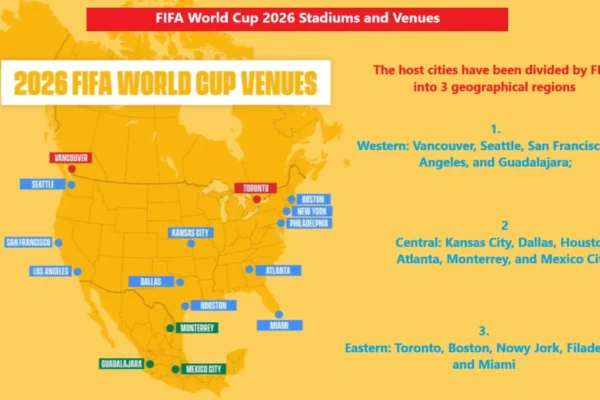

The FIFA World Cup 2026 stadiums will do more than host matches — they’ll create the tournament’s biggest moments. From MetLife’s colossal stage for the final to SoFi’s ultra-modern bowl and the volcanic atmosphere of Estadio Azteca, these five venues combine record-breaking capacity, next-level design, and fan energy that guarantees global headlines.
Whether you’re planning for 2026 FIFA World Cup travel, ticket hunts, or headline copy, this guide ranks the top 5 FIFA World Cup 2026 stadiums that will define the drama, the noise, and the unforgettable images of World Cup 2026.
Top 5 FIFA World Cup 2026 stadiums
World Cup 2026 isn’t just about teams — it’s about stadiums. Here are the top 5 FIFA World Cup 2026 stadiums that promise massive crowds, iconic moments, and photo-ready atmospheres — from MetLife’s final to Estadio Azteca’s historic roar.
These venues balance history, capacity, match significance, design, and fan experience, all set in photo-ready atmospheres—from the final at MetLife Stadium to the historic roar of Estadio Azteca.
MetLife Stadium (New York / New Jersey)

The MetLife Stadium hosts the FIFA World Cup final (July 19, 2026). Huge capacity and proven experience with mega-events (Super Bowl, Copa América), plus strong transport links into NYC — makes it the natural No.1.
- Location: East Rutherford, New Jersey, USA
- Capacity: About 82,500 for World Cup configuration.
- Key role: Hosts the World Cup 2026 Final plus multiple group games and knockout matches (Round of 32, Round of 16).
- Why it’s top‑tier:
AT&T Stadium (Arlington / Dallas)

Capacity monster and spectacle venue — one of the largest stadiums in the tournament and set to host the most matches (nine). Its retractable roof, gigantic video board and event infrastructure make it a tournament favourite for atmosphere and scale.
- Location: Arlington, Texas, USA
- Capacity: Listed at 94,000 for the World Cup, the largest 2026 venue by capacity.
- Key role: Hosts nine matches, the most of any stadium, including a semi‑final and multiple round of 32 in knockout games.
- Why it stands out:
SoFi Stadium (Los Angeles)
Ultra-modern, stadium-of-the-future with world-class facilities and a compact, intense matchday bowl. Hosts several high-profile matches including USMNT fixtures — a perfect blend of tech, comfort and Hollywood spectacle.

- Location: Inglewood, California, USA
- Capacity: Officially about 70,240 but expandable towards 100,000.
- Key role: Hosts USA’s opening match (USA vs Paraguay) plus group games, Round of 32, Round of 16, and a quarter‑final.
- Why it’s special:
Estadio Azteca (Mexico City)

The historic cathedral of Latin American Soccer — first stadium to host three different World Cups (1970, 1986, 2026). Massive capacity after renovations, atmosphere is unrivalled for local passion and history; it will also stage the tournament opening match.
- Location: Mexico City, Mexico
- Capacity: Around 83,000 after renovations.
- Key role: Hosts the opening match on 11 June 2026 and Mexico group games.
- Why it’s elite:
BC Place (Vancouver)

Canada’s standout: retractable roof, excellent sightlines and a great fan city to visit. A compact, vocal stadium that guarantees an intense group-stage atmosphere and strong broadcast visuals.
- Location: Vancouver, British Columbia, Canada
- Capacity: Around 54,500 for World Cup 2026 matches.
- Key role: Hosts several group‑stage games and at least one Round of 32 match as one of the two Canadian venues (with Toronto’s BMO Field).
- Why it makes the cut:
- Multipurpose stadium with a retractable roof, ensuring matches go ahead regardless of Vancouver’s variable weather, plus excellent downtown location near hotels and transit.
- Has proven big‑tournament pedigree, having hosted the 2015 FIFA Women’s World Cup Final, which adds to its World Cup legacy and fan appeal.