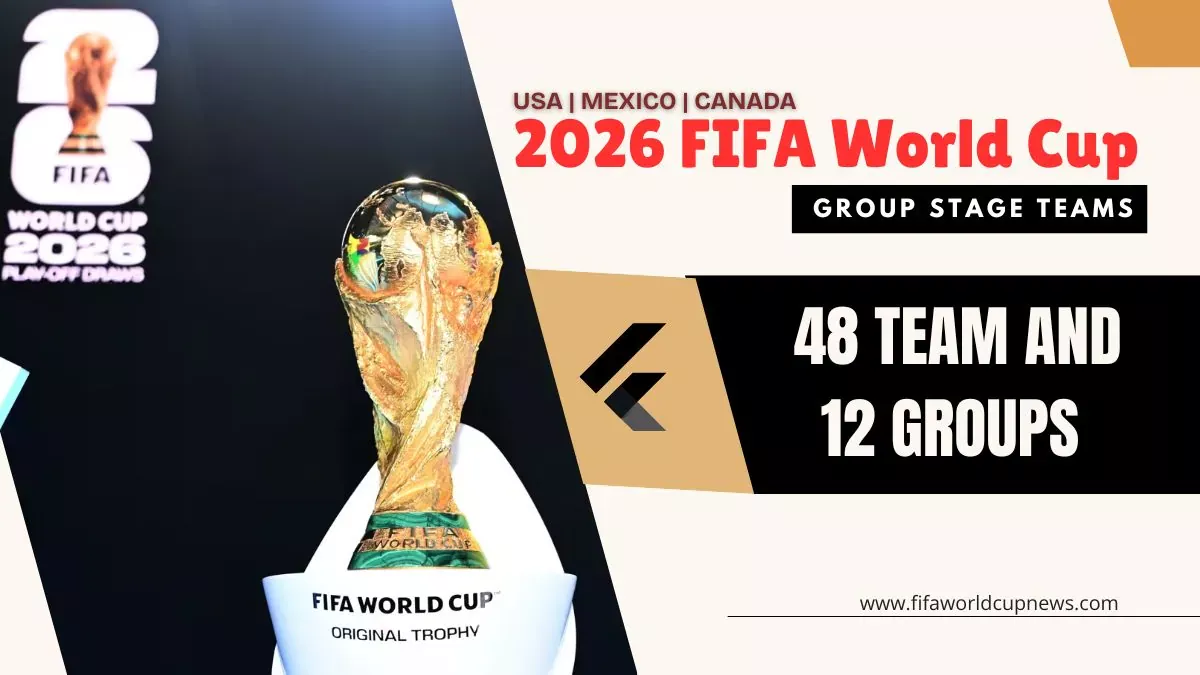
The 2026 FIFA World Cup group stage represents a historic expansion of world football’s greatest tournament, introducing the first-ever 12-group format with 48 teams.
The 23rd edition of the Men’s Soccer tournament is divided into 12 groups of 4 teams (Groups A through L), departing from the previous 32-team format. After the 2026 FIFA World Cup Group Stage matches, the top 2 teams from each of the 12 groups advance directly, and the 8 best third-place finishers across all groups also secure a spot in the next round.
This comprehensive guide explains the revolutionary new structure, how teams are distributed across groups, the schedule, venues, and how qualification works in this expanded tournament format.
Group Stage Overview: Historic First
The 2026 FIFA World Cup marks the first tournament expansion since 1998, introducing significant changes to the traditional tournament format. The group stage will determine the 32 teams advancing to the knockout rounds through a new three-tier qualification system.
Key Group Stage Facts
Tournament Scale
- Total Teams: 48 (increased from 32)
- Total Groups: 12 (Labeled A through L)
- Teams per Group: 4
- Total Group Stage Matches: 72 (increased from 48)
- Each Team Plays: 3 matches (round-robin format)
Tournament Timeline
- Group Stage Start: Thursday, June 11, 2026
- Group Stage End: Sunday, June 27, 2026
- Total Duration: 17 days
- Tournament Total Duration: 39 days (June 11 – July 19, 2026)
The 12 Groups: Format and Structure
The 2026 FIFA World Cup will be divided into 12 groups (A through L), each containing exactly 4 teams. This represents a revolutionary change from the previous 32-team, 8-group format.
2026 FIFA World Cup Group Stage Teams List ( 48 teams and 12 Groups)

| Group | Team 1 | Team 2 | Team 3 | Team 4 |
|---|---|---|---|---|
| Group A | Mexico | South Africa | South Korea | Czechia |
| Group B | Canada | Bosnia and Herzegovina | Qatar | Switzerland |
| Group C | Brazil | Morocco | Haiti | Scotland |
| Group D | United States | Paraguay | Australia | Turkey |
| Group E | Germany | Curaçao | Ivory Coast | Ecuador |
| Group F | Netherlands | Japan | Tunisia | Sweden |
| Group G | Belgium | Egypt | Iran | New Zealand |
| Group H | Spain | Cape Verde | Saudi Arabia | Uruguay |
| Group I | France | Senegal | Iraq | Norway |
| Group J | Argentina | Algeria | Austria | Jordan |
| Group K | Portugal | DR Congo | Uzbekistan | Colombia |
| Group L | England | Croatia | Ghana | Panama |
How Teams Are Seeded in the Group: The Four Pots
The FIFA Draw divides all 48 participating teams into four seeding pots, with one team from each pot placed into each group. This system ensures competitive balance and prevents top teams from clustering together.
Pot 1: The Elite (12 Teams)
Composition:
- 3 Host Nations: Mexico, Canada, United States
- 9 Highest-Ranked Qualified Teams: Based on FIFA World Rankings at the time of draw
Group Assignment:
- Mexico is automatically assigned to Group A (A1)
- Canada was automatically assigned to Group B (B1)
- The United States was automatically assigned to Group C (C1)
- Nine other Pot 1 teams are distributed to the remaining Groups D-L (D1, E1, F1, etc.)
Pot 2: Strong Teams (12 Teams)
Composition: Teams ranked 10-21 in FIFA World Rankings (among qualified teams)
Placement: One team from Pot 2 placed in each of the 12 groups alongside one Pot 1 team (as A2, B2, C2, etc.)
Pot 3: Mid-Tier Teams (12 Teams)
Composition: Teams ranked 22-33 in FIFA World Rankings (among qualified teams)
Placement: One team from Pot 3 placed in each group (as A3, B3, C3, etc.)
Pot 4: Emerging Teams (12 Teams)
Composition:
- Remaining qualified teams (ranked outside top 33)
- Play-off winners from UEFA, CONMEBOL, OFC, AFC, CAF
Placement: One team from Pot 4 completes each group (as A4, B4, C4, etc.)
Confederation Rules: Preventing Stacked Groups

European Teams Distribution
Total European Teams: 16 (most represented confederation)
Group Rule: No group can contain more than 2 European teams (with limited exceptions required by geography)
Rationale: Prevents clustering of strong European sides in single groups, ensuring competitive balance
Other Confederation Balance
- Maximum 2 teams from same confederation per group (with limited exceptions)
- UEFA exception: With 16 European teams and 12 groups, some groups must have 2 European teams
- Geographical diversity: Teams from the same confederation are generally separated across groups
Group Stage Schedule: Match Dates and Venues
Match Day Structure
The FIFA World Cup 2026 group stage runs from June 11 through June 27 (17 days), featuring 72 matches across 12 groups, with matches distributed to manage travel, rest periods, and stadium availability.
Match Calendar Highlights
- Opening Match (June 11, 2026): The tournament begins at Mexico City Stadium (Estadio Azteca), where Mexico will face South Africa in the opening Group A match.
- Canada’s Opening Match (June 12, 2026): Canada starts its FIFA World Cup 2026 campaign against Bosnia and Herzegovina at BMO Field in Toronto.
- United States Opening Match (June 12, 2026): The USMNT opens its tournament at SoFi Stadium in Los Angeles against Paraguay.
- Group Stage Schedule: The group stage will run from June 11 to June 27, ending with the final synchronized round of matches.
- Knockout Stage: The new Round of 32 will take place from June 28 to July 3, followed by the Round of 16 from July 4 to July 7.
- FIFA World Cup Final (July 19, 2026): The final will be hosted at MetLife Stadium in New York/New Jersey, located in East Rutherford.
Key Schedule Feature: The final round of matches in each group will start simultaneously to prevent collusion and ensure fairness
Host Venues: 16 Cities Across Three Nations
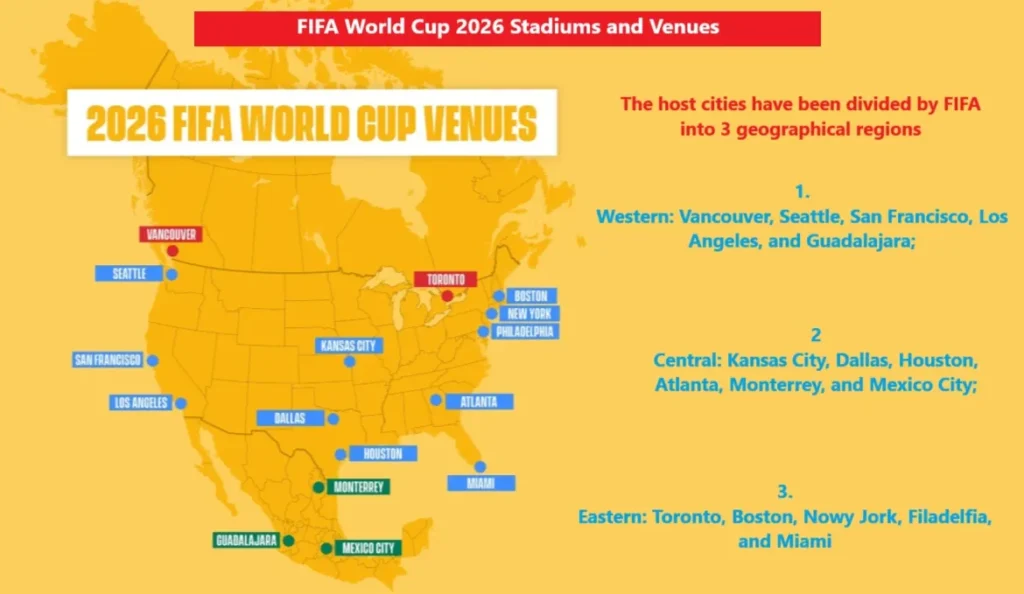
United States (11 Venues)
- Dallas: Dallas Stadium | 94,000 capacity
- New York/New Jersey: New York New Jersey Stadium | 82,500 capacity (Hosts the Final)
- Atlanta: Atlanta Stadium | 75,000 capacity
- Kansas City: Kansas City Stadium | 73,000 capacity
- Houston: Houston Stadium | 72,000 capacity
- San Francisco: San Francisco Bay Area Stadium | 71,000 capacity
- Los Angeles: Los Angeles Stadium | 70,000 capacity
- Philadelphia: Philadelphia Stadium | 69,000 capacity
- Seattle: Seattle Stadium | 69,000 capacity
- Boston: Boston Stadium | 65,000 capacity
- Miami: Miami Stadium | 65,000 capacity
Canada (2 Venues)
- Vancouver: BC Place Vancouver | 54,000 capacity
- Toronto: Toronto Stadium | 45,000 capacity
Mexico (3 Venues)
- Mexico City: Mexico City Stadium | 83,000 capacity (Hosts the Opener)
- Monterrey: Estadio Monterrey | 53,500 capacity
- Guadalajara: Estadio Guadalajara | 48,000 capacity
Qualification System: How Teams Advance from Groups
Under this new format, a total of 32 teams will advance from the group stage into the knockout phase:
- Automatic Qualifiers: The top 2 teams from each of the 12 groups advance directly.
- Wildcard Qualifiers: The 8 best third-place finishers across all groups also secure a spot in the next round
Automatic Qualification: Top Two Teams
Advancement Rule: The top 2 teams from each of the 12 groups automatically advance to the Round of 32
Total Advancing: 24 teams (2 teams × 12 groups)
Determination Method:
- Points: 3 for a win, 1 for a draw, 0 for a loss
- Goal Difference: Goals scored minus goals conceded
- Goals Scored: Total goals scored in group
- Head-to-Head: Results in matches between tied teams
- Discipline Points: Yellow card = -1 point, Red card = -4 points
- FIFA World Ranking: If all criteria equal
Third-Place Qualification: 8 Best Teams
Advancement Rule: The 8 best-ranked third-place teams from across all 12 groups advance to the Round of 32
Total Advancing: 8 teams (selected from 12 third-place teams)
Selection Criteria
- Points from group matches
- Goal Difference from group matches
- Goals Scored from group matches
- Discipline Points applied consistently
- FIFA World Ranking if criteria are equal
Total Round of 32 Qualification
Total teams advancing: 32 teams
- 24 group winners/runners-up (top 2 from each group)
- 8 best third-place teams across all groups
This three-tier system ensures competitive balance while allowing occasional upsets to advance.
Match Format: Round-Robin Group Play
Each Team’s Schedule
- Matches per team: 3 (each team faces the other 3 teams once)
- Format: Round-robin (no repeat matchups)
- Total group matches: 6 matches per group × 12 groups = 72 matches
Each group plays exactly 6 matches with every team facing each other once.
Format Evolution: Old vs New Tournament Structure
| Aspect | 1998-2022 Format | 2026 New Format | Change |
|---|---|---|---|
| Total Teams | 32 | 48 | +16 teams |
| Groups | 8 | 12 | +4 groups |
| Teams per Group | 4 | 4 | Same |
| Group Stage Matches | 48 | 72 | +24 matches (+50%) |
| Total Tournament Matches | 64 | 104 | +40 matches (+63%) |
| Advancing Teams | 16 (2 per group) | 32 (2 + 8 best 3rd) | +16 teams |
| Tournament Duration | ~32 days | 39 days | +7 days |
| First Knockout Stage | Round of 16 | Round of 32 | New stage |
Why 12 Groups of 4? The Format Evolution
Original Proposal vs Final Approval
Initially Proposed (2017): 16 groups of 3 teams
- Would produce 80 group-stage matches
- Created unbalanced advancement numbers
- Increased risk of collusion in final matches
Revised and Approved (March 2023): 12 groups of 4 teams
- Produces 72 group-stage matches (balanced increase)
- Allows 8 third-place teams to advance alongside 24 group winners/runners-up
- Creates perfectly balanced 32-team Round of 32
- Prevents collusion with simultaneous final group matches
- Ensures every team plays a minimum 3 matches
Strategic Implications of New Format
Tournament Benefits
- Balanced Advancement: 32-team knockout provides mathematical perfect bracket
- Third-Place Opportunity: Allows upset teams to advance as best third-place qualifiers
- Expanded Participation: More teams participate than ever before
- Extended Entertainment: 72 group matches vs. 48 previously (50% increase)
- Geographic Balance: 12 groups distribute better across three host nations
- Confederation Diversity: Forces meaningful mixing of football powers and emerging nations
Tournament Challenges
- Compressed Schedule: More matches squeezed into tournament timeframe
- Venue Requirements: Requires 14-16 stadiums across three countries
- Limited Rest: Teams play three matches with minimal recovery time
- Massive Travel: Constant movement between distant venues
Key Dates: Group Stage Timeline
| Event | Date |
|---|---|
| Official Group Draw | December 5, 2025 (Kennedy Center, Washington D.C.) |
| Tournament Begins | June 11, 2026 (Thursday) |
| Opening Match | Estadio Azteca, Mexico City |
| Matchday 1 | June 11, 2026 |
| Matchday 2-16 | June 12-25, 2026 |
| Final Matchday | June 26-27, 2026 (Simultaneous kick-offs) |
| Round of 32 Begins | June 28, 2026 |
| Tournament Final | July 19, 2026 |
2026 FIFA World Cup Group Stage: New format Revolution
The 2026 FIFA World Cup group stage represents the most significant tournament format change in nearly three decades, introducing a 48-team, 12-group structure that maximizes global participation while maintaining competitive integrity.
From June 11-27, 2026, all 48 teams will battle across 72 group stage matches in 16 North American cities to secure one of 32 spots in the revolutionary new Round of 32 knockout stage.
The three-tier qualification system (top 2 from each group plus 8 best third-place teams) ensures competitive balance while rewarding excellence across the entire tournament.
This historic expansion doubles the number of group stage matches, extends the tournament’s duration, and promises an unprecedented global celebration of football across Canada, Mexico, and the United States—making the 2026 World Cup the largest and most inclusive in the tournament’s 96-year history.