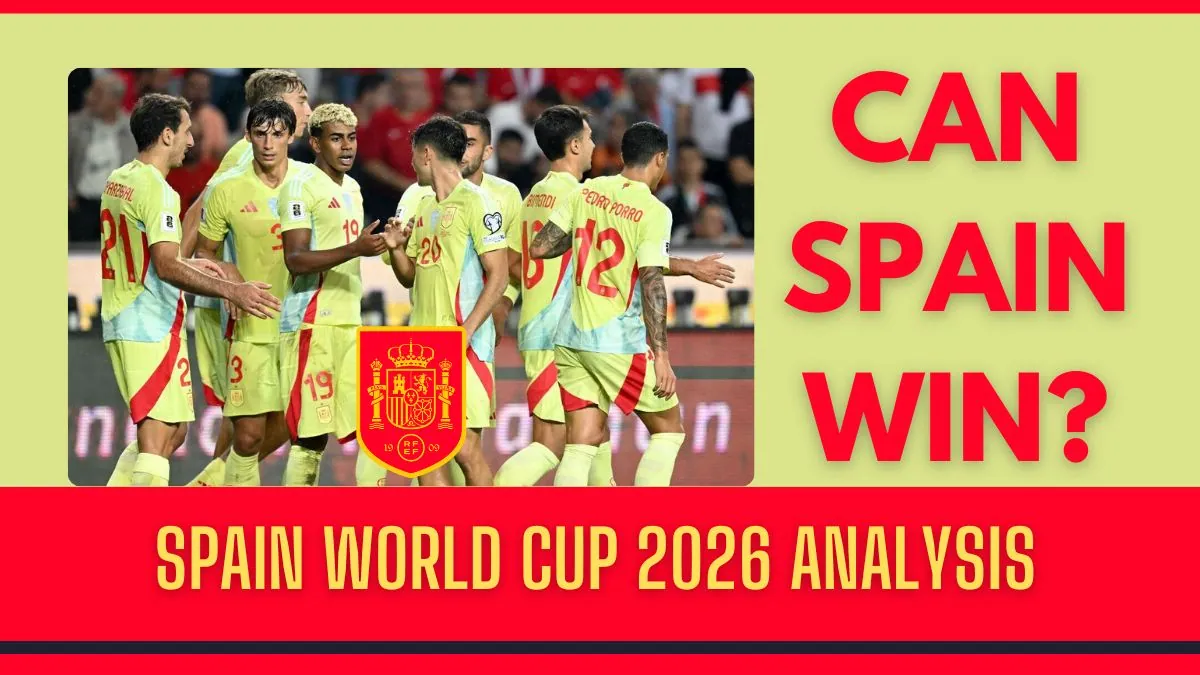
Spain enters the 2026 FIFA World Cup as one of the leading contenders to win the tournament, with bookmakers and football analysts placing them among the favorites after their impressive Euro 2024 triumph.
With a blend of tactical maturity, youthful dynamism and world-class talent across every line, Spain’s national team has transformed into a serious title threat heading into North America next summer.
While history shows the unpredictable nature of the World Cup and fitness concerns remain a factor, Spain’s blend of experience and emerging stars gives them the momentum and depth to challenge for global glory.
The Spanish national team has transformed from a group overshadowed by three consecutive World Cup group-stage exits (2014, 2018, 2022) into an elite force blending youthful exuberance with tactical sophistication.
Spain’s 26-man World Cup squad was officially announced by manager Luis de la Fuente on May 25, 2026, with Barcelona teenager Lamine Yamal highlighting the final roster. Following their tune-up match against Iraq, the squad is finalizing preparations for the World Cup Group H.
Yet success is never guaranteed, and several injury concerns and historical precedents threaten their coronation in North America next summer.
Spain’s World Cup 2026 Odds & Market Positioning
| Rank | Team | Odds | Implied Probability | Status |
|---|---|---|---|---|
| 1 | Spain | 9/2 | 18.2% | Heavy Favorite |
| 2 | England | 11/2 | 15.4% | Close Contender |
| 3 | France | 8/1 | 11.1% | Trophy Experience |
| 3 | Brazil | 8/1 | 11.1% | Always Dangerous |
| 3 | Argentina | 8/1 | 11.1% | Reigning Champions |
| 6 | Portugal | 11/1 | 8.3% | Dark Horse |
| 7 | Germany | 12/1 | 7.7% | Rebuilding |
Spain’s odds have shifted dramatically upward from the 2022 pre-draw market, where they opened at +1000 (sixth choice behind France, Brazil, England, Argentina, and Germany). The Opta supercomputer validates market confidence: across 10,000 pre-draw simulations, Spain won the tournament in 17% of scenarios—more frequently than any other nation.
The Euro 2024 Foundation: Why Spain Is Different
Spain’s path to favorite status rests on undisputed continental dominance. Under Luis de la Fuente, La Roja delivered an astonishing Euro 2024 campaign—winning all seven matches while eliminating Italy, Germany, France, and England en route to their fourth European Championship.
More impressively, their unbeaten streak now extends to 31 consecutive matches (25W, 6D), equaling the Italian record set between 2018 and 2021 under Gianluigi Buffon’s watch.
The squad’s depth is staggering: Spain boasts 334 players competing in Europe’s top five leagues—nearly 100 more than France, who ranks second with 262.
This depth advantage manifests most acutely in midfield. With Rodri (Ballon d’Or 2024), Pedri, Fabián Ruiz, Martín Zubimendi, Mikel Merino, and others, Spain possesses arguably the world’s deepest and most technically gifted midfield corps.
De la Fuente has engineered a tactical evolution that distinguishes this generation from the rigid tiki-taka template. Spain maintained 70.4% possession during qualifying (fourth-highest, behind England, Germany, and Portugal) while generating the second-highest xG per 90 (2.97) and second-lowest xG conceded (0.41) defensive numbers rivaled only by England.
This represents a harmonious blend: possession-based control paired with directness and physicality, particularly from wingers Lamine Yamal (18) and Nico Williams (21).
The Generational Shift in Spain’s Team: Young Stars, Skill, and Dynamic Wingers

Spain’s path to World Cup glory hinges on a constellation of teenage and early-20s talent operating at elite levels:
| Player | Club | Position | Market Value |
|---|---|---|---|
| Lamine Yamal | FC Barcelona | Right Winger | €200.00m |
| Pedri | FC Barcelona | Central Midfield | €140.00m |
| Pau Cubarsí | FC Barcelona | Centre-Back | €80.00m |
| Rodri | Manchester City | Defensive Midfield | €77.00m |
| Martín Zubimendi | Real Sociedad | Defensive Midfield | €75.00m |
| Dani Olmo | Barcelona | Attacking Midfield | €60.00m |
Lamine Yamal (18) dominates the conversation as the tournament’s potential Golden Boot winner. The Barcelona winger was named to the 2025 Ballon d’Or podium (runner-up to Ousmane Dembélé) and has been tipped as the youngest-ever World Cup Golden Boot winner. At Euro 2024, Yamal scored the tournament’s best goal—a curling 25-yard strike against France in the semi-final—and recorded four assists in seven appearances. In World Cup qualifying, he contributed three assists despite appearing in only two matches, showcasing elite playmaking efficiency.
Nico Williams (21) lit up Euro 2024 as Spain’s dynamic left-flank weapon, terrorizing defenses with pace and technical precision. His partnership with Yamal on the opposite wing creates asymmetrical attacking threats that most defenses struggle to contain.
Pedri (21) operates as the midfield heartbeat, transitioning between defense and attack with preternatural composure. Widely regarded as one of the global elite in his position, Pedri is just one assist short of his La Liga personal best, suggesting another season of elite playmaking output.
Pau Cubarsí (19) and Dean Huijsen (20) represent a potentially era-defining centre-back partnership. Cubarsí, a Barcelona academy product, became the youngest defender to play for Spain at age 17. Huijsen, the Dutch-born centre-back representing Spain, recently joined Real Madrid for €59.5 million and has impressed immediately in La Liga.
Rodri (27), the 2024 Ballon d’Or winner, sets the tempo from midfield, his intelligent positioning and range of passing orchestrating Spain’s rhythm. Yet his injury history—two significant setbacks (hamstring in October 2025, ACL rupture requiring an 8-month absence)—creates genuine vulnerability.
The Favorable Draw: Group H Simplicity
Spain’s 2026 World Cup draw was a stroke of luck, landing them in Group H with Uruguay, Saudi Arabia, and Cape Verde. They start as heavy 1/5 favorites to win the group, with Uruguay posing the only real challenge. This setup allows de la Fuente’s squad to manage player fitness during the group stage, rotating key players like Yamal, Rodri, and Williams to reduce injury risks ahead of the knockout rounds.
The knockout bracket offers a strategic edge: depending on the Round of 16 pairings, Spain might manage to avoid Brazil, Argentina, and Portugal until the semi-finals or later—giving them more time to peak against opponents who are either weakened or more fatigued.
The Injury Crisis: Can Spain Overcome?

Despite market confidence, a gathering injury storm threatens Spain’s coronation. Lamine Yamal suffers from a persistent groin injury (athletic pubalgia/sports hernia) that materialized during Euro 2024 qualifying and has worsened through club play.
In November 2025, Barcelona and the Spanish Football Federation (RFEF) engaged in a public dispute. The RFEF accused Barcelona of conducting a radiofrequency ablation procedure—used to block nerves and reduce pain—without prior notification.
Barcelona defended its actions, claiming they were in Yamal’s best health interest. The injury Yamal suffered is not due to an impact but rather results from wear and tear caused by his signature skills of cutting and turning.
Rodri’s hamstring injury (October 2025) compounds concerns. Spain’s midfield maestro sustained a suspected hamstring strain during Manchester City’s match against Brentford on September 29, 2025, forcing him to miss critical World Cup qualifiers. More troubling: Rodri’s injury history includes an 8-month ACL absence earlier, raising durability questions entering a tournament scheduled for June 2026.
Nico Williams has struggled with fitness issues throughout the qualifying campaign, missing multiple matches and dampening Spain’s attacking threat on the left flank.
Pedri also faces recurring injury concerns, having been omitted from squads at critical junctures.
The cumulative impact: Spain faced Turkey in their final World Cup qualifier on November 18, 2025, without five key players: Lamine Yamal, Nico Williams, Rodri, Pedri, and Gavi.
his absence forced coach de la Fuente to field a significantly weakened squad, resulting in a 2-2 draw after trailing 2-1. In his post-match comments, de la Fuente expressed his frustration: “There’s a lot of work to do, and I have time to think about many things.”
The “True Striker” Problem in the Spanish Football Team
Unlike previous Spanish generations, this current squad does not have a proven elite No. 9 playing at a world-class level. The forward positions are filled by Dani Olmo, a versatile attacker; Mikel Oyarzabal, a forward from Real Sociedad; Álvaro Morata, an experienced veteran; and Ferran Torres, who has been converted into a forward.
However, none of these players are truly world-class finishers, which could be a weakness against disciplined defenses in the knockout stages.
Historical Precedent: The Back-to-Back Trophy Challenge
Spain’s World Cup ambitions face a historical hurdle: no European nation has won consecutive European Championship and World Cup titles since France in 2000 (Euro 2000 + World Cup 2002). France’s achievement came with a side featuring Zidane, Thuram, Henry, and Trezeguet—a constellation of talent arguably deeper than Spain’s current squad.
More concerning for Spanish historians: Spain’s World Cup pedigree lags far behind its Euro dominance. In four World Cups since their 2010 final loss to the Netherlands, Spain has exited at the group stage three times (2014, 2018, 2022).
Their only World Cup victory came in 1964 when the tournament was limited to 16 teams, and Spain faced only regional competition. Winning the World Cup would represent a historic breakthrough, transcending decades of continental brilliance.
Pre-World Cup Preparation: The Finalissima Test
Spain will face a perfect pre-World Cup litmus test: the Finalissima 2026 against Argentina on March 27, 2026, in Qatar’s Lusail Stadium. This fixture pits the Euro 2024 winners against the Copa América 2024 champions and reigning World Cup holders, offering an elite opponent against which to audit World Cup readiness.
The match presents an opportunity to assess injury recovery (particularly Yamal’s groin rehabilitation), tactical adjustments, and squad cohesion six weeks before group play.
Historically, Finalissima matches carry symbolic weight: only Michel Platini (France), Diego Maradona (Argentina), and Lionel Messi (Argentina) haLionel Messive lifted the trophy across its four editions.
Is Spain the real favourites for the 2026 World Cup?
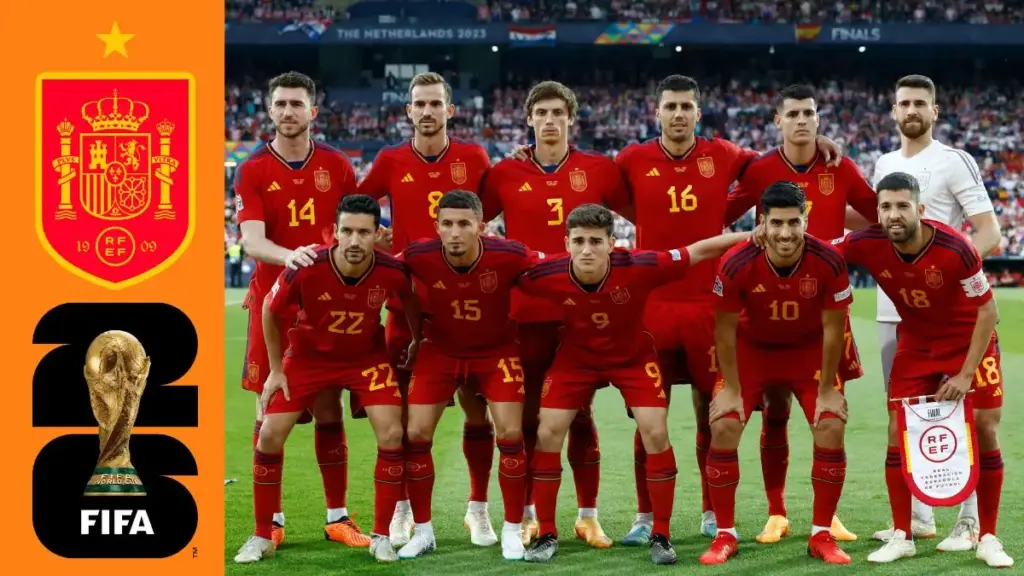
Spain boasts the strongest collective squad depth entering the tournament, with world-class talent in every position. Their impressive unbeaten streak of 31 games, along with their Euro 2024 victory and favorable draw in Group H, position them perfectly for a deep run in the competition.
The young generation, including players like Yamal, Williams, Cubarsi, Huijsen, and Pedri, showcases a remarkable pool of talent that demonstrates mature decision-making, despite the average age of 26 during qualifying.
De la Fuente’s tactical flexibility, favoring a possession-based yet direct style, provides Spain with strategic options that most rivals lack.
Luis de la Fuente’s experience and ability to build trust with his players foster strong team chemistry. Unlike the rigid Tiki-taka style of past eras, this Spain side isn’t afraid to mix in physicality and pragmatism when the situation calls for it, as shown by their well-balanced xG stats.
Can Spain Win the World Cup 2026?
Verdict: 65-70% likelihood of reaching the semi-finals; 35-40% likelihood of winning the tournament.
The Case Against Spain
Injury uncertainties surrounding Yamal, Rodri, Pedri, and Williams create significant depth concerns in a short tournament where recovery time is nonexistent. The groin injury plaguing Yamal (involving pain with cutting and turning—his defining qualities) could persist or worsen under World Cup pressure, particularly if he undergoes accelerated play-time to justify his starting position.
Spain lacks a proven elite pure striker, forcing reliance on creative midfielders and wing-to-centre conversions. This creates tactical predictability that elite defensive units (Brazil, France, Argentina) can exploit through compact deep-block pressure, limiting Spain’s possession advantages.
The historical “back-to-back curse” is real: no European team has won consecutive Euro-World Cup since France 2000. Psychological burden of defending a continental title while chasing a World Cup crown is immense, particularly with media and fan expectations set at maximum.
Luis de la Fuente lacks World Cup management experience—a tournament’s unique pressure rhythms differ markedly from Euros, where knockout stages begin earlier and recovery periods are tighter.
Verdict: 30-35% realistic probability Spain wins the World Cup; 60-65% probability they reach semi-finals but exit there.
Tournament Trajectory Prediction

Group Stage: Spain (3 wins, 0 losses, 0 draws) advances as group winners with minimum tactical exertion.
Round of 16: Spain (probable opponent: runners-up from Group A, likely Portugal or possibly Uruguay if they advance from Group H) defeats mid-tier opposition with 2-0 scoreline.
Quarter-finals: Spain’s greatest vulnerability point. If they face France, Brazil, or Argentina here, a 1-0 or 0-0 elimination on penalties becomes increasingly likely. If they face Portugal or a weaker opponent, progression to the semi-finals is at 75%+ probability.
Semi-finals: Spain vs. France or Argentina. The elite offensive power of these opponents against Spain’s youthful defense (Cubarsi/Huijsen) creates genuine uncertainty. Probability of World Cup final: ~35-40%.
Final: If Spain reach the final, they would face either Argentina or France, both featuring a proven big-tournament pedigree. The pressure of winning a first World Cup in 60+ years would be immense. Semi-final elimination is more likely than a final victory.
The Bottom Line
Spain enters 2026 as the justified favorites given squad depth, form, and recent trophy success. Yet between injury uncertainties, the back-to-back trophy curse, and lack of a world-elite striker, the gap between “favorites” and “likely winners” remains substantial. A 35-40% World Cup win probability reflects this nuance: Spain are the most likely winner, but three-in-five times, another team will hoist the trophy.
The Finalissima in March 2026 will provide crucial clarity on whether Yamal’s groin has healed, Rodri’s hamstring durability has returned, and whether de la Fuente’s squad has consolidated the necessary depth to overcome the tournament’s inevitable injuries and attrition.
Expect Spain to reach the semi-finals with high probability. Expect them to win the World Cup with moderate probability. No better bet exists in the market.
Spain Squad for the 2026 World Cup
| Position | Player | Club | Notes |
|---|---|---|---|
| GK | Unai Simón | Athletic Club | Primary keeper |
| David Raya | Arsenal | Modern shot-stopper | |
| Joan García | Barcelona | Backup keeper | |
| DF | Aymeric Laporte | Athletic Club | Centre-back |
| Marc Cucurella | Chelsea | Left-back | |
| Marcos Llorente | Atlético Madrid | Versatile defender/mid | |
| Eric García | Barcelona | Centre-back | |
| Pedro Porro | Tottenham | Right-back | |
| Álex Grimaldo | Bayer Leverkusen | Left-back option | |
| Pau Cubarsí | Barcelona | Young centre-back | |
| Marc Pubill | Atlético Madrid | Full-back / wing-back | |
| MF | Rodri | Manchester City | Deep-lying midfielder |
| Fabián Ruiz | PSG | Creative midfielder | |
| Mikel Merino | Arsenal | Box-to-box option | |
| Pedri | Barcelona | Playmaker | |
| Gavi | Barcelona | Dynamic midfielder | |
| Martín Zubimendi | Arsenal | Defensive mid | |
| Álex Baena | Atlético Madrid | Attacking mid / wide | |
| FW | Ferran Torres | Barcelona | Forward / wide |
| Mikel Oyarzabal | Real Sociedad | Winger / forward | |
| Dani Olmo | Barcelona | Creative attacker | |
| Nico Williams | Athletic Club | Left-side pace | |
| Lamine Yamal | Barcelona | Right-wing prodigy | |
| Yeremy Pino | Crystal Palace | Wide attacker | |
| Borja Iglesias | Celta Vigo | Striker | |
| Víctor Muñoz | Osasuna | Forward option |